容联七陌

Search documents
2025-2026智能客服市场全景解析:全链路智能赋能与选型指南
Sou Hu Cai Jing· 2026-02-03 19:31
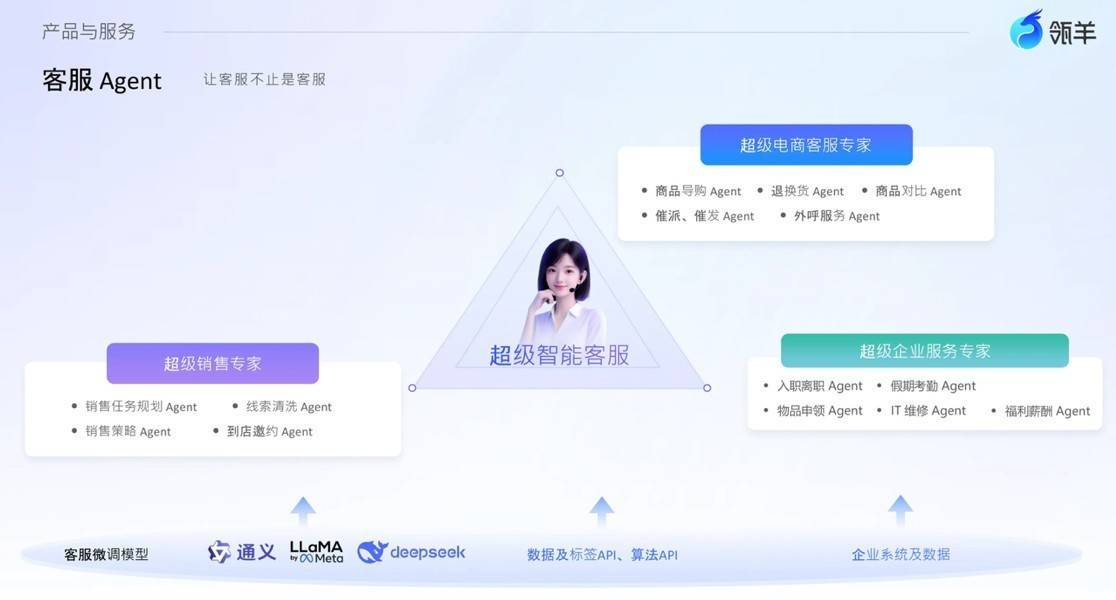
Core Insights - The intelligent customer service market is evolving from a supportive tool to a core infrastructure driving business efficiency and growth, supported by government policies and technological advancements [1][11] - The global intelligent customer service market is projected to exceed $32 billion by 2025, with a compound annual growth rate (CAGR) of 28.6%, while the domestic market in China is expected to reach 3.6 billion yuan by 2025, with a staggering CAGR of 107% from 2023 to 2027 [1] Market Trends - The intelligent customer service market is characterized by three clear development trends: 1. Transition from single-point intelligence to full-link agentization, enhancing service automation rates [4] 2. Full-channel integration becoming a standard requirement for businesses [4] 3. Value positioning shifting from cost reduction to efficiency and growth enhancement [4] Product Tiers - The market is segmented into four product tiers based on technical strength, industry application, and market feedback: 1. **First Tier: Leaders** - Example: Lingyang Quick Service, which integrates advanced models and offers comprehensive solutions for various enterprises [2] 2. **Second Tier: Strong Competitors** - Products in this tier have notable advantages in specific fields or scenarios [6] 3. **Third Tier: Niche Experts** - These products focus on specific industries or enterprise sizes, providing tailored solutions [7] 4. **Fourth Tier: Cost-Effective Options** - Targeting small and medium enterprises with simpler needs [8] Selection Guidelines - Companies should evaluate potential products based on six core dimensions, including AI capability, channel integration, business adaptability, data value closure, deployment and integration, and total cost of ownership [10] - Special attention should be given to internal service applications, sensitive information security, service level agreement (SLA) customizability, and ecosystem compatibility [10] Future Outlook - The development of intelligent customer service systems will focus on four key directions: 1. Emotional computing and empathetic service capabilities [9] 2. Predictive proactive service based on user behavior analysis [9] 3. Integration with enterprise knowledge bases for real-time updates [10] 4. Automated generation of service content [10] Conclusion - The competition in the intelligent customer service market has shifted from mere technology comparison to a comprehensive evaluation of full-link capabilities, industry adaptability, and value creation [11] - The market structure provides clear selection references for enterprises of different sizes and industries, emphasizing the importance of aligning technology strength, implementation effectiveness, and cost investment with long-term business needs [11]


骚扰电话,一场无尽的地下战争
Xin Lang Cai Jing· 2025-11-06 07:45
Core Viewpoint - The article discusses the evolution and escalation of marketing and harassment calls, highlighting the technological advancements that have made these calls more pervasive and difficult to combat, despite the introduction of protective measures like "Do Not Disturb" services [1][5][12]. Group 1: Evolution of Harassment Calls - The history of harassment calls parallels the history of telephone usage, with marketing calls becoming more intrusive over time as technology advanced [3]. - Initially, marketing calls were less frequent and provided some functional value, but as information access improved, they became more of a nuisance [5]. - The introduction of VoIP technology in the early 21st century marked a new phase, allowing for automated mass calling, significantly increasing the efficiency of harassment calls [5][6]. Group 2: Technological Advancements - AI technology has enabled the creation of sophisticated calling systems that can simulate human conversation and adapt based on responses, making it harder for users to identify spam calls [6][12]. - Companies like Ronglian Cloud have developed systems that can mask caller identities and evade regulatory scrutiny, further complicating efforts to combat harassment calls [6][12]. - The cost of making calls has drastically decreased due to these technological advancements, making it economically viable for companies to continue their operations despite low conversion rates [10][12]. Group 3: Regulatory Responses and Challenges - Recent regulations, such as the new lending rules implemented by the National Financial Regulatory Administration, aim to reduce the volume of harassment calls by limiting partnerships to approved institutions [13]. - Despite some improvements, the enforcement of penalties for harassment remains weak, leading to a persistent issue where the cost of violations is lower than the potential profits [15][16]. - The establishment of a "Do Not Call" registry in the U.S. serves as a model for potential regulatory frameworks that could be adopted to mitigate harassment calls [16]. Group 4: Industry Impact and Future Outlook - Companies like Ronglian Cloud have had to adjust their business models in response to public scrutiny and regulatory pressures, shifting towards more compliant and high-value AI solutions [18]. - The ongoing battle against harassment calls suggests that while complete eradication may be unrealistic, continuous efforts can lead to a quieter communication environment [18].