导盲机器狗

Search documents
追光 | 科技之光,点亮他们的“出彩人生路”
Xin Hua She· 2025-12-11 09:24
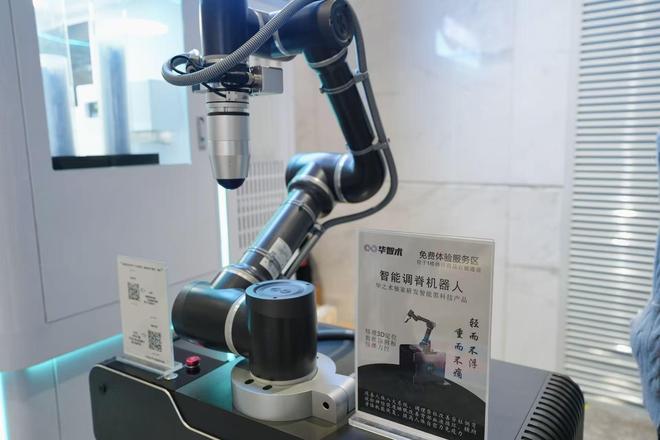
Core Viewpoint - The integration of advanced technology in assistive devices for people with disabilities is showcased at the National Special Olympics, highlighting the trend towards personalized and intelligent solutions in this sector [1][6]. Group 1: Technological Innovations - Various innovative assistive technologies, such as AI-driven wheelchairs and smart rehabilitation robots, were displayed, attracting significant attention [1][3]. - The use of a six-legged guide dog robot and a digital twin technology for real-time venue management demonstrates the practical application of these technologies in sports and daily life [3][4]. Group 2: Policy and Support - The event serves as a platform to promote the Guangdong-Hong Kong-Macao Greater Bay Area as a hub for technological innovation and assistive device development, emphasizing the importance of refined management and advanced equipment [6]. - A joint initiative by multiple government departments aims to enhance the research and application of assistive technology, with policies already yielding positive results [9][10]. Group 3: Community Impact - The introduction of a WeChat mini-program for sign language translation services has improved accessibility for athletes and coaches, ensuring an inclusive experience throughout the event [7]. - The advancements in assistive technology are expected to not only support athletes but also enhance the quality of life for individuals with disabilities, making these innovations more widely available [15]. Group 4: Recognition and Collaboration - Recognition of technology companies and initiatives at national events underscores the growing importance of assistive technology in society, with programs like iFlytek's "Three Voices of Fortune" creating numerous accessible applications [12][13]. - Collaborative efforts between tech companies and organizations like the China Disabled Persons' Federation aim to address the needs of people with disabilities, fostering employment and innovation in this field [13]. Group 5: Vision for the Future - The evolution of technology in the Special Olympics reflects a broader societal commitment to equality and integration, with a vision of a future where assistive technologies are commonplace in households [17]. - The ongoing development of assistive technologies is seen as a pathway to empower individuals with disabilities, enabling them to excel in sports and life [15][17].

全国残特奥会 | 科技赋能,成就残疾人不凡奋斗路
Xin Hua She· 2025-12-11 08:42
Group 1: Core Insights - The National Special Olympics showcases the integration of technology in assisting disabled individuals, highlighting the "love without barriers" concept in the Guangdong-Hong Kong-Macao Greater Bay Area [1] - The event features various technological innovations, including guide dogs, all-terrain wheelchairs, and smart transcription applications, enhancing the lives of participants [1][8] - The emphasis on "technology assisting the disabled" is a significant highlight of this year's event, with practical tech solutions deployed for athletes' training and recovery [4][8] Group 2: Technological Innovations - The "All Sports Guangzhou" WeChat mini-program provides instant access to sign language translation services, connecting users with volunteers for real-time assistance [2][4] - The Guangzhou venue has implemented a smart barrier-free construction, featuring emergency buttons, smart query platforms, and online sign language translation machines, all integrated into a central management system [5] - The use of AI models and 5G technology in barrier-free service systems, along with innovative products like guide dogs and all-terrain wheelchairs, enhances safety and convenience for disabled individuals [6][8] Group 3: Industry Development - Guangdong's rehabilitation aid industry has developed a "trillion-level aid + billion-level service" dual-drive model, rapidly applying cutting-edge technologies in the field [8] - The collaboration between the China Disabled Persons' Federation and various sectors aims to strengthen the development and application of assistive technology, fostering a cooperative framework among government, industry, academia, and research [8][9] - The introduction of smart electronic dartboards and other assistive devices at the event demonstrates the potential for these technologies to improve the quality of life for disabled individuals [10][13]

“穿轮滑鞋”的导盲机器狗上岗
Hang Zhou Ri Bao· 2025-07-01 02:29
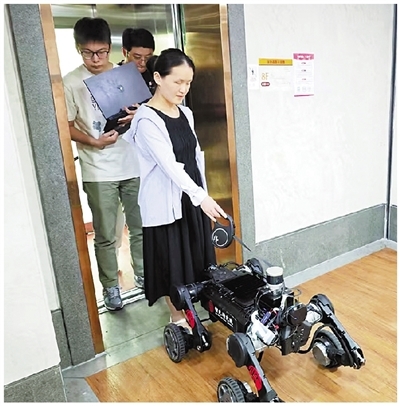
Core Insights - The article discusses the development of a guide dog robot by Hangzhou Zhiyuan Research Institute, which is currently in the testing phase and aims to assist visually impaired individuals in navigation [2][3] Group 1: Product Features - The guide dog robot is equipped with sensors that connect to elevator control systems and provides voice prompts for navigation [2] - It features a unique wheel-foot hybrid design, allowing it to traverse various terrains such as paved roads, stairs, grass, and sand, and can climb steps with a height difference of up to 50 centimeters [2] - The robot has capabilities for indoor autonomous mapping and outdoor real-time map navigation, enabling safe travel for visually impaired users in familiar areas [2] Group 2: Development Goals - The project aims to enhance the robot's ability to navigate complex and unfamiliar environments, including recognizing traffic signals and boarding public transport [3] - The development team is focused on creating a user-friendly experience, allowing users to operate the robot via a mobile app by inputting destination points [3] - Future versions of the guide dog robot are expected to be smaller, have longer battery life, and resemble biological guide dogs more closely [3] Group 3: Social Impact - The initiative aims to alleviate travel difficulties for the visually impaired through technological innovation and upgraded smart products [3] - The guide dog robot will include a self-developed voice interaction system to provide companionship, potentially reducing feelings of loneliness for users [3]
上海电信“双万兆+AI”:智能生活新图景,城市美好如何重塑?
Sou Hu Cai Jing· 2025-06-24 06:35
Group 1 - The core viewpoint highlights the integration of advanced technologies such as 5G-A and AI in enhancing urban experiences, exemplified by the "Wan Zhao" cruise ship showcasing high-speed connectivity and interactive cultural exploration [1][5] - Shanghai Telecom has successfully implemented a solution for high-quality network coverage on water, achieving downlink speeds of 3Gbps and uplink speeds of 300Mbps through the deployment of high-bandwidth 5G-A base stations along the Huangpu River [1][3] - The 5G-A network coverage in Shanghai is expanding across various dimensions, achieving a 99.4% visibility ratio in commercial scenarios and impressive download speeds exceeding 800Mbps in subway environments [3] Group 2 - The F5G-A technology is being utilized to create a "ten-thousand megabit optical network," providing users with exceptional experiences, such as downloading a 90GB movie in just 76 seconds [3] - The integration of AI with 5G-A/F5G-A technologies has emerged as a significant highlight, with applications like AI glasses and delivery robots demonstrating the potential of these technologies in enhancing user experiences [5][6] - Small and medium enterprises are leveraging the "ten-thousand megabit network + AI" to restructure costs and efficiency, with innovations like AI delivery robots reducing deployment costs and providing flexible delivery solutions [6]