
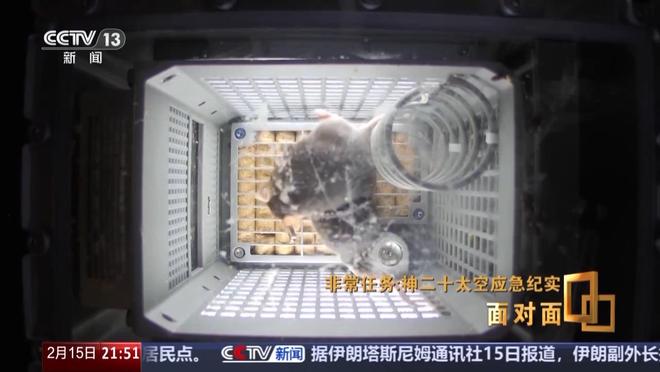
小型哺乳动物饲养装置

Search documents
首次上太空的“鼠鼠乘组”在空间站的加班餐食是豆浆
Huan Qiu Wang Zi Xun· 2026-02-16 00:28
Group 1 - The Shenzhou-20 mission included the return of four experimental mice, marking the first mammalian visitors to the Chinese space station [1] - The mice were housed in a specialized small mammal breeding device, with two males and two females [1] - Initial observations noted the mice appeared larger and more active in microgravity, leading to speculation about their adaptation to the space environment [3][6] Group 2 - The mice were originally scheduled to stay in space for five days, but an unexpected window malfunction extended their stay to 14 days [8] - Due to the extended duration, the food supply was insufficient, leading to the crew providing water and concentrated soybean milk to sustain the mice [8][11] - Despite the extended period without adequate food, the mice adapted well to microgravity conditions, appearing to be in good health [11]

6名航天员太空会师拍下全家福
Bei Jing Wan Bao· 2025-11-01 07:06
Core Points - The Shenzhou 21 manned spacecraft successfully docked with the space station in a record time of 3.5 hours, marking a significant improvement in China's autonomous docking capabilities [1][2] - This mission included the first in-orbit breeding and experimental research of mice, which will help fill gaps in China's research on small mammals in space [4] - The upcoming 2026 manned spaceflight missions will include four significant tasks, showcasing China's continued commitment to advancing its space exploration efforts [6][7] Group 1 - The Shenzhou 21 spacecraft launched from the Jiuquan Satellite Launch Center and achieved docking with the space station, creating a new record for the fastest docking time [1][2] - The autonomous docking capability has been enhanced through more precise launch and orbit control, allowing for fewer orbital adjustments [2] - The mission involved a reunion of two crew commanders, Chen Dong and Zhang Lu, who previously participated in China's first "space meeting" nearly three years ago [2][3] Group 2 - The mission also included the introduction of four experimental mice, which will be monitored for their behavior and physiological changes in space [4] - The mice were selected through rigorous testing to ensure their adaptability to the space environment, and their experiments will contribute to understanding biological processes in microgravity [4] - The research on amino acids using microfluidic chips will explore the chiral characteristics of amino acids, marking a world-first study in this area [5][6] Group 3 - The 2026 manned spaceflight plan includes the Tianzhou 10 cargo spacecraft, Shenzhou 22 and 23 missions, and the first flight of the Mengzhou 1 crewed spacecraft [6][7] - The Shenzhou 22 mission will feature a crew member conducting a long-term stay experiment of over one year, emphasizing the focus on extended human presence in space [7] - The design of mission insignias for these upcoming flights is open for public submission, reflecting a community engagement approach in China's space endeavors [8]
