小豆

Search documents
9000年前的炭化小豆遗存现身山东
Ke Ji Ri Bao· 2025-10-13 07:30
Group 1 - An international team, including Shandong University and Washington University in St. Louis, discovered carbonized small bean remains dating back 9,000 years at the Xiaogao site in Zibo, Shandong Province, which is 4,000 years earlier than previously found carbonized small beans in China [1] - The Xiaogao site is located in the lower Yellow River region and is associated with the Late Li culture, a culture that transitioned towards settlement approximately 9,000 to 7,000 years ago [1] - The research team identified 45 small bean grains at the Xiaogao site, although most had lost their seed coats and cotyledons [1] Group 2 - The findings indicate that 9,000 years ago, the lower Yellow River region had already formed the initial "millet + bean" composite crop system in East Asia, significantly influencing the development of settled societies and the origins of civilization in the Yellow River basin [2] - Beans played two crucial roles: they improved soil through crop rotation with millet and supplemented the protein and fat deficiencies in millet-based diets [2] - A comparative study of over 140 archaeological sites in East Asia revealed distinct evolutionary trajectories of small beans in the Yellow River basin, Japan, and Korea, with the Xiaogao site's small beans being the smallest recorded globally at an average volume of 5.8 cubic millimeters [2]
现代科技破解9000年前“古种”的身世之谜
Zhong Guo Xin Wen Wang· 2025-10-11 09:22
Core Insights - Modern technology has uncovered the identity of ancient seeds dating back 9,000 years, revealing significant agricultural practices in early Chinese civilization [1][3]. Group 1: Research Findings - An international team, including Shandong University and Washington University in St. Louis, published findings in the Proceedings of the National Academy of Sciences, identifying carbonized seeds from the Xiaogao site in Zibo, Shandong, which are 4,000 years older than previously discovered carbonized seeds in China [1][3]. - The discovery includes various crops such as millet, rice, and adzuki beans, with 45 adzuki beans found, indicating early agricultural practices in the Yellow River region [3][4]. Group 2: Methodology - The identification process involves over ten steps, including soil sampling, flotation, sorting, and carbonization experiments, to analyze the seeds' structure and classify them [4][6]. - Carbon-14 dating, known as "nature's clock," is used to determine the age of the seeds by measuring the remaining carbon-14 content, providing precise dating of the ancient seeds [6]. Group 3: Implications - The findings challenge traditional beliefs about the spread of wheat in China, suggesting that wheat may have been present in Shandong earlier than in other regions, which could reshape understanding of agricultural development in ancient China [6]. - The research aims to further explore the evolution of crop combinations in settled societies along the Yellow River, contributing to the understanding of the origins of Chinese civilization and agricultural development [6].

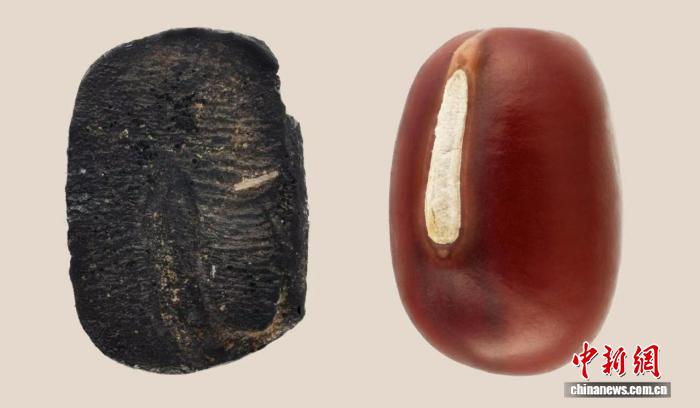
山东发现9000年前炭化小豆遗存,打破日本学术界认为的“日本小豆起源论”
Da Zhong Ri Bao· 2025-10-11 00:59
Core Viewpoint - The discovery of carbonized adzuki beans dating back 9,000 years in Shandong challenges the previously held belief in Japan's central role in the origin of adzuki beans, suggesting that China is also a significant origin point for this crop [4]. Group 1: Archaeological Findings - An international team, including Shandong University and Washington University in St. Louis, published findings in the Proceedings of the National Academy of Sciences, revealing the earliest known adzuki bean remains in the Yellow River basin, predating previous discoveries in China by 4,000 years [2]. - The Xiaogao site, located in the lower Yellow River region, is associated with the Late Li culture, which dates back approximately 9,000 to 7,000 years [2]. - A total of 45 adzuki beans were identified at the site, although most had lost their seed coats and cotyledons [2]. Group 2: Methodology and Analysis - The age of the carbonized seeds was determined using carbon-14 dating, which measures the remaining carbon-14 content to estimate the time since the organism ceased living [2]. - The research team compared adzuki bean remains from over 140 archaeological sites across East Asia, noting significant evolutionary differences between beans from the Yellow River basin, Japan, and Korea [3]. Group 3: Agricultural Implications - The findings indicate that 9,000 years ago, the lower Yellow River region had already developed an early "millet + bean" cropping system, which significantly influenced the development of settled societies and civilization in the area [3]. - Adzuki beans played two crucial roles: improving soil through crop rotation with millet and providing essential protein and fats in the diet [3]. - The average size of the adzuki beans found at Xiaogao was 5.8 cubic millimeters, the smallest recorded among archaeological sites, with significant size increases in Chinese adzuki beans occurring between 4,000 to 2,000 years ago [3].
41.2摄氏度!日本高温创新纪录
Xin Hua Wang· 2025-07-31 03:21
Group 1 - Japan is experiencing extreme heat, with temperatures exceeding 40 degrees Celsius in multiple locations, setting a new national record of 41.2 degrees Celsius in Tamba City, Hyogo Prefecture on July 30 [1][3] - On the same day, 271 out of 914 observation points recorded temperatures above 35 degrees Celsius, and 39 locations set new high-temperature records [3] - The extreme weather is adversely affecting agricultural production, particularly in rice-growing regions such as Fukui, Niigata, and Nagano, where severe water shortages are reported [3] Group 2 - The high temperatures are impacting the growth of local crops, with reports of farmers in Tamba City facing issues with adzuki beans not germinating due to heat and lack of water [3] - If the high temperatures persist, there is a potential for significant negative effects on crop yields [3]

豆瓣20岁,生日快乐!
乱翻书· 2025-03-06 15:33
Core Viewpoint - Douban, founded in 2005, has evolved into a platform that helps users discover quality content across various categories, including books, music, movies, and more, marking its 20th anniversary in 2025 [1] User Experiences - Users have shared their personal stories and connections with Douban, highlighting its role in their social and cultural lives [2][3][4][5][6][7][8][9][10][11][12][13][14][15][16][17][18][19] - Douban is perceived as a significant platform for networking and cultural exchange, with some users attributing personal relationships and professional opportunities to their engagement on the site [3][4][10][11] - The platform is described as a "cultural library" and a "stable anchor" for aesthetic and taste preferences, reflecting its impact on users' identities [10][12][14] Features and Functions - Users reminisced about favorite features and the impact of certain functionalities being removed, indicating the platform's evolving nature [3][4][5][6][7] - Douban's introduction of innovative features, such as the "小豆" (Little Douban), showcases its commitment to creativity and adaptation in the digital landscape [5][19] Cultural Significance - Douban is recognized as a vital part of the Chinese internet landscape, often compared to a "gene mutation" for its unique contributions to online culture [8] - The platform serves as a space for discussions and exchanges on various topics, including literature and entertainment, maintaining relevance in a rapidly changing digital environment [17][18]