工银e生活App

Search documents
深耕“文体旅”消费场景,工商银行为大湾区融合发展添活力
Xin Hua She· 2025-11-24 06:53
Core Viewpoint - Industrial and Commercial Bank of China (ICBC) leverages the 15th National Games to enhance cultural, sports, and tourism consumption, integrating financial services into the entire event and tourism chain to invigorate the Guangdong-Hong Kong-Macao Greater Bay Area [1] Group 1: Consumption Service Ecosystem - ICBC focuses on the "Greater Bay Area" theme of the National Games, extending its "cultural, sports, and tourism" service radius to create a comprehensive service ecosystem that includes event attraction, consumer engagement, and service retention [3] - The bank has developed 52 themed travel routes covering popular locations such as Guangzhou Tower, Macau cultural landmarks, and Hong Kong shopping districts, while establishing a "National Games Consumption Alliance" with 1,000 quality merchants [3] Group 2: Innovative Products and Services - ICBC has launched a "National Games Commemorative Edition Guangdong-Hong Kong-Macao Bay Area Credit Card," featuring event mascots, combining collectible value with trendy appeal [4] - The bank has optimized the "Card Code Pass" service for residents of Hong Kong and Macau, facilitating convenient cross-border payments at various locations [4] - A tiered discount system has been created for the entire event experience, including ticket discounts, travel and accommodation offers, and local consumption incentives [4] Group 3: Online and Offline Service Enhancement - ICBC has introduced a dedicated section for the National Games on its mobile banking platform, integrating event information, quizzes, and promotional activities [4] - The bank is enhancing service layouts in key areas such as popular shopping districts and event venues, increasing discounts for nearby dining and shopping merchants to convert event enthusiasm into consumer spending [4] - Approximately 1,500 branches in the Greater Bay Area have established "National Games Service Green Channels" to provide supportive services for volunteers, citizens, and spectators [5]



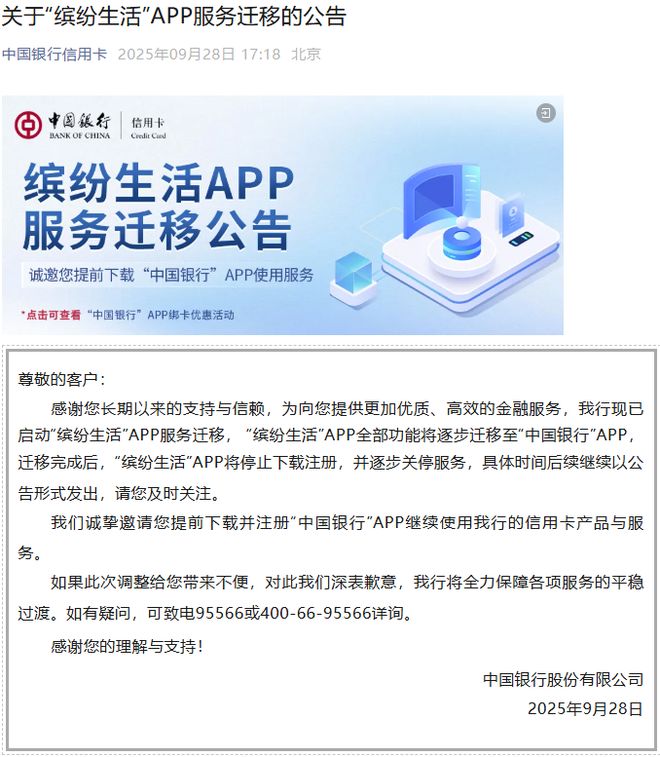
首现国有大行关停信用卡App
2 1 Shi Ji Jing Ji Bao Dao· 2025-10-13 13:24
Core Viewpoint - The recent announcement by Bank of China to gradually shut down its "Bountiful Life" app and migrate its functions to the main "Bank of China" app highlights a shift in the credit card app landscape, moving from smaller banks to major state-owned banks amid a backdrop of declining credit card business and cost-cutting measures in the banking industry [1][5][17]. Summary by Sections Credit Card App Shutdown - Bank of China announced the gradual shutdown of its "Bountiful Life" app, which will have all its functions transferred to the main "Bank of China" app [1]. - This trend of shutting down credit card apps is not new, as several banks, including Shanghai Rural Commercial Bank and Beijing Rural Commercial Bank, have previously made similar moves [5]. Market Dynamics - The credit card app market is experiencing increasing differentiation, with a clear ranking in monthly active users [7]. - As of June 2025, the top 20 credit card apps include 5 state-owned banks, 9 joint-stock banks, and 2 city commercial banks, with the highest monthly active users exceeding 14 million for several apps [7][8]. - Bank of China's "Bountiful Life" app had only 1.55 million monthly active users, ranking 13th among state-owned bank credit card apps [7][9]. Credit Card Loan Scale - State-owned banks maintain a significant advantage in credit card loan scales, with China Construction Bank being the only bank with a credit card loan scale exceeding 1 trillion yuan, reaching 1,054.95 billion yuan as of June [10][11]. - Other major state-owned banks also report credit card loan scales above 500 billion yuan, while joint-stock banks like China Merchants Bank show strong performance with a credit card loan balance of 924.49 billion yuan [10][11]. User Engagement and Competition - The focus of credit card apps has shifted from acquiring new customers to retaining existing ones, as many consumers already hold multiple credit cards [14][15]. - The competition for user engagement is intensifying, with various lifestyle service apps entering the market, making it challenging for credit card apps to attract new users [15][19]. Operational Efficiency - The closure of independent credit card apps reflects a broader trend towards centralized management of banking channels [17]. - Regulatory guidance has prompted banks to streamline their mobile applications, focusing on user engagement and operational efficiency [18][19].