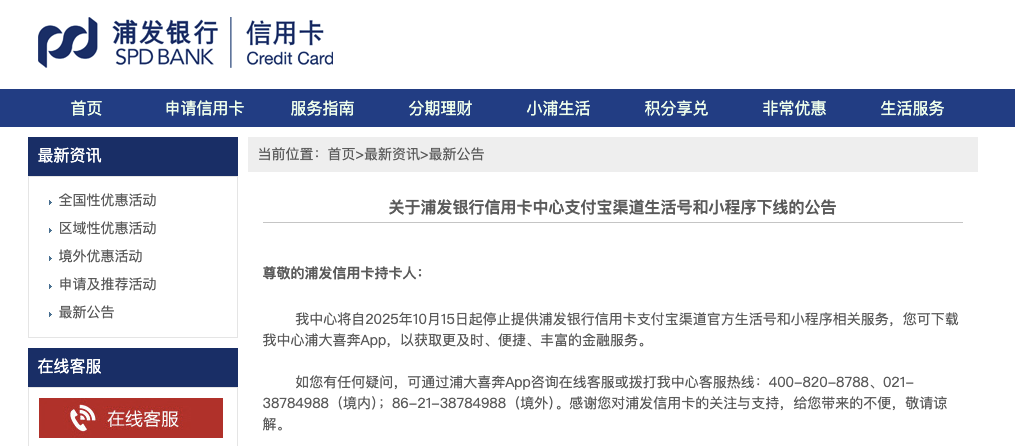
浦大喜奔App

Search documents
首现国有大行关停信用卡App
2 1 Shi Ji Jing Ji Bao Dao· 2025-10-13 13:24
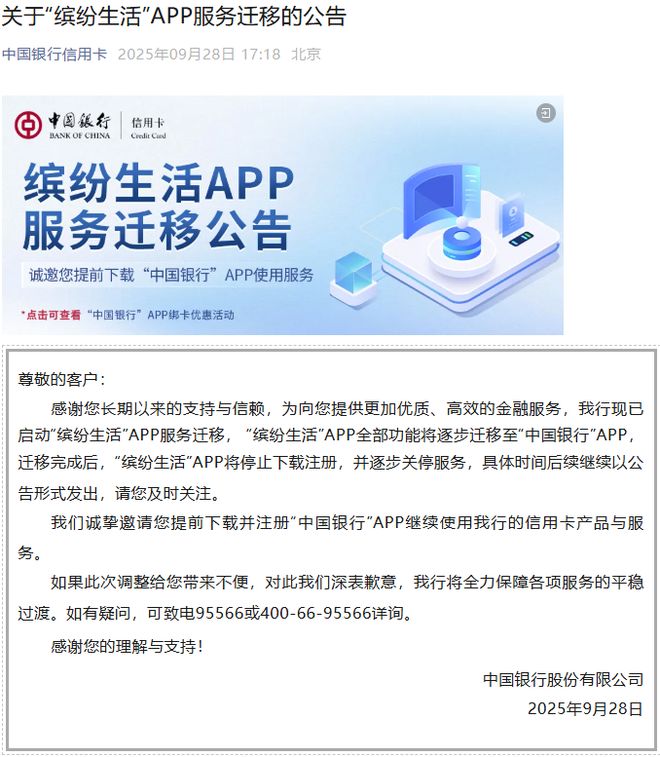
Core Viewpoint - The recent announcement by Bank of China to gradually shut down its "Bountiful Life" app and migrate its functions to the main "Bank of China" app highlights a shift in the credit card app landscape, moving from smaller banks to major state-owned banks amid a backdrop of declining credit card business and cost-cutting measures in the banking industry [1][5][17]. Summary by Sections Credit Card App Shutdown - Bank of China announced the gradual shutdown of its "Bountiful Life" app, which will have all its functions transferred to the main "Bank of China" app [1]. - This trend of shutting down credit card apps is not new, as several banks, including Shanghai Rural Commercial Bank and Beijing Rural Commercial Bank, have previously made similar moves [5]. Market Dynamics - The credit card app market is experiencing increasing differentiation, with a clear ranking in monthly active users [7]. - As of June 2025, the top 20 credit card apps include 5 state-owned banks, 9 joint-stock banks, and 2 city commercial banks, with the highest monthly active users exceeding 14 million for several apps [7][8]. - Bank of China's "Bountiful Life" app had only 1.55 million monthly active users, ranking 13th among state-owned bank credit card apps [7][9]. Credit Card Loan Scale - State-owned banks maintain a significant advantage in credit card loan scales, with China Construction Bank being the only bank with a credit card loan scale exceeding 1 trillion yuan, reaching 1,054.95 billion yuan as of June [10][11]. - Other major state-owned banks also report credit card loan scales above 500 billion yuan, while joint-stock banks like China Merchants Bank show strong performance with a credit card loan balance of 924.49 billion yuan [10][11]. User Engagement and Competition - The focus of credit card apps has shifted from acquiring new customers to retaining existing ones, as many consumers already hold multiple credit cards [14][15]. - The competition for user engagement is intensifying, with various lifestyle service apps entering the market, making it challenging for credit card apps to attract new users [15][19]. Operational Efficiency - The closure of independent credit card apps reflects a broader trend towards centralized management of banking channels [17]. - Regulatory guidance has prompted banks to streamline their mobile applications, focusing on user engagement and operational efficiency [18][19].



首现大行关停独立信用卡App,银行渠道运营集约化加速
2 1 Shi Ji Jing Ji Bao Dao· 2025-10-13 12:01
Core Viewpoint - The recent announcement by the Bank of China to gradually shut down its "Bountiful Life" app and migrate its functions to the main "Bank of China" app highlights a shift in the credit card app landscape, moving from smaller banks to major state-owned banks amid a backdrop of declining credit card business and cost-cutting measures in the banking industry [1][4]. Group 1: Credit Card App Landscape - The credit card apps have traditionally served two main purposes: connecting online and offline channels for customer acquisition and creating a digital tagging system for user behavior analysis [4][9]. - The closure of the "Bountiful Life" app follows similar actions by other banks, indicating a trend where standalone credit card apps are becoming less viable due to shrinking credit card business [4][10]. - As of June 2025, the "Bountiful Life" app had a monthly active user count of 1.5454 million, ranking 13th among state-owned bank credit card apps, significantly lower than leading apps with over 14 million users [5][6]. Group 2: Market Dynamics and Competition - The credit card market is experiencing increasing differentiation, with major banks like China Construction Bank leading in credit card loan scale, having surpassed 1 trillion yuan in loans [7][8]. - The competitive landscape for credit card apps is intensifying, with many banks focusing on retaining existing customers rather than acquiring new ones, as many consumers already hold multiple credit cards [10][11]. - The top credit card apps are increasingly integrated into lifestyle services, making it challenging for standalone credit card apps to compete for user attention in a saturated market [9][10]. Group 3: Operational Changes in Banking - The closure of independent credit card apps reflects a broader trend in the banking industry towards centralized management of mobile applications, as mandated by regulatory guidelines [12][13]. - Major banks are restructuring their digital operations, establishing dedicated centers to streamline app management and enhance user experience, which is expected to improve operational efficiency [12][13].
10月15日起停用!浦发银行信用卡终止支付宝渠道生活号和小程序服务
Bei Jing Shang Bao· 2025-08-26 11:28
Core Viewpoint - The announcement from Shanghai Pudong Development Bank's Credit Card Center indicates the discontinuation of services related to the Alipay channel's official account and mini-programs starting from October 15, 2025, urging cardholders to use the Pudong Bank's app for financial services [1] Group 1 - Shanghai Pudong Development Bank's Credit Card Center will stop providing services through Alipay's official account and mini-programs [1] - The cessation of these services is set to take effect on October 15, 2025 [1] - Cardholders are encouraged to download the Pudong Bank's Pudong Happy App for more timely and convenient financial services [1]

浦发银行信用卡中心:将于10月15日下线支付宝渠道生活号和小程序
Xin Lang Cai Jing· 2025-08-26 09:29
Core Points - SPD Bank's credit card center announced that it will cease providing services through Alipay's official account and mini-programs starting from October 15, 2025 [1] - Users are encouraged to download the SPD Bank Credit Card Center's app, "浦大喜奔," for financial services [1] Group 1 - SPD Bank will stop offering credit card services via Alipay channels, indicating a strategic shift in its service delivery [1] - The announcement highlights the bank's focus on promoting its own app for customer engagement and service access [1]