巴拿马运河港口特许经营权

Search documents
专访香港法律专家:巴拿马撕毁合约背信弃义,中方护企有实招
Xin Lang Cai Jing· 2026-02-07 15:36
Core Viewpoint - The Panama Supreme Court ruled the renewal of the concession contract for the Panama Canal port operated by a Hong Kong company as unconstitutional, which has raised concerns about the legal rights of Chinese enterprises in foreign investments [1][4]. Group 1: Legal and Political Context - The ruling has been criticized by the Chinese government as a violation of the legitimate rights of Hong Kong enterprises, emphasizing the commitment to protect these rights [1][4]. - The timing of the ruling coincides with U.S. efforts to diminish Chinese influence in Latin America, suggesting potential political motivations behind the decision [6]. Group 2: Response Strategies - The company involved, CK Hutchison Holdings (长江和记实业有限公司), has initiated arbitration against the Republic of Panama based on the concession agreement, claiming breach of contract [7]. - Possible measures for the Chinese government include diplomatic negotiations, compliance reviews, and enhanced scrutiny of trade and investment in Panama [3][4]. Group 3: Legal Vulnerabilities - The ruling raises questions about procedural fairness and the protection of investor rights, particularly given the long-standing operation of the port by the company since 1997 [6]. - The legality of the temporary takeover of the port by the Danish shipping company Maersk, as stated by the Panamanian government, is also under scrutiny [6]. Group 4: Lessons for Chinese Enterprises - Companies are advised to conduct thorough legal due diligence before investing, considering not only contract terms but also the political stability and legal environment of the host country [10]. - Establishing a compliance mechanism that integrates local legal expertise is crucial for monitoring regulatory changes during project operations [11]. - In the event of adverse legal rulings, companies should act swiftly to initiate arbitration or seek injunctions to mitigate negative impacts [11].



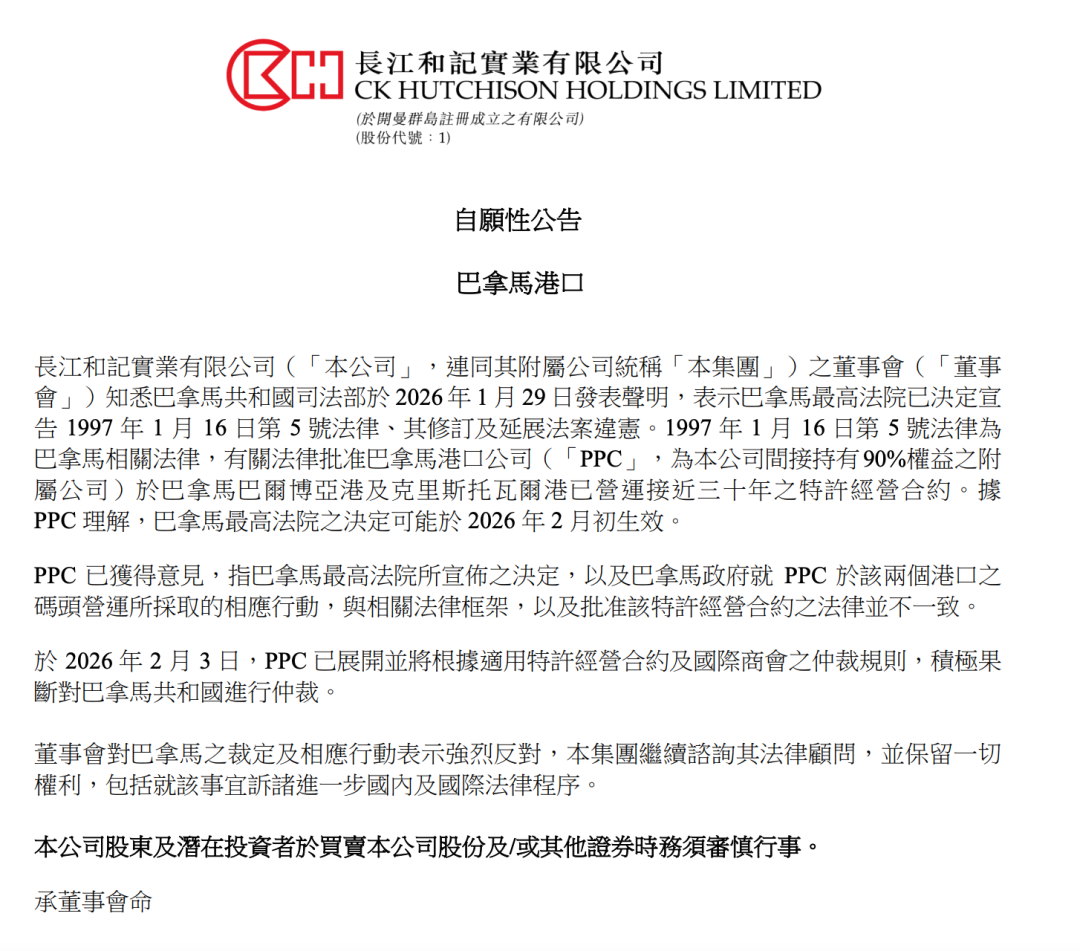
长江和记:强烈反对,保留一切权利
Nan Fang Du Shi Bao· 2026-02-04 06:40
Core Viewpoint - The Panama Supreme Court's ruling declaring the contract for the operation of ports by Hong Kong enterprises as unconstitutional is seen as a violation of legal principles and has drawn strong opposition from both the Chinese government and the Hong Kong Special Administrative Region (HKSAR) government [4][5][9]. Group 1: Company Actions and Responses - Changjiang Holdings announced that its subsidiary, Panama Port Company (PPC), which holds a 90% stake, has initiated arbitration against the Republic of Panama due to the Supreme Court's ruling and government actions being inconsistent with the original legal framework and concession agreement [1]. - The board of Changjiang Holdings expressed strong opposition to the ruling and plans to consult legal advisors while reserving all rights, including pursuing further domestic and international legal actions [1]. Group 2: Government and Public Reactions - The Chinese government and HKSAR government have firmly opposed the ruling, emphasizing that it severely undermines the legitimate rights of Hong Kong enterprises and damages the business environment in Panama [4][9]. - The HKSAR government stated that the ruling could shake investor confidence and harm bilateral relations and long-term economic development [9]. - The Chinese Foreign Ministry has indicated that it will take all necessary measures to protect the legitimate rights of Chinese enterprises, including those from Hong Kong, against such coercive actions [10]. Group 3: Economic Implications - The ruling is viewed as a significant threat to Panama's credibility as a host for international investments, potentially leading to long-term damage to its business environment and economic development [5][6]. - The Hong Kong enterprises have invested over $1.8 billion in Panama, creating thousands of jobs, and the ruling is seen as detrimental not only to the companies involved but also to Panama's own interests [5].