
法治原则

Search documents
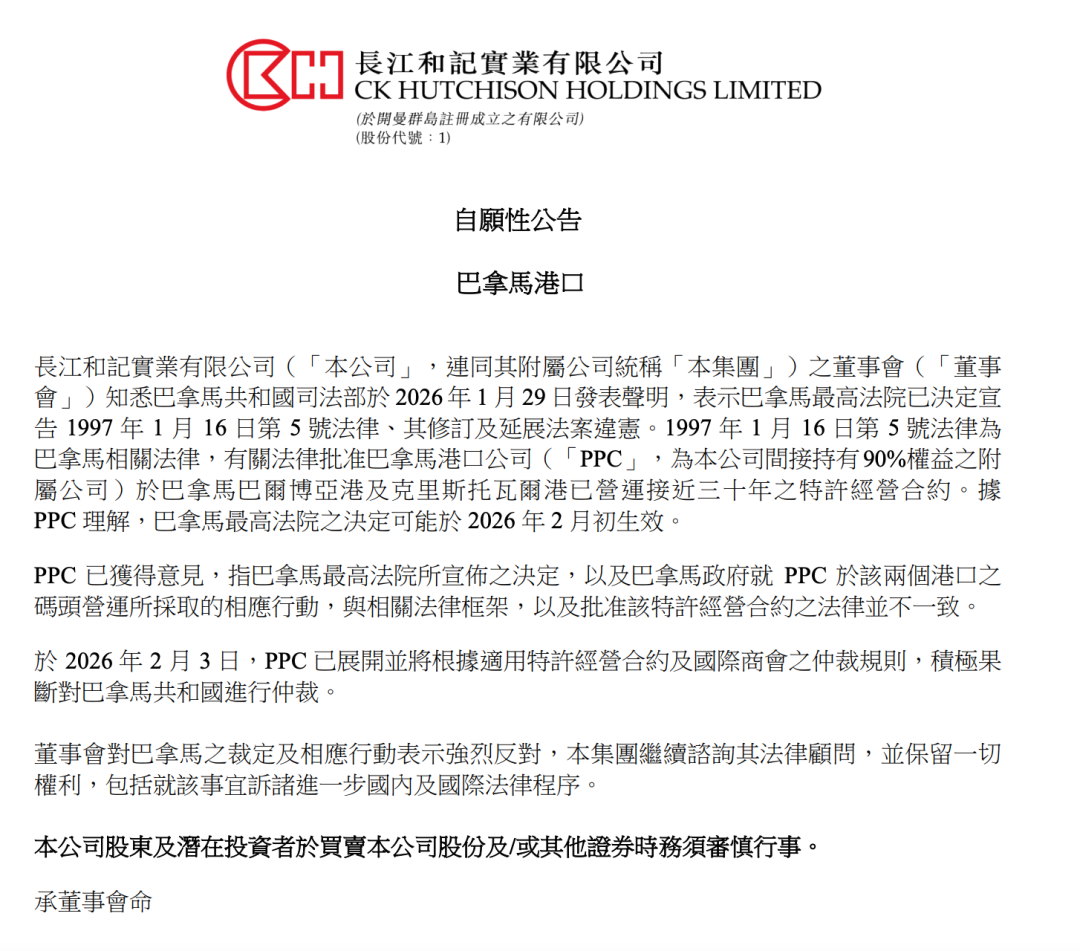
长江和记:强烈反对,保留一切权利
Nan Fang Du Shi Bao· 2026-02-04 06:40
Core Viewpoint - The Panama Supreme Court's ruling declaring the contract for the operation of ports by Hong Kong enterprises as unconstitutional is seen as a violation of legal principles and has drawn strong opposition from both the Chinese government and the Hong Kong Special Administrative Region (HKSAR) government [4][5][9]. Group 1: Company Actions and Responses - Changjiang Holdings announced that its subsidiary, Panama Port Company (PPC), which holds a 90% stake, has initiated arbitration against the Republic of Panama due to the Supreme Court's ruling and government actions being inconsistent with the original legal framework and concession agreement [1]. - The board of Changjiang Holdings expressed strong opposition to the ruling and plans to consult legal advisors while reserving all rights, including pursuing further domestic and international legal actions [1]. Group 2: Government and Public Reactions - The Chinese government and HKSAR government have firmly opposed the ruling, emphasizing that it severely undermines the legitimate rights of Hong Kong enterprises and damages the business environment in Panama [4][9]. - The HKSAR government stated that the ruling could shake investor confidence and harm bilateral relations and long-term economic development [9]. - The Chinese Foreign Ministry has indicated that it will take all necessary measures to protect the legitimate rights of Chinese enterprises, including those from Hong Kong, against such coercive actions [10]. Group 3: Economic Implications - The ruling is viewed as a significant threat to Panama's credibility as a host for international investments, potentially leading to long-term damage to its business environment and economic development [5][6]. - The Hong Kong enterprises have invested over $1.8 billion in Panama, creating thousands of jobs, and the ruling is seen as detrimental not only to the companies involved but also to Panama's own interests [5].


宽严相济的传统思维及其当代转化
Xin Lang Cai Jing· 2026-01-27 17:52
Core Viewpoint - The article discusses the historical evolution and core connotations of the "leniency and severity" legal philosophy in China, emphasizing its importance in governance and social order throughout Chinese legal history [2][3]. Historical Evolution - The evolution of the "leniency and severity" legal thought can be divided into three stages: 1. The foundational theories during the Pre-Qin period, where Confucianism emphasized benevolence and the value of leniency, while Legalism advocated for strict laws to maintain social order [2]. 2. The formation of a systematic approach during the Han and Tang dynasties, where the integration of Confucian and Legalist ideas led to the principle of "morality as the mainstay, punishment as a supplement" [2]. 3. The deepening of practical applications during the Song, Ming, and Qing dynasties, where the dialectical use of leniency and severity became more pronounced in legal practices [2]. Core Connotations - The core connotations of the "leniency and severity" philosophy are reflected in three main aspects: 1. The value orientation of "morality as the mainstay, punishment as a supplement," emphasizing the leading role of moral education while using punishment as a secondary means [2]. 2. The principle of "appropriate leniency and severity," which includes leniency for minor offenses and strict punishment for serious crimes, ensuring that leniency does not encourage wrongdoing and severity does not harm the innocent [2]. 3. The dynamic adjustment of "adapting to circumstances," which highlights the need to flexibly adjust the balance of leniency and severity according to social conditions [2]. Modern Transformation - The contemporary transformation of the "leniency and severity" philosophy is characterized by its integration with the rule of law, ensuring that both leniency and severity adhere strictly to legal norms [3]. - The philosophy has evolved from a criminal justice policy to a comprehensive governance concept, as seen in the regulations of the Communist Party of China regarding disciplinary actions [3]. - Specific institutional innovations, such as the plea bargaining system and non-prosecution policies, have made the "leniency and severity" philosophy more operational in modern judicial practices [3][4]. Implementation and Adaptation - The implementation of the "leniency and severity" policy requires innovative practices, including legislative reforms to modernize penalties and judicial mechanisms that balance legal norms with case-specific circumstances [4]. - Recent trends show a dynamic adaptability in applying the policy, such as a more lenient approach towards juvenile offenders and a stricter stance on serious crimes [4]. - In the context of the digital age, the policy must address new types of crimes while maintaining a balance between strict enforcement and leniency for minor infractions, reflecting the evolving nature of societal challenges [4].
国际刑事法院谴责美国发起新一轮制裁
Zhong Guo Xin Wen Wang· 2025-12-19 01:16
Core Viewpoint - The International Criminal Court (ICC) condemns the new round of sanctions imposed by the United States, asserting that such actions openly attack the independence of judicial institutions and undermine the rule of law [1]. Group 1: ICC's Response to Sanctions - The ICC issued a statement on December 18, condemning the U.S. sanctions against two of its judges, bringing the total number of ICC officials sanctioned by the U.S. to 11 [1]. - The ICC emphasizes that the sanctions are a blatant attack on an independent and impartial judicial body, jeopardizing the international legal order [1]. - The ICC reaffirms its commitment to support its staff and victims of atrocities, maintaining its independence and adherence to the Rome Statute [1]. Group 2: Background on ICC and U.S. Sanctions - The ICC was established in July 2002 under the Rome Statute, with jurisdiction over crimes such as genocide, crimes against humanity, war crimes, and aggression [1]. - The U.S. and Israel do not recognize the ICC's jurisdiction, and previous sanctions were initiated by the Trump administration against ICC officials, including Prosecutor Karim Khan [2]. - The U.S. has imposed multiple rounds of sanctions, totaling six judges and two deputy prosecutors targeted [2].
欧盟委员会主席冯德莱恩:法治原则的尊重将适用于所有欧盟资金。
news flash· 2025-07-16 14:47
Core Points - The President of the European Commission, Ursula von der Leyen, stated that respect for the rule of law will apply to all EU funding [1] Group 1 - The principle of rule of law is emphasized as a fundamental requirement for the allocation of EU funds [1]
德国外交部官员:否认俄罗斯外交部的指控;德国大使今天强调了这一点。德国坚持法治原则和新闻自由。
news flash· 2025-06-27 15:04
Group 1 - The German Foreign Ministry officials denied the accusations made by the Russian Foreign Ministry, emphasizing Germany's commitment to the rule of law and freedom of the press [1]