
希飞碳纤维滑雪板

Search documents
【人民日报】冰雪经济滑上“高级道”
Ren Min Ri Bao· 2026-01-21 00:34
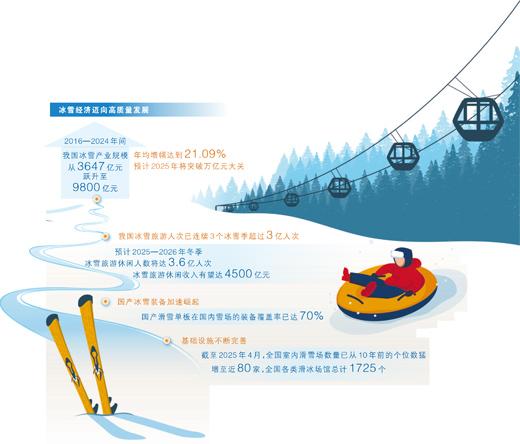
Core Insights - The booming ice and snow economy in China is highlighted by the significant increase in tourist numbers and industry growth, with the ice and snow industry scale rising from 364.7 billion yuan to 980 billion yuan from 2016 to 2024, averaging an annual growth rate of 21.09% [1][4] Industry Growth - Harbin received 1.405 million tourists on January 1, 2026, marking an 11.4% year-on-year increase [1] - The ice and snow tourism has consistently exceeded 300 million visitors for three consecutive seasons [1] Domestic Brand Development - Domestic brands are emerging in the ice and snow equipment market, with companies like Jilin Chemical Fiber Group developing carbon fiber ski boards that are lighter and more affordable than international brands [3] - The domestic ski board, branded as "Xifei," is 30% lighter and has 3 to 5 times the strength of regular boards, appealing to consumers [3] Market Trends and Innovations - The ice and snow equipment market is expanding, with a focus on technology and design that resonates with local culture, such as incorporating "Chinese style" elements into product designs [5] - The industry is transitioning from OEM to independent R&D and standard-setting, driven by advancements in new materials and smart technologies [5] Regional Development Patterns - The "North Snow, South Expansion" trend is evident, with southern cities like Chengdu and Guangzhou developing indoor snow facilities to attract tourists year-round [6] - New operational models, such as night skiing and immersive experiences, are being introduced to enhance visitor engagement [6] Diverse Offerings and Consumer Experience - New ice and snow experiences, such as ice floating in Xinjiang, are gaining popularity, with the region introducing various winter tourism projects to diversify offerings [9][10] - The total number of visitors to the Jiangjun Mountain International Ski Resort in Xinjiang reached 460,000, a 52% increase year-on-year, showcasing the growing appeal of diverse winter activities [10]


开发新项目、开拓新场景 冰雪经济滑上“高级道”
Ren Min Ri Bao· 2026-01-20 23:51
Core Insights - The article highlights the rapid growth of China's ice and snow economy, with the industry scale increasing from 364.7 billion yuan in 2016 to 980 billion yuan in 2024, reflecting an average annual growth rate of 21.09% [1] - The number of ice and snow tourism participants has exceeded 300 million for three consecutive seasons, indicating a robust demand for winter sports and activities [1] Group 1: Industry Growth and Trends - The ice and snow economy in China is experiencing significant expansion, with projections indicating that the industry will surpass 1 trillion yuan by 2025 [1] - Harbin received 1.405 million tourists on January 1, 2026, marking an 11.4% year-on-year increase, showcasing the popularity of winter tourism [1] - The emergence of new operational models, such as night skiing and indoor snow parks, is reshaping the landscape of ice and snow activities, particularly in southern regions [5][6] Group 2: Domestic Brand Development - Domestic brands are gaining traction in the ice and snow equipment market, with companies like Jilin Chemical Fiber Group developing competitive carbon fiber ski boards that are lighter and more affordable than international brands [3][4] - The focus on technology and design is evident, with brands incorporating local cultural elements into their products to appeal to younger consumers [4] - The ice and snow equipment industry is expected to exceed 5 billion yuan in output value by 2030, driven by the growth of domestic brands and innovation [3] Group 3: Regional Development and Consumer Experience - The "North Snow South Expansion" trend is evident, with southern cities like Chengdu and Guangzhou developing indoor snow facilities to attract tourists from warmer regions [6][8] - New experiential projects, such as ice floating in Xinjiang, are diversifying the offerings in the ice and snow tourism sector, enhancing visitor engagement [9][10] - The introduction of various winter sports activities, including ice fishing and themed parks, is aimed at enriching the consumer experience and boosting tourism in regions like Xinjiang [9][11]