
广东菜心

Search documents
视频教学!一文看懂如何推动广东菜心产业高质量发展
Nan Fang Nong Cun Bao· 2026-01-28 02:01
Core Insights - The Guangdong Provincial Agricultural Technology Promotion Center launched a series of thematic courses on "Digital + Light Cavalry" focusing on cold storage and preservation facilities for agricultural products [2] Group 1 - The course titled "Suggestions for High-Quality Development of Guangdong Choy Sum Industry" was presented by Professor Liu Houcheng from the Horticulture College of South China Agricultural University [2] - The training specifically addressed green and efficient cultivation, pre-cooling, preservation, and drying technologies for Choy Sum, providing detailed explanations for growers [2]
寒潮中,沪郊菜农冒着风雪保供应:护好秧苗,抢收绿叶菜,给大棚“升温”……
Xin Lang Cai Jing· 2026-01-20 05:30
Group 1 - The article discusses the impact of a nationwide cold wave on agricultural production in Shanghai, particularly in Jinshan District, where temperatures are expected to drop to -7 degrees Celsius, posing significant challenges to farming [4] - A warm action plan is being implemented to protect the city's vegetable supply, involving high-tech seedling bases and cooperative vegetable production [4][6] Group 2 - Shanghai Hanyi Agricultural Technology Co., Ltd. is operating at full capacity in its seedling greenhouses, utilizing heating equipment and supplemental lighting to create a stable environment for over 10 million spring seedlings [6][8] - The facility has upgraded its physical cold protection measures, including double-layer insulation and an integrated monitoring system to manage temperature, humidity, and light [6][8] Group 3 - Farmers in Zhu Jing Town are actively harvesting various leafy vegetables across more than 200 acres to ensure fresh produce reaches the market despite the extreme cold [10] - The cooperative is implementing a detailed harvesting plan based on the growth cycles and cold resistance of each vegetable type, ensuring quality and continuous supply [10] Group 4 - The Zhu Jing Town Agricultural and Rural Service Center plays a crucial role in coordinating responses to the cold wave, providing timely warnings and technical support to farmers [12] - The center has organized agricultural technical service teams to offer on-site guidance and monitor the implementation of cold protection measures [12]

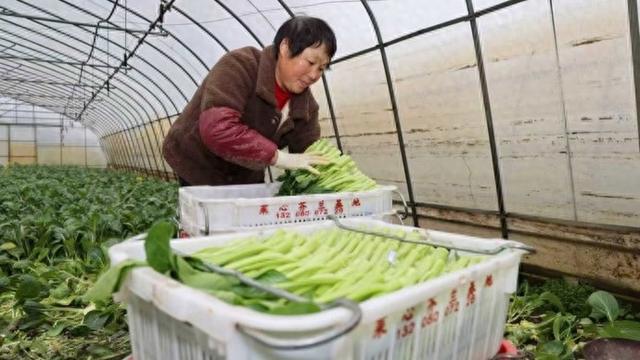
村里来了蔬菜经纪人
Jing Ji Ri Bao· 2025-12-11 21:37
Core Insights - The article highlights the successful implementation of a smart agriculture model in the vegetable planting base in Caohua Township, Zhoukou City, Henan Province, focusing on the cultivation of vegetables for Hong Kong, particularly the Guangdong Choy Sum [1][2] Group 1: Agricultural Practices - The vegetable planting base spans approximately 1,000 acres and produces over 20,000 pounds of vegetables daily, which are quickly transported to the Greater Bay Area via refrigerated trucks [2] - The base employs advanced irrigation systems that optimize water usage based on crop needs and soil moisture, ensuring efficient resource management [1] - The use of smart greenhouses allows for better control of temperature, humidity, and light, creating optimal growing conditions for year-round vegetable supply [1] Group 2: Economic Impact - Zhoukou City is a major vegetable production area in Henan Province, with over 5.1 million acres dedicated to vegetable cultivation and an annual output exceeding 15 million tons, leading the province in both area and production [2] - The influx of workers from various provinces to the vegetable industry in Salt Field Village has resulted in over half of the labor force being composed of external workers [2] - The dual income mechanism established in Caohua Township allows for land rental income and local employment opportunities, benefiting both large-scale farmers and local villagers [3]
广东菜心大迁徙 种全国卖全国
Nan Fang Nong Cun Bao· 2025-09-16 08:05
Core Viewpoint - The article discusses the migration of Guangdong vegetable farmers to Ningxia, highlighting how they have transformed their lives and the agricultural landscape through the cultivation of Guangdong vegetable heart, which has become a staple in the Guangdong-Hong Kong-Macau Greater Bay Area [1]. Group 1: Migration and Transformation - The migration of farmers from Guizhou to Ningxia has led to the establishment of a significant vegetable heart industry, with a planting area of 270,000 acres and sales exceeding 3.6 billion yuan [34]. - The farmers, primarily from the impoverished Ma Mountain area, have improved their living standards, with many owning houses and cars, reflecting a dramatic shift from their previous economic conditions [46][54]. - The journey of these farmers, spanning over 1,700 kilometers from Guizhou to Ningxia, symbolizes their commitment to cultivating high-quality vegetables for consumers across China [42][44]. Group 2: Agricultural Practices and Economic Impact - The article emphasizes the evolution of agricultural practices, noting that modern technology, such as drones and machinery, has significantly reduced labor intensity while increasing productivity [100][96]. - The logistics of transporting vegetables have improved, with costs dropping from 25 yuan to 12 yuan per 30-kilogram box, and total costs decreasing from 100 yuan to 75 yuan, facilitating faster delivery to consumers [105][106]. - The success of the vegetable heart industry illustrates a broader trend of regional economic development, where the wealth generated in agriculture is being reinvested into local communities, creating a cycle of prosperity [70][88]. Group 3: Entrepreneurial Spirit and Future Prospects - The article highlights the entrepreneurial spirit among the second generation of farmers, who are increasingly taking leadership roles and starting their own businesses, contributing to the growth of the industry [74][81]. - The narrative of these farmers reflects a shift from mere survival to thriving, as they leverage their skills and experiences to create sustainable livelihoods [66][110]. - The ongoing development of the vegetable heart industry serves as a model for other regions, showcasing how agricultural innovation and hard work can lead to significant economic advancement [109][68].
