
延误险

Search documents
携程被查背后:到底触碰了哪些红线
Xin Lang Cai Jing· 2026-01-16 07:08
Core Viewpoint - The investigation into Ctrip Group for alleged abuse of market dominance marks a significant event in China's online travel agency (OTA) sector, highlighting the extension of antitrust regulations from e-commerce to travel services [1][20]. Group 1: Investigation Background - Ctrip's investigation is a result of long-standing monopolistic practices that have led to collective grievances from merchants and a surge in consumer complaints, prompting regulatory intervention [21]. - The domestic OTA market is highly concentrated, with the top four companies holding over 85% market share, disrupting fair competition [21]. - Ctrip's financial performance starkly contrasts with the struggling hotel industry, with Ctrip reporting revenues of 62.85 billion yuan and a net profit of 29.113 billion yuan in 2025, while the average net profit margin for hotels is only 5%-8% [21]. Group 2: Monopolistic Practices - Ctrip's monopolistic behavior is characterized by three main areas: exploitation of suppliers, consumer exploitation, and stifling competition [22]. - On the supply side, Ctrip employs coercive strategies such as exclusive agreements and high commissions, forcing small businesses into untenable positions [23]. - Ctrip's pricing tools allow it to unilaterally adjust hotel prices without merchant consent, significantly impacting their profitability [24]. - The commission rates charged by Ctrip have increased from 8%-10% to 15%-22%, severely squeezing the profit margins of partner businesses [25]. Group 3: Consumer Impact - Ctrip's practices have led to consumer exploitation through differential pricing based on user profiles, resulting in significant price discrepancies for similar services [26]. - The company employs forced bundling of services, which increases costs for consumers and complicates the purchasing process [26]. - High cancellation fees and restrictive refund policies further diminish consumer rights and satisfaction [27]. Group 4: Competitive Landscape - Ctrip has utilized capital acquisitions to eliminate competition, significantly increasing its market share to over 70% by acquiring key competitors [28]. - The company imposes restrictions on new platforms, limiting their access to hotel resources and data, thereby maintaining its dominant position [28]. Group 5: Broader Implications - Ctrip's monopolistic behavior has stifled innovation within the OTA industry, leading to a decline in investment in service upgrades and product innovation [30]. - The financial strain on suppliers has increased, with many small businesses facing unsustainable operating conditions due to high commission fees [31]. - Consumers are paying significantly higher prices through OTA platforms compared to direct bookings, with estimates suggesting an annual overpayment exceeding 120 billion yuan [33]. - Following the investigation announcement, Ctrip's market value plummeted, with a loss of approximately 248 billion HKD in a single day, reflecting investor concerns over future profitability [34]. Group 6: Regulatory Insights - The investigation signifies a shift towards regularized antitrust enforcement in China's platform economy, with clear compliance boundaries established for OTA operations [35]. - Ctrip may face substantial fines if found guilty of violating antitrust laws, which could range from 5.3 billion to 53.3 billion yuan based on its previous year's revenue [35]. - The outcome of this investigation could reshape the competitive landscape, fostering a more equitable environment for smaller players and enhancing consumer choices [36].
航旅纵横大面积误报飞机取消!最新回应:承担差价和退票手续费
Xin Lang Cai Jing· 2025-12-02 12:05
Core Viewpoint - The recent incident involving "Hangkong Lvyong" sending erroneous flight cancellation notifications has raised significant public concern, leading to user complaints and demands for compensation due to the misinformation caused by a system failure [2][3][5]. Group 1: Incident Details - On November 29, around 15:00, users received false notifications about flight cancellations, which were later confirmed to be incorrect due to a system malfunction [2][3]. - The erroneous notifications affected passengers from multiple airlines, including Eastern Airlines, Hainan Airlines, and Xiamen Airlines, indicating a wide impact on users [5][12]. - The specific timeframe for the erroneous notifications was identified as between 15:10 and 15:26 on the same day [13][14]. Group 2: Company Response - Following extensive user complaints and media coverage, the company announced it would provide special compensation for actual losses incurred by users, including ticket price differences and refund fees [5][14]. - The company has completed the system repairs but is still determining the details of the compensation plan for affected users [2][14]. Group 3: User Trust Issues - The company has faced ongoing trust issues due to repeated incidents of misinformation regarding flight statuses and complications with delay insurance claims [6][15]. - Complaints have also been directed at the company's customer service, which has been criticized for slow response times and poor attitudes, alongside issues with ticket refunds and high change fees [17][18]. - The company aims to establish itself as the "civil aviation version of 12306," but it faces significant challenges in restoring user trust and improving service quality [18].

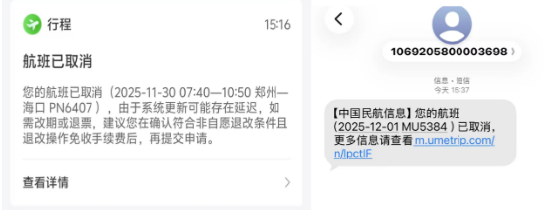
航旅纵横大面积误报飞机取消!涉东方航空、海南航空等多家航司
新浪财经· 2025-12-02 12:02
Core Viewpoint - The article discusses a significant incident involving the "Hangkong Lvyong" app, which mistakenly sent out flight cancellation notifications due to a system error, leading to user confusion and financial losses [2][5][8]. Group 1: Incident Overview - On November 29, around 15:00, users received erroneous notifications about flight cancellations, which were later confirmed to be false due to a system malfunction [2][5]. - Affected airlines included Eastern Airlines, Hainan Airlines, Xiamen Airlines, and others, indicating a wide impact on users [7]. - The company has acknowledged the issue and stated it would provide compensation for the additional costs incurred by users, including ticket price differences and cancellation fees [4][8]. Group 2: User Reactions and Company Response - Users expressed frustration over the lack of immediate solutions and the company's initial refusal to refund based on the notifications being "for reference only" [7][8]. - Following media exposure and user complaints, the company committed to compensating affected users for the financial losses incurred due to the erroneous notifications [8][9]. Group 3: Broader Trust Issues - The company has faced ongoing trust issues due to previous incidents involving inaccurate flight information and problematic insurance claims, leading to a perception of a "trust crisis" among users [9][13]. - Complaints about slow customer service responses and high fees for ticket changes and cancellations have also contributed to user dissatisfaction [13][14]. - The company aims to establish itself as the "civil aviation version of 12306," but it faces significant challenges in rebuilding user trust and improving service quality [14].
