平台经济反垄断

Search documents
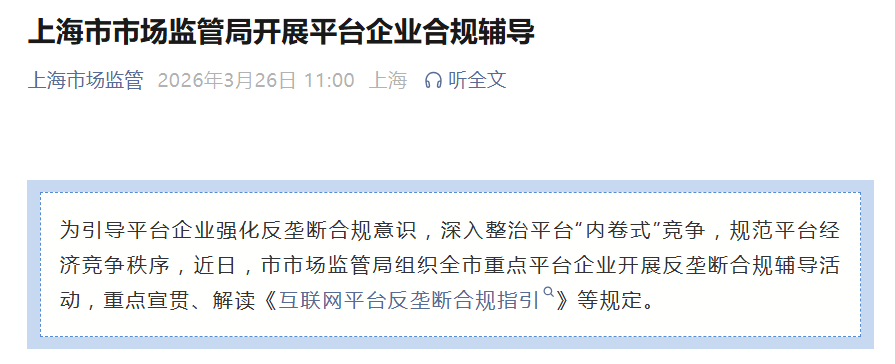
上海市市场监管局开展平台企业合规辅导,拼多多、携程、美团、淘宝闪购、抖音电商等参会
Jin Rong Jie· 2026-03-26 04:38
Core Viewpoint - The Shanghai Municipal Market Supervision Administration is promoting antitrust compliance awareness among platform enterprises to address "involution" competition and regulate the competitive order in the platform economy [1][3] Group 1: Antitrust Compliance Guidance - The Market Supervision Administration organized antitrust compliance training for key platform enterprises, focusing on the interpretation of the "Antitrust Compliance Guidelines for Internet Platforms" [1][3] - The training emphasized new types of monopoly risks in the platform economy, such as "algorithm collusion" and "choose one from two" practices, and provided in-depth explanations of core provisions related to monopoly agreements and abuse of market dominance [3] Group 2: Identified Risks - Eight specific risks were highlighted for platform operators, including algorithm collusion, assisting in reaching monopoly agreements, unfair pricing, selling below cost, blocking or banning, "choose one from two" behavior, "lowest price on the entire network," and differential treatment by platforms [3] - These risks pertain to various operational activities within internet platforms, including data transmission, algorithm application, service pricing, search ranking, recommendation display, traffic allocation, and subsidy offers [3] Group 3: Participation - Over 40 key platform enterprises, including Pinduoduo, Ctrip, Meituan, Taobao Shanguo, Douyin E-commerce, Bilibili, Xiaohongshu, and Dewu, had their legal, compliance, and business leaders participate in the training session [3]



平台经济反垄断迈入系统化、精细化 治理新阶段
Zhong Guo Jing Ji Wang· 2026-02-13 12:08
Core Viewpoint - The formal introduction of the "Antitrust Compliance Guidelines for Internet Platforms" marks a new phase in China's systematic and refined governance in the field of platform economy antitrust, reflecting the maturity and development of the antitrust legal system in China over the past five years [1] Group 1: Key Features and Highlights - The guidelines integrate "pre-regulation" with "compliance governance," shifting from passive response to proactive risk prevention, ensuring compliance throughout the entire business decision-making process [2] - The guidelines provide detailed legal interpretations and practical risk examples, transforming abstract legal standards into identifiable behavioral boundaries, thus enhancing compliance efficiency for platform operators [2] - The guidelines focus on social concerns regarding monopolistic risks in the platform economy, providing detailed explanations for issues such as below-cost sales, "choose one from two" practices, and minimum price requirements [3] Group 2: Regulatory and Theoretical Responses - The guidelines clarify competitive behavior boundaries in the platform economy, addressing public concerns and establishing clear rules for a healthy competitive ecosystem [4] - The guidelines incorporate dynamic market factors into antitrust regulations, ensuring that the rules adapt to the rapidly changing digital market environment [6] - The guidelines emphasize the establishment of a chief compliance officer role within platform operators, aligning with the trend of integrated compliance management [6] Group 3: Risk Management and Compliance Mechanisms - The guidelines innovate in risk management and compliance mechanisms, promoting a proactive approach to compliance management and embedding compliance requirements into business processes [7] - The guidelines require platform operators to conduct antitrust risk assessments before key business activities, ensuring that compliance is integrated into the decision-making process [7] - The guidelines mandate transparency in algorithmic processes, aiming to prevent algorithmic practices that could harm market competition and consumer interests [7]
市场监管总局发布互联网平台反垄断合规指引,8大垄断风险场景被明确划线
Sou Hu Cai Jing· 2026-02-13 08:53
Core Viewpoint - The release of the "Antitrust Compliance Guidelines for Internet Platforms" marks a significant step in regulating monopolistic risks in the platform economy, providing clear behavioral boundaries for platform operators [1][2]. Group 1: Antitrust Compliance Guidelines - The guidelines are based on the Anti-Monopoly Law of the People's Republic of China and focus on four types of monopolistic risks: monopoly agreements, abuse of market dominance, operator concentration, and abuse of administrative power to eliminate or restrict competition [1]. - Eight specific scenarios of new monopolistic risks are identified, including algorithm collusion between platforms, unfair high pricing, below-cost sales, banning or blocking, "choose one from two" behavior, "lowest price on the entire network," and differential treatment by platforms [1][2]. Group 2: Algorithm Governance - The guidelines emphasize algorithm governance, highlighting risks associated with horizontal and vertical monopoly agreements, where platform operators may use algorithms to collude on pricing mechanisms and commission rates [2]. - The guidelines aim to provide practical compliance guidance for platform enterprises, addressing various operational activities such as data transmission, algorithm application, service pricing, search ranking, recommendation display, traffic distribution, and subsidy preferences [2]. Group 3: Principles of Compliance Management - Platform operators are required to adhere to four principles in their antitrust compliance management: targeted, comprehensive, penetrating, and continuous [1]. - The "penetrating principle" mandates that compliance measures should extend across all levels of the platform, including headquarters, subsidiaries, and affiliated companies, ensuring thorough implementation of rules and algorithms [1].
激活竞争状况调查评估机制,破解平台经济 反垄断监管难点
Zhong Guo Jing Ji Wang· 2026-01-22 03:13
Group 1 - The core issue in the food delivery industry is the ongoing "subsidy war" initiated by leading platforms, which has led to excessive subsidies and a price war, pressuring small and medium-sized merchants to engage in low-price competition, exacerbating industry competition [1] - The food delivery service sector is a significant part of the platform economy, characterized by network effects, multi-sided markets, and data-driven elements, deeply integrated into daily life and the economic cycle, involving various stakeholders [2][4] - The investigation into the market competition status of the food delivery service industry is legally grounded in the Anti-Monopoly Law of the People's Republic of China, which empowers the State Council's Anti-Monopoly Committee to conduct such assessments [3] Group 2 - The investigation aims to address the irrational competition in the food delivery sector, where quality is overlooked in favor of price and subsidies, and serves as a proactive regulatory measure to respond to societal concerns [4][5] - This approach aligns with international practices in antitrust jurisdictions, emphasizing preventive regulation to identify risks and guide compliance, thus fostering a multi-faceted governance structure involving government oversight, platform self-regulation, merchant collaboration, and social supervision [5]
携程被查背后:到底触碰了哪些红线
Xin Lang Cai Jing· 2026-01-16 07:08
Core Viewpoint - The investigation into Ctrip Group for alleged abuse of market dominance marks a significant event in China's online travel agency (OTA) sector, highlighting the extension of antitrust regulations from e-commerce to travel services [1][20]. Group 1: Investigation Background - Ctrip's investigation is a result of long-standing monopolistic practices that have led to collective grievances from merchants and a surge in consumer complaints, prompting regulatory intervention [21]. - The domestic OTA market is highly concentrated, with the top four companies holding over 85% market share, disrupting fair competition [21]. - Ctrip's financial performance starkly contrasts with the struggling hotel industry, with Ctrip reporting revenues of 62.85 billion yuan and a net profit of 29.113 billion yuan in 2025, while the average net profit margin for hotels is only 5%-8% [21]. Group 2: Monopolistic Practices - Ctrip's monopolistic behavior is characterized by three main areas: exploitation of suppliers, consumer exploitation, and stifling competition [22]. - On the supply side, Ctrip employs coercive strategies such as exclusive agreements and high commissions, forcing small businesses into untenable positions [23]. - Ctrip's pricing tools allow it to unilaterally adjust hotel prices without merchant consent, significantly impacting their profitability [24]. - The commission rates charged by Ctrip have increased from 8%-10% to 15%-22%, severely squeezing the profit margins of partner businesses [25]. Group 3: Consumer Impact - Ctrip's practices have led to consumer exploitation through differential pricing based on user profiles, resulting in significant price discrepancies for similar services [26]. - The company employs forced bundling of services, which increases costs for consumers and complicates the purchasing process [26]. - High cancellation fees and restrictive refund policies further diminish consumer rights and satisfaction [27]. Group 4: Competitive Landscape - Ctrip has utilized capital acquisitions to eliminate competition, significantly increasing its market share to over 70% by acquiring key competitors [28]. - The company imposes restrictions on new platforms, limiting their access to hotel resources and data, thereby maintaining its dominant position [28]. Group 5: Broader Implications - Ctrip's monopolistic behavior has stifled innovation within the OTA industry, leading to a decline in investment in service upgrades and product innovation [30]. - The financial strain on suppliers has increased, with many small businesses facing unsustainable operating conditions due to high commission fees [31]. - Consumers are paying significantly higher prices through OTA platforms compared to direct bookings, with estimates suggesting an annual overpayment exceeding 120 billion yuan [33]. - Following the investigation announcement, Ctrip's market value plummeted, with a loss of approximately 248 billion HKD in a single day, reflecting investor concerns over future profitability [34]. Group 6: Regulatory Insights - The investigation signifies a shift towards regularized antitrust enforcement in China's platform economy, with clear compliance boundaries established for OTA operations [35]. - Ctrip may face substantial fines if found guilty of violating antitrust laws, which could range from 5.3 billion to 53.3 billion yuan based on its previous year's revenue [35]. - The outcome of this investigation could reshape the competitive landscape, fostering a more equitable environment for smaller players and enhancing consumer choices [36].
“全网最低价”,可能构成垄断协议行为!
Jin Rong Shi Bao· 2025-12-18 02:44
Core Viewpoint - The recently released "Antitrust Compliance Guidelines for Internet Platforms (Draft for Comments)" introduces eight new types of monopoly risks, providing practical compliance guidance for platform enterprises [1][2] Group 1: Purpose and Context - The purpose of the guidelines is to guide platform enterprises in enhancing risk identification, risk management, and compliance assurance to effectively prevent antitrust compliance risks and promote the innovative and healthy development of the platform economy [1] - The platform economy in China has developed rapidly, characterized by significant scale effects and network effects, leading to a "winner-takes-all" scenario where leading platform enterprises can easily engage in cross-industry competition and rapid expansion [1] Group 2: Key Risks and Compliance Guidance - The guidelines adopt a problem-oriented approach, combining specific rules with eight risk examples to provide practical compliance guidance for platform enterprises [2] - The guidelines highlight that platform enterprises with market dominance should avoid implementing "choose one from two" practices through punitive or incentivizing measures, based on enforcement experiences [2] - The guidelines warn that requiring merchants on platforms to sell goods at prices lower than those on competing platforms may constitute abuse of market dominance or monopolistic agreements [2] - The guidelines emphasize the importance of transparency in algorithms, identifying "algorithm collusion" as a risk, and encourage platform enterprises to conduct algorithm screening to prevent monopolistic behaviors from the source [2] Group 3: Regulatory Approach - The regulatory approach aims to balance regulation and development, accelerating the introduction of the guidelines, strengthening antitrust enforcement in the platform economy, and fostering a positive competitive ecosystem while protecting the legitimate rights and interests of relevant parties [2]
市监局警告多家互联网平台,“全网最低价”可能构成垄断
Huan Qiu Wang· 2025-12-18 01:09
Core Points - The Market Regulation Administration has released a draft of the "Antitrust Compliance Guidelines for Internet Platforms," highlighting the significant antitrust risks in the platform economy [1] - The draft identifies "minimum price" requirements as one of the eight potential violations, indicating that platforms may not prohibit merchants from selling at lower prices elsewhere [1] - The guidelines aim to enhance the antitrust compliance awareness and capabilities of platform companies [1] Group 1 - The draft warns major e-commerce platforms against using punitive or incentivizing measures to enforce exclusivity [4] - The regulatory body aims to guide companies in strengthening risk management and compliance [4] - There is a focus on promoting algorithm transparency, requiring companies to disclose the logic behind their algorithms [4]
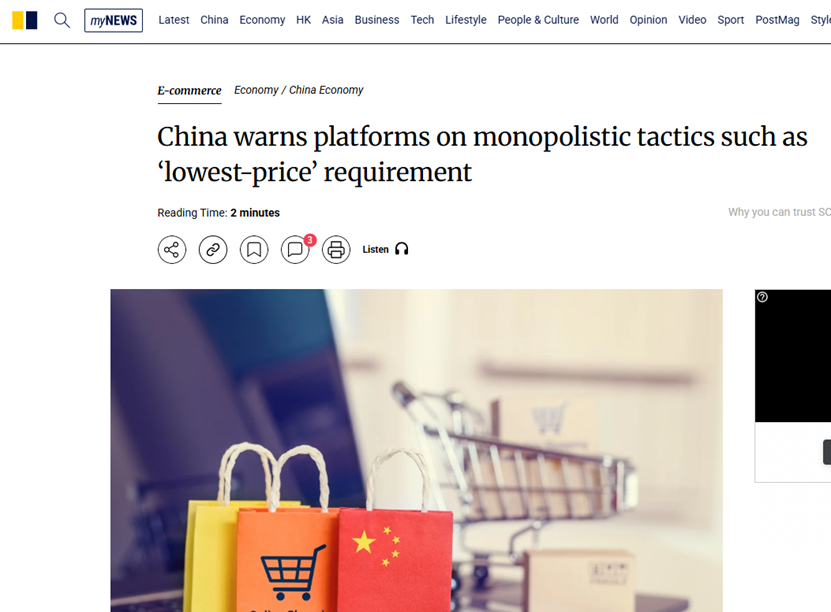
中国官方:平台要求商家“全网最低价”或构成垄断
Zhong Guo Xin Wen Wang· 2025-12-17 23:39
Core Viewpoint - The Chinese National Market Regulation Administration is accelerating the introduction of the "Antitrust Compliance Guidelines for Internet Platforms," indicating that requiring merchants to offer the "lowest price on the entire network" may constitute abuse of market dominance or monopolistic agreements [1][2] Group 1: Regulatory Actions - The National Market Regulation Administration plans to expedite the release of the "Antitrust Compliance Guidelines for Internet Platforms" to help platform operators identify, assess, and prevent antitrust compliance risks [1] - The guidelines aim to clarify behavioral boundaries for platform operators and enhance their compliance awareness and capabilities in the context of significant antitrust risks in the platform economy [2] Group 2: Market Characteristics - The platform economy exhibits distinct competitive characteristics compared to traditional economies, including significant scale effects and network effects, which facilitate cross-industry competition and rapid expansion [1] - Platform enterprises possess inherent advantages over merchants and consumers, allowing them to set rules, manage data, utilize algorithms, and allocate traffic [1] Group 3: Compliance Guidelines - The guidelines advise platform enterprises with market dominance to avoid implementing "either-or" practices through punitive or incentivizing measures [2] - The requirement for merchants to offer the "lowest price on the entire network" is highlighted as a potential abuse of market dominance or a monopolistic agreement [2] - The guidelines also address risks associated with "algorithm collusion" and encourage platforms to conduct algorithm screening to establish a system for identifying and preventing algorithmic monopolies [2]
市场监管总局:“全网最低价”可能构成垄断
Zheng Quan Shi Bao· 2025-12-17 17:09
Core Viewpoint - The article discusses the potential antitrust risks associated with platform companies requiring merchants to maintain "lowest prices across the internet," which may constitute abuse of market dominance or collusion agreements [1]. Group 1: Antitrust Guidelines - The recently released "Antitrust Compliance Guidelines for Internet Platforms (Draft for Comments)" outlines eight new types of monopoly risks, providing practical compliance guidance for platform companies [1]. - The guidelines indicate that requiring merchants to sell products at prices lower than those on competing platforms could be seen as an abuse of market dominance or collusion [1]. - The guidelines emphasize the importance of transparency in algorithms, warning that "algorithm black boxes" can harm the interests of merchants and consumers [1]. Group 2: Regulatory Actions - The market regulatory authority has taken legal action against several platform companies for "choose one from two" monopolistic practices, summarizing enforcement experiences in the guidelines [1]. - The guidelines advise platform companies with market dominance to avoid implementing "choose one from two" behaviors through punitive or incentivizing measures [1]. Group 3: Platform Economy - The platform economy has unique business logic and behavior patterns, involving multiple stakeholders, making it complex to delineate behavioral boundaries [2]. - Regulatory authorities aim to guide platform companies in enhancing risk identification, risk management, and compliance assurance to effectively prevent antitrust compliance risks and promote healthy development of the platform economy [2].
市场监管总局:“全网最低价”可能构成垄断
证券时报· 2025-12-17 10:00
Core Viewpoint - The article discusses the recent guidelines issued by the State Administration for Market Regulation (SAMR) regarding antitrust compliance for internet platforms, highlighting potential monopolistic behaviors and risks associated with platform operations [1][2]. Group 1: Antitrust Compliance Guidelines - The SAMR has introduced the "Antitrust Compliance Guidelines for Internet Platforms (Draft for Comments)" which outlines eight new types of monopolistic risks to provide practical compliance guidance for platform enterprises [1]. - One of the highlighted risks is the requirement for merchants to sell products at "the lowest price on the entire network," which may constitute abuse of market dominance or collusion [1]. - The guidelines emphasize the importance of transparency in algorithms, warning against "algorithm black boxes" that could harm the interests of merchants and consumers, and encourage platforms to develop systems for identifying and preventing monopolistic behaviors [1]. Group 2: Regulatory Actions and Market Dynamics - The SAMR has already taken legal action against several platform companies for engaging in "choose one from two" monopolistic practices, and the guidelines summarize enforcement experiences to help dominant platforms avoid punitive or incentivizing measures that lead to such behaviors [1]. - The unique business logic and behavior patterns of platform economies complicate the delineation of behavioral boundaries, necessitating regulatory guidance for platforms to enhance risk identification, management, and compliance assurance [2].