异育银鲫“中科6号”

Search documents
没有小刺的鲫鱼、水稻明星品种,中国科学院种子专项成果发布
Xin Jing Bao· 2025-12-23 01:52
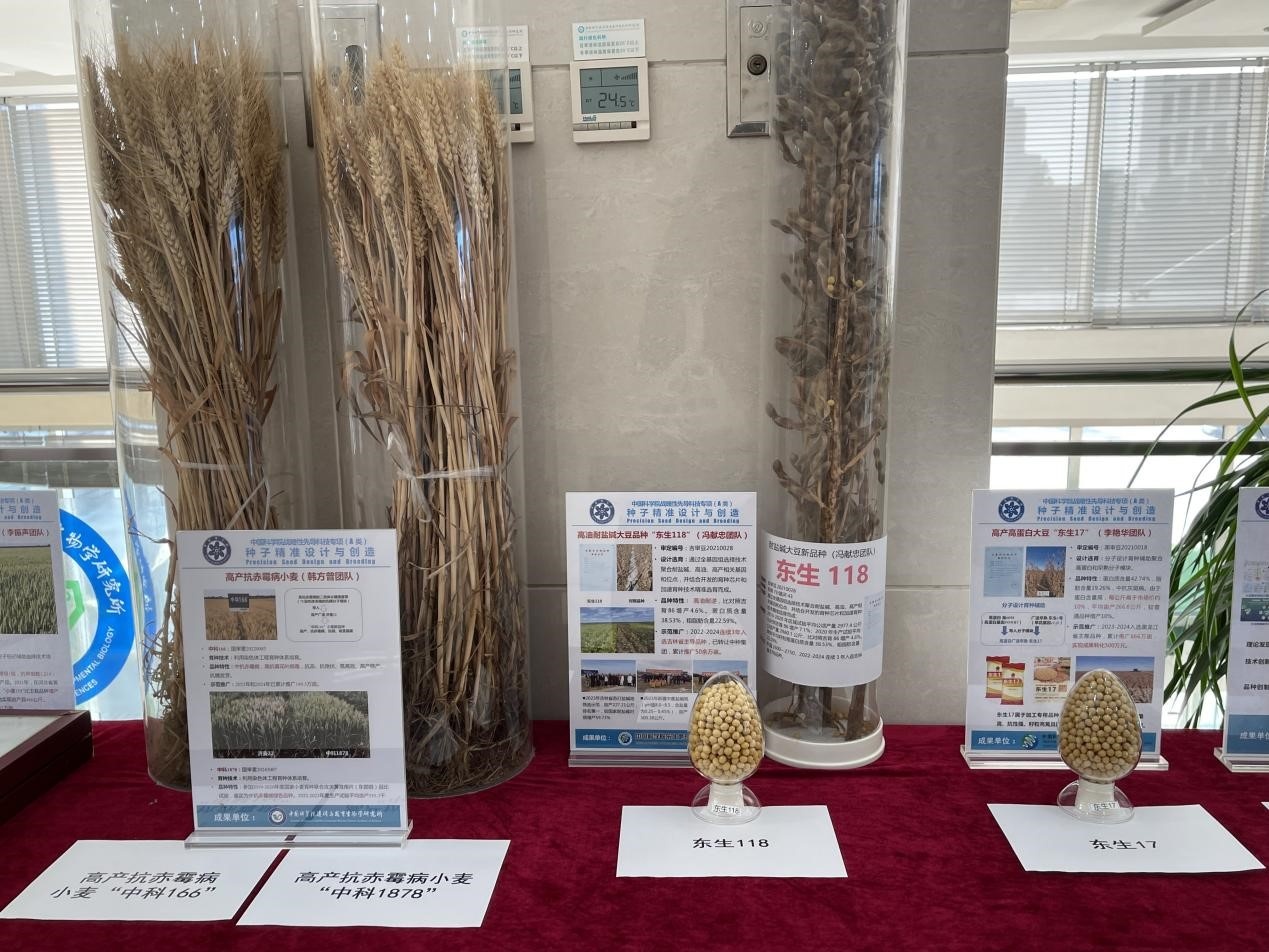
Core Insights - The Chinese Academy of Sciences has launched a seed precision design initiative, achieving significant agricultural advancements over six years, including the creation of 37 "increase and decrease" pilot varieties and the promotion of 14.48 million acres of new crop varieties, resulting in notable socio-economic benefits [1][2]. Group 1: Agricultural Innovations - The seed initiative aims to address challenges in sustainable agriculture, focusing on increasing crop yield and quality while reducing fertilizer and pesticide usage by 15% to 20% and minimizing losses from natural disasters by the same percentage [2][3]. - Key breakthroughs include the cloning of the nitrogen-efficient gene OsTCP19, allowing rice to maintain stable yields while reducing nitrogen fertilizer by 20% to 30%, contributing to a "green revolution" in rice production [3][4]. - The initiative has also developed a high-yield wheat variety "Zhongke 166" that is resistant to major diseases, significantly reducing pesticide usage and covering nearly 1.5 million acres [4]. Group 2: Advanced Breeding Techniques - The project has transformed traditional breeding methods into a precise science, utilizing genome editing technologies to create disease-resistant and high-yield crop varieties [5][6]. - A new approach to rapid domestication of wild rice has been established, shortening the domestication process from thousands of years to just a few years [6]. - The "Zhongke Fa" series of rice has become a star variety, with significant yield improvements over local varieties, and has introduced early-maturing rice options to the market [7]. Group 3: Future Directions - The initiative emphasizes the importance of establishing an independent and leading scientific system in seed technology, aiming to develop smarter seeds that are higher yielding, more nutritious, and resilient to disasters, contributing to global food security and sustainable agriculture [8].
高产优质的密码是什么?从作物到水产,中国科学院种子专项取得全链条突破
Yang Guang Wang· 2025-12-22 14:32
Core Viewpoint - The Chinese Academy of Sciences has made significant breakthroughs in seed precision design and creation, aiming to enhance crop yields and reduce resource inputs through innovative breeding techniques [1][9]. Group 1: Achievements in Crop Breeding - The initiative focuses on major crops like rice and wheat, targeting a yield increase of 10% to 20%, a reduction in input costs by 15% to 20%, and a decrease in losses by 15% to 20% [1]. - Researchers have developed a nitrogen-efficient rice variety that maintains stable yields even with a 20% to 30% reduction in nitrogen fertilizer, addressing the issue of excessive fertilizer use [1][2]. - A new high-yield wheat variety, "Zhongke 166," has been created with broad-spectrum resistance to diseases, significantly reducing pesticide usage and covering nearly 1.5 million acres [5]. Group 2: Innovations in Genetic Editing - The research team has successfully integrated disease resistance traits into 13 major wheat varieties using advanced genome editing techniques, achieving the first biosafety certificate for gene-edited staple crops in China [5][6]. - A novel approach to domesticate wild rice has been developed, potentially shortening the domestication process from thousands of years to just a few years [6]. Group 3: Developments in Aquaculture - The introduction of the "Zhongke 6" silver crucian carp variety has shown a 25% increase in growth rate and a 66.5% improvement in survival rates compared to previous strains [7]. - The breeding program has produced 37 leading varieties that enhance yield, nitrogen efficiency, and disease resistance, with a total of 14.48 million acres of new crop varieties promoted [9]. Group 4: Future Directions - The initiative emphasizes the importance of establishing an independent and innovative agricultural science system to ensure food security and sustainable agricultural development [9].