
种子精准设计与创造

Search documents
【人民日报】专攻农业痛点,种子“精准设计”
Ren Min Ri Bao· 2026-01-12 04:56
Core Insights - The Chinese Academy of Sciences has released significant research outcomes from the A-class pilot project "Precision Design and Creation of Seeds," achieving systematic breakthroughs across theory, technology, and products over six years [1] - The project has developed 37 leading varieties focused on increasing yield and quality while reducing input and losses, promoting 14.48 million acres of new crop varieties, thus providing technological support for revitalizing the seed industry in China [1] Group 1 - The research team has cloned key genes that allow rice to maintain stable yields while reducing nitrogen fertilizer by 20%-30%, addressing the issue of excessive fertilizer use [2] - The team has identified a broad-spectrum resistance gene, Pm24, from local wheat varieties to combat diseases like powdery mildew and has developed high-yielding wheat varieties such as "Zhongke 166," significantly reducing pesticide usage with nearly 1.5 million acres promoted [2] - The project has successfully created new tetraploid rice materials by overcoming challenges in genetic transformation and genome annotation, opening new pathways for breeding [2] Group 2 - The research team has developed high-yield, high-nutrition soybean varieties, including the "Kedou" and "Dongsheng" series, to address China's high soybean import dependency and low productivity [3] - In aquaculture, the concept of "double triploid" has been introduced, leading to the development of a candidate new strain of silver crucian carp, "Zhongke 6," which shows significant improvements in growth rate, survival rate, and feed efficiency [3] - The "Zhongke Fa" series of rice has become a star variety, with "Zhongke Fa 5" yielding over 20% more than local premium varieties in Northeast rice areas, and "Zhongke Fa Early Jing 1" achieving a breakthrough in early-season japonica rice varieties [3] Group 3 - The traditional breeding cycle has been reduced from 8-10 years to a more predictable, programmable, and customizable process, thanks to the advancements made under the pilot project initiated in November 2019 [4] - The project focuses on major crops like rice and wheat, as well as aquatic animals, aiming for a target of increasing yield by 10%-20%, reducing input by 15%-20%, and minimizing losses by 15%-20% through the creation of precision-designed varieties [4]
专攻农业痛点,种子“精准设计”
Ren Min Wang· 2026-01-11 22:43
Core Insights - The Chinese Academy of Sciences has announced significant breakthroughs in the A-class pilot project "Seed Precision Design and Creation," achieving a comprehensive system of theoretical, technical, and product advancements over six years [1] - The project has developed 37 leading varieties aimed at increasing yield and quality while reducing input and losses, with a total of 14.48 million acres of new crop varieties promoted, yielding substantial socio-economic benefits [1] Group 1: Agricultural Innovations - A research team has cloned key genes that allow rice to maintain stable yields while reducing nitrogen fertilizer by 20%-30%, addressing the issue of excessive fertilizer use [2] - The team has also identified a broad-spectrum resistance gene (Pm24) in local wheat varieties, leading to the development of high-yield, disease-resistant wheat varieties, significantly reducing pesticide usage [2] - The project has successfully created new tetraploid rice materials, opening new pathways for breeding by overcoming challenges in genetic transformation and genome annotation [2] Group 2: Crop and Aquaculture Development - The "Zhongke Fa" series of rice has become a star variety, with "Zhongke Fa 5" yielding over 20% more than local premium varieties in Northeast China, and "Zhongke Fa Early Jing 1" breaking new ground in early-season rice varieties [3] - Traditional breeding cycles have been reduced from 8-10 years to a more predictable and programmable process, enhancing the efficiency of crop development [3] - The project aims to achieve a 10%-20% increase in yield, a 15%-20% reduction in inputs, and a 15%-20% reduction in losses through the creation of precision-designed plant and animal varieties [3]
种业有了智慧“中国芯”
Jing Ji Ri Bao· 2025-12-29 00:10
Group 1 - The core achievement of the "Seed Special" is the development of innovative seed varieties, such as the hybrid silver crucian carp, which addresses consumer concerns about fish bones [1] - The "Seed Special" aims to establish a self-reliant and leading scientific system in seed technology, focusing on higher yield, better nutrition, water conservation, and disaster resistance [1] - The initiative was launched in November 2019 to address strategic needs for food security in China, focusing on breeding key crops like rice and wheat [1] Group 2 - The "Zhongke Fa" series of rice has become a star variety, with "Zhongke Fa 5" yielding over 20% more than local varieties in Northeast China and achieving a yield of over 600 kg per mu in saline-alkali land [2] - The "Zhongke Fa Early Jing 1" variety has advanced the market availability of high-quality new japonica rice by 2 to 3 months in southern double-cropping rice areas [2] - The initiative has successfully created 37 leading varieties, promoting new crop varieties across 14.48 million mu, resulting in significant social and economic benefits [2] Group 3 - The successful implementation of the "Seed Special" is a practical example of addressing national needs and leveraging a new type of national system to enhance agricultural technology [3]
“种子专项”已创制三十七个先导型品种——种业有了智慧“中国芯”
Jing Ji Ri Bao· 2025-12-28 21:50
Core Insights - The "Seed Precision Design and Creation" project by the Chinese Academy of Sciences has made significant advancements, particularly with the development of the hybrid silver crucian carp, which addresses consumer concerns about fish bones [1] - The project aims to establish a self-sufficient and leading seed science system to enhance agricultural productivity and food security in China [1][3] Group 1: Achievements in Crop Breeding - The "Zhongke Fa" series of rice, led by Li Jiayang, has become a "star variety," with "Zhongke Fa No. 5" yielding over 20% more than local premium varieties in Northeast China and achieving a yield of over 600 kg per mu in saline-alkali land [2] - In the southern double-cropping rice areas, "Zhongke Fa Early Jing No. 1" has achieved a breakthrough, allowing for the early market release of high-quality new rice by 2 to 3 months [2] - The project has developed a nitrogen-efficient gene that allows rice to maintain stable yields with a 20% to 30% reduction in nitrogen fertilizer, promoting green farming practices [2] Group 2: Disease Resistance and Economic Impact - The research team has identified the broad-spectrum disease resistance gene Pm24, leading to the development of the high-yield, disease-resistant wheat variety "Zhongke 166," which has been promoted over 1.5 million mu, significantly reducing pesticide use [2] - The core objective of the project is to achieve a 10% to 20% increase in yield, a 15% to 20% reduction in input, and a 15% to 20% reduction in losses for plant and animal varieties, with 37 leading varieties created and 14.48 million mu of new crop varieties promoted [2]
李家洋院士解读如何“五选一定”开展重大品种选育
Xin Lang Cai Jing· 2025-12-23 14:59
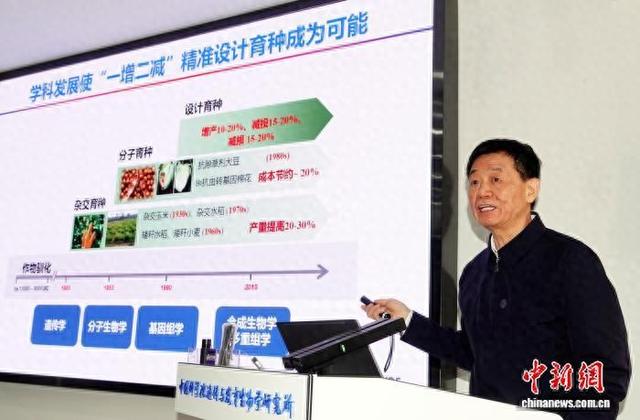
Core Viewpoint - The Chinese Academy of Sciences emphasizes the importance of a new breeding paradigm called "Five Selections and One Determination" to achieve breakthroughs in major crop varieties for food security and sustainable agriculture in China [1][2]. Group 1: Five Selections - Selection of Region: Each crop variety is influenced by regional environmental factors, which also affect pest and disease occurrences [2]. - Selection of Goals: Different regions have specific issues that need to be addressed, such as high yield, quality, efficiency, disease resistance, pest resistance, and soil adaptability [2]. - Selection of Traits: After determining the region and goals, it is essential to break down the agronomic traits that influence the main objectives, such as identifying the ideal plant type for high yield [2][3]. - Selection of Genes: Identifying key genes that affect the desired traits is crucial, such as those determining plant height and tiller number [2][3]. - Selection of Parental Lines: Effective hybridization requires selecting parental lines that contain the necessary key genes to facilitate the rapid and effective aggregation of superior genes [3]. Group 2: One Determination - Determining the Pathway: After completing the "Five Selections," it is vital to establish a clear implementation plan, including the sequence and method of hybridization, to minimize errors and successfully cultivate significant new varieties [5]. Group 3: Future Outlook - During the "14th Five-Year Plan" period, the seed project will focus on creating high-yield and high-quality major varieties, advancing foundational theories, key technologies, and significant variety creation to enhance national food security [7].

【新华社】我国科研团队培育出“无肌间刺”银鲫
Xin Hua She· 2025-12-23 05:05
Core Insights - The research team led by academician Gui Jianfang from the Chinese Academy of Sciences has developed a breeding technology system that creates a new candidate variety of silver crucian carp with high yield, disease resistance, and feed efficiency, while also eliminating the presence of small intermuscular bones [1][2] - The new variety, referred to as "Zhongke No. 6," shows significant improvements in growth rate, survival rate in aquaculture, and feed utilization, marking a shift towards a more predictable and programmable breeding era in China's agricultural sector [1] Group 1 - The innovative breeding technology utilizes "molecular scissors" to edit the genetic code responsible for the growth of intermuscular bones, significantly reducing their occurrence [1] - The breeding system produces sterile fish, which prevents them from reproducing in natural environments, thereby considering ecological safety [1] - The advancements are part of a six-year systematic effort under the Chinese Academy of Sciences' A-class pilot project focused on "precise design and creation of seeds," indicating a transition in agricultural breeding practices [1] Group 2 - The goal of this "precise design" innovation is to enhance national food security and agricultural modernization, providing a strong foundation for China's agricultural development [2]
【新华社】全链条技术突破让“一粒种子”实现精准设计
Xin Hua She· 2025-12-23 02:43
Core Insights - China's research team has achieved a breakthrough in seed precision design, enabling simultaneous improvements in yield, fertilizer efficiency, and disaster resistance [1][2] - The project, initiated in November 2019, involves collaboration among 30 institutions and aims for a 10% to 20% increase in yield, a 15% to 20% reduction in input, and a 15% to 20% reduction in losses [1] - The research has led to the creation of 37 leading varieties and the promotion of 14.48 million acres of new crop varieties [1] Group 1 - In the Northeast rice region, the "Zhongke Fa 5" variety has achieved over a 20% yield increase compared to local premium varieties, with yields exceeding 600 kg per acre in saline-alkali land [1] - In the Southern rice region, "Zhongke Fa Early Jing 1" has marked a breakthrough in double-season early japonica rice, allowing for the market release of high-quality new rice 2 to 3 months earlier [1] - The research team has utilized innovative multi-genome editing technology to create disease-resistant and high-yield wheat varieties, with the first safety certificate for gene-edited staple crops expected in 2024 [1] Group 2 - The research has also identified broad-spectrum disease-resistant genes in local wheat varieties, leading to the development of the high-yield, disease-resistant variety "Zhongke 166," which has been promoted across nearly 1.5 million acres, significantly reducing pesticide use [2] - The cloning of the nitrogen-efficient gene OsTCP19 allows rice to maintain stable yields with a 20% to 30% reduction in nitrogen fertilizer [2] - The project's outcomes have extended to aquaculture, creating a new breeding design system that enhances growth rate, survival rate, and feed efficiency in new carp strains, including a new variety of silver carp with no intermuscular bones, improving consumer experience [2] - The successful implementation of this project exemplifies the advantages of a new type of national system, laying a solid technological foundation for China's transition from a major seed industry country to a strong seed industry nation [2]
没有小刺的鲫鱼、水稻明星品种,中国科学院种子专项成果发布
Xin Jing Bao· 2025-12-23 01:52
Core Insights - The Chinese Academy of Sciences has launched a seed precision design initiative, achieving significant agricultural advancements over six years, including the creation of 37 "increase and decrease" pilot varieties and the promotion of 14.48 million acres of new crop varieties, resulting in notable socio-economic benefits [1][2]. Group 1: Agricultural Innovations - The seed initiative aims to address challenges in sustainable agriculture, focusing on increasing crop yield and quality while reducing fertilizer and pesticide usage by 15% to 20% and minimizing losses from natural disasters by the same percentage [2][3]. - Key breakthroughs include the cloning of the nitrogen-efficient gene OsTCP19, allowing rice to maintain stable yields while reducing nitrogen fertilizer by 20% to 30%, contributing to a "green revolution" in rice production [3][4]. - The initiative has also developed a high-yield wheat variety "Zhongke 166" that is resistant to major diseases, significantly reducing pesticide usage and covering nearly 1.5 million acres [4]. Group 2: Advanced Breeding Techniques - The project has transformed traditional breeding methods into a precise science, utilizing genome editing technologies to create disease-resistant and high-yield crop varieties [5][6]. - A new approach to rapid domestication of wild rice has been established, shortening the domestication process from thousands of years to just a few years [6]. - The "Zhongke Fa" series of rice has become a star variety, with significant yield improvements over local varieties, and has introduced early-maturing rice options to the market [7]. Group 3: Future Directions - The initiative emphasizes the importance of establishing an independent and leading scientific system in seed technology, aiming to develop smarter seeds that are higher yielding, more nutritious, and resilient to disasters, contributing to global food security and sustainable agriculture [8].
把“农业芯片”紧紧攥在我们手中
Xin Lang Cai Jing· 2025-12-22 20:23
Core Insights - The article discusses breakthroughs in agricultural biotechnology through the "Seed Precision Design and Creation" project initiated by the Chinese Academy of Sciences, focusing on enhancing crop yields while reducing chemical inputs [1][2]. Group 1: Project Overview - The "Seed Precision Design" project began in November 2019, involving collaboration among 30 institutions to address key issues in food security and agricultural development in China [1]. - The project aims to increase crop yields by 10% to 20% while reducing chemical fertilizer and pesticide use by 15% to 20% and minimizing losses by 15% to 20% [1]. Group 2: Innovations in Crop Breeding - Scientists have identified a key gene, OsTCP19, which significantly improves rice's nitrogen utilization efficiency, allowing stable yields even with a 20% to 30% reduction in nitrogen fertilizer [2][3]. - A broad-spectrum disease-resistant gene, Pm24, has been discovered from local wheat varieties, leading to the creation of high-yield, disease-resistant wheat strains [3]. - The new wheat variety "Zhongke 166" has been developed with strong disease resistance, resulting in a significant reduction in pesticide use, with a cumulative planting area nearing 1.5 million acres [3]. Group 3: Advanced Breeding Techniques - The project employs advanced gene editing techniques to create new crop varieties that combine high yield and disease resistance, overcoming traditional breeding challenges [5]. - A novel approach termed "from scratch domestication" has been utilized to harness wild rice's genetic potential, leading to the successful creation of new four-fold rice materials [5][6]. Group 4: Market Impact and Adoption - The "Zhongke Fa" series of rice has received positive feedback from farmers, demonstrating high yields and quality, with "Zhongke Fa 5" achieving over 20% yield increase compared to local varieties [7][8]. - The introduction of "Zhongke Fa Early Glutinous 1" has addressed the market need for early-season rice, allowing consumers to access fresh glutinous rice 2 to 3 months earlier [9]. Group 5: Broader Agricultural Applications - The project has also developed high-yield soybean varieties and established a comprehensive genomic database for soybean breeding, addressing China's high dependency on imported soybeans [10][11]. - In aquaculture, the "Zhongke 6" fish variety has shown a 25% increase in growth rate and a 66.5% improvement in survival rate compared to widely farmed varieties [11].
“无刺鲫鱼”有望端上餐桌
Xin Lang Cai Jing· 2025-12-22 18:17
Core Viewpoint - The research team led by academician Gui Jianfang from the Chinese Academy of Sciences has developed a breeding technology system that creates a new candidate variety of silver crucian carp with high yield, disease resistance, and feed efficiency, while also eliminating the presence of small bones in the fish [1][2] Group 1: Breeding Technology and Innovations - The new breeding technology utilizes "molecular scissors" to edit the genetic code that controls the growth of small bones, significantly reducing their occurrence [1] - The candidate variety "Zhongke No. 6" shows substantial improvements in growth rate, survival rate in aquaculture, and feed utilization efficiency [1] - The breeding system is designed to produce sterile fish, preventing them from reproducing in natural environments, thus ensuring ecological safety [1] Group 2: Implications for Food Security and Agriculture - The innovations aim to enhance national food security and modernize agriculture, providing a strong foundation for China's agricultural development [2] - The advancements mark a shift in agricultural breeding from traditional methods to a more predictable and programmable "precision design" era [1]