征信修复服务

Search documents
征信修复中介宣称能从央行删数据
Xin Lang Cai Jing· 2026-02-07 08:26
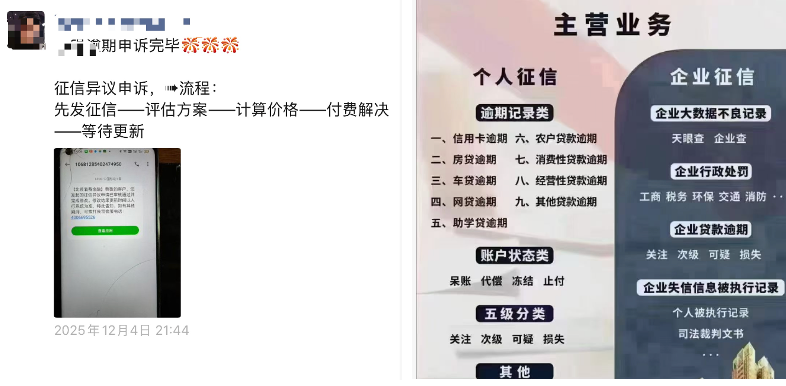
Core Viewpoint - The article reveals the emergence of numerous intermediaries claiming to offer "credit repair" services, suggesting they can erase negative credit records, particularly those exceeding 10,000 yuan, through dubious methods [1] Group 1: Industry Overview - A significant number of intermediaries are advertising services to repair credit records, with slogans like "Overdue is not scary, professional teams help you delete records" [1] - These intermediaries assert they can exploit "loopholes" in regulations to eliminate bad credit records, indicating a potential gray market in credit repair [1] Group 2: Business Practices - One intermediary claimed to have a deep understanding of the "underlying logic" of credit data management, stating that while overdue records under 10,000 yuan may not be displayed, the underlying data still exists in the People's Bank of China credit management system [1] - The intermediary suggested that their service could effectively delete the data from the foundational database, implying that clients would appear as if they had never had overdue payments [1]
征信“洗白”当心钱包、隐私双双受损
Xin Lang Cai Jing· 2026-01-29 17:43
Core Viewpoint - The article highlights the emergence of credit repair intermediaries exploiting borrowers' anxiety over overdue payments, particularly for amounts exceeding 10,000 RMB, despite the official credit repair policy introduced by the central bank aimed at small overdue amounts [1][9]. Group 1: Credit Repair Policy - The central bank has established a credit repair policy effective from January 1, 2026, allowing individuals to have overdue records under 10,000 RMB removed from credit reports if paid off by March 31, 2026 [9][10]. - The policy is designed to support honest borrowers while maintaining credit constraints on those with larger overdue amounts [11]. Group 2: Intermediary Services - Numerous intermediaries are offering credit repair services, charging between 2,000 to 3,000 RMB per case, but success rates are not guaranteed [3][4]. - Some intermediaries sell guides and materials for credit dispute processes, often promoting dubious methods for quick fixes [3][4]. Group 3: Risks of Using Intermediaries - Engaging with intermediaries for credit repair poses significant risks, including financial loss and potential legal issues, as many of these services may involve fraudulent practices [5][7]. - Borrowers may be misled into providing sensitive personal information, which could be misused, and may also face legal consequences for participating in illegal activities [6][7]. Group 4: Legal and Compliance - The only legitimate way for borrowers to dispute credit records is through formal channels with financial institutions or the central bank, contrasting sharply with the illegal methods promoted by intermediaries [11][12]. - The legal process for disputing credit records involves submitting a formal application, which is distinct from the fraudulent claims made by intermediaries [11][12].
“征信修复”灰黑产再起:多环节收费高至10%
第一财经· 2026-01-15 09:28
Core Viewpoint - The implementation of personal credit repair policies in 2026 has created opportunities for overdue borrowers, but it has also attracted underground "credit repair" schemes that exploit vulnerable individuals [3][5]. Group 1: Policy Implementation and Exploitation - The personal credit repair policy allows for the removal of overdue records from 2020 to 2025 for amounts not exceeding 10,000 yuan if settled by March 2026 [5]. - Some intermediaries claim to "break through the 10,000 yuan limit" and offer complete credit repair, misleading borrowers and charging high fees [5][7]. - These intermediaries often use deceptive practices, such as fabricating documents and inducing borrowers to communicate with banks using specific scripts [7][9]. Group 2: Business Models of Intermediaries - Different intermediaries employ various business models, with some providing remote support and communication strategies to enhance borrower-bank interactions [8]. - Some intermediaries offer "one-stop services" that include debt consolidation and subsequent loan facilitation, claiming to negotiate better terms with banks [10][12]. - The fees charged by these intermediaries range from 2% to 10% of the total debt, with some charging based on the number of overdue records [15][16]. Group 3: Legal and Regulatory Concerns - The methods used by intermediaries to delete overdue records are often non-compliant and unlikely to succeed, as the credit repair process is fundamentally about correcting errors, not erasing valid records [9][19]. - Many intermediaries engage in fraudulent activities, such as instructing clients to submit false claims or documents, which can lead to legal repercussions [19][20]. - Contracts with these intermediaries often contain vague terms and high penalties for breach, making it difficult for clients to seek recourse [15][16]. Group 4: Recommendations for Addressing the Issue - Experts suggest a multi-faceted approach to combat these underground operations, including enhanced monitoring, public education on legitimate credit repair processes, and stricter regulations on social media platforms to prevent the spread of misinformation [22].


“征信修复”灰黑产再起:宣称可“突破万元限制”,多环节收费高至10%
Di Yi Cai Jing· 2026-01-15 09:04
Core Viewpoint - The article highlights the emergence of illegal and fraudulent practices surrounding credit repair services, particularly in response to the new personal credit repair policy set to take effect in 2026, which has led to the exploitation of vulnerable borrowers by unscrupulous intermediaries [1][2][8]. Group 1: Credit Repair Policy and Its Exploitation - The personal credit repair policy will be implemented on January 1, 2026, allowing borrowers with overdue records from 2020 to 2025 to clear their credit if the overdue amount is under 10,000 yuan and settled by March 31, 2026 [2]. - Many borrowers are unable to meet the policy's criteria, leading to the rise of intermediaries claiming they can "break through the 10,000 yuan limit" and fully repair credit [2][4]. - These intermediaries often charge high fees ranging from 2% to 10% of the debt amount, using deceptive practices to lure borrowers into costly services [1][12]. Group 2: Methods and Operations of Intermediaries - Intermediaries employ various tactics, including exaggerating the policy's applicability, forging documents, and creating a sense of urgency among borrowers [2][4]. - They typically offer services such as "debt consolidation" and "credit repair," often misleading clients about the legality and effectiveness of their methods [6][7]. - Some intermediaries provide "one-stop services," claiming to assist clients in negotiating with banks to remove overdue records, despite these practices being non-compliant with regulations [6][7]. Group 3: Legal and Ethical Concerns - The practices of these intermediaries not only involve potential fraud but also pose risks of personal information leakage and legal repercussions for borrowers [1][8]. - The article emphasizes that credit records cannot be arbitrarily deleted, and the process of disputing credit information is strictly regulated [5][16]. - Many contracts from intermediaries contain vague terms and high penalties for breach, making it difficult for clients to seek recourse [11][13]. Group 4: Recommendations for Addressing the Issue - Experts suggest a multi-faceted approach to combat these gray and black market practices, including better public education on legitimate credit repair processes and stricter regulation of intermediaries [18]. - Financial institutions are encouraged to enhance internal controls and streamline legitimate dispute processes to reduce borrower costs [18]. - Social media platforms should improve content moderation to prevent the spread of misleading advertisements related to credit repair services [18].