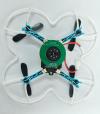
微型化机载气体传感模组

Search documents
无人机“飞向”千行百业
Ke Ji Ri Bao· 2025-11-03 01:00
Core Insights - The article highlights the rapid advancements in drone technology in China during the "14th Five-Year Plan" period, showcasing its integration into various industries and the significant improvements in performance and applications [1][2][4]. Group 1: Drone Technology Advancements - Drones have evolved to perform inspections efficiently, with capabilities to detect even minor cracks in structures like the Aizhai Bridge, demonstrating their adaptability to harsh weather conditions [1]. - The integration of AI, 5G, and new energy technologies has accelerated the iteration of drone models, leading to a product system that is low-cost, reliable, high-performance, and safe [2]. - High-energy lithium-ion batteries have significantly improved drone performance, enhancing flight duration by 20% to 40% and enabling stable operation in extreme temperatures [2]. Group 2: Autonomous Capabilities - Drones are transitioning from passive executors to autonomous decision-makers, capable of planning flight routes and avoiding obstacles independently [3]. - The development of miniaturized gas sensing modules has equipped drones with the ability to detect environmental changes, such as carbon monoxide levels, enhancing their operational intelligence [3]. Group 3: Industry Integration - Drones are transforming traditional industries by providing innovative solutions, such as autonomous exploration in hazardous mining environments, which improves safety and efficiency [4]. - In logistics, drones are effectively handling an average of 20,000 packages daily in Shenzhen, indicating technological maturity and the viability of the business model [5]. Group 4: Economic Impact - The growth of the drone industry is contributing to the development of China's low-altitude economy, with projections indicating over 2.726 million registered drones by mid-2025, a net increase of 513,000 from the previous year [5].
“心脏”强大 “大脑”聪明 “嗅觉”灵敏 无人机“飞向”千行百业
Ke Ji Ri Bao· 2025-11-02 23:33
Core Insights - The integration of drones in various industries is transforming traditional practices, enhancing efficiency and safety in operations [1][4][5] - China's drone industry is experiencing rapid growth, with significant advancements in technology and applications, positioning the country as a global leader in drone exports and patents [1][2][5] Group 1: Technological Advancements - Drones are now equipped with advanced AI capabilities, allowing for autonomous decision-making and route planning, which enhances operational efficiency [3] - The development of high-performance lithium-ion batteries has improved drone endurance by 20% to 40%, enabling stable operation in extreme temperatures [2] - New sensor technologies, such as gas detection modules, have enhanced drones' environmental sensing capabilities, allowing them to detect minute changes in air quality [3] Group 2: Industry Applications - Drones are revolutionizing traditional industries, such as mining, by autonomously generating high-precision 3D models and collecting data in hazardous environments [4] - In logistics, drones are effectively handling an average of 20,000 packages daily in Shenzhen, demonstrating the maturity of the technology and the viability of the business model [5] - The integration of drones in disaster response has proven effective, with drones being used for reconnaissance and communication in emergency situations [5] Group 3: Market Growth - The drone industry in China is expanding rapidly, with projections indicating that the number of registered drones will exceed 2.726 million by June 2025, reflecting a net increase of 513,000 from the previous year [5]
能视觉感知更能探测CO浓度 无人机练就“嗅得准”的“电子鼻”
Ke Ji Ri Bao· 2025-10-28 00:12
Core Viewpoint - The development of a miniaturized airborne gas sensing module by a team at Civil Aviation University of China enables drones to detect carbon monoxide (CO) concentrations as low as one part per million and create three-dimensional concentration distribution maps, marking a significant advancement in low-altitude environmental sensing technology [1][4]. Group 1: Technological Breakthrough - The new technology integrates hardware and software, allowing the sensor to function as an organic part of the drone's perception system, enhancing its ability to monitor environmental conditions [4]. - The gas sensing module, which is the size of a coin, utilizes nanocomposite materials to achieve high-performance CO detection, with a detection limit down to one part per million and a response time reduced to seconds [4][5]. - The system can provide early warnings for lithium battery thermal runaway by detecting CO, a characteristic gas produced during the early decomposition of the battery's electrolyte [4][5]. Group 2: Applications and Industry Impact - The technology has completed laboratory validation and initial flight tests, showing excellent performance stability, and is moving towards industrialization with partnerships in various sectors including environmental protection and emergency management [6]. - In smart environmental monitoring, drone fleets can conduct regular, grid-based surveillance to create high-resolution real-time 3D pollution maps and identify pollution sources accurately [6]. - In emergency rescue scenarios, drones can quickly arrive at accident sites and create real-time 3D diffusion maps of toxic gas clouds, providing precise guidance for rescue operations and public evacuation [6][7].
给无人机装上“电子鼻”:中国团队突破低空大气精准感知技术
Ke Ji Ri Bao· 2025-10-13 05:46
Core Insights - The article discusses a breakthrough technology developed by a research team led by Professor Chen Da at the Civil Aviation University of China, which enables drones to detect carbon monoxide (CO) at concentrations as low as parts per million (ppm) and create three-dimensional concentration distribution maps [1][8]. Group 1: Technology Development - A miniaturized onboard gas sensing module, comparable in size to a coin, serves as the "olfactory nerve" for the drone, facilitating intelligent atmospheric monitoring [1][8]. - The technology has been published in the international journal "ACS Sensors," marking significant progress in low-altitude environmental sensing in China [1]. - The sensing module can detect CO levels with precision and has a response time reduced to seconds, matching the accuracy of large ground-based analytical instruments [8]. Group 2: Application and Market Potential - The technology addresses the limitations of traditional ground-based monitoring stations, which are sparse and slow to update, making them inadequate for capturing pollution dispersion in complex environments [2]. - Drones equipped with this technology can enhance environmental monitoring and emergency response capabilities, providing timely data for decision-making during pollution events [2][9]. - The research team is actively pursuing industrial applications, collaborating with various drone system integrators and environmental management departments to implement the technology in real-world scenarios [9][10]. Group 3: Safety and Risk Management - The technology also includes a feature for early warning of lithium battery thermal runaway, which is critical for ensuring drone flight safety [3][10]. - By detecting CO as a byproduct of battery decomposition, the system can provide warnings up to several minutes earlier than traditional methods [8]. - The integration of the sensing module with the drone's flight control system allows for real-time data analysis and autonomous decision-making in emergency situations [8][9].