快航服务

Search documents
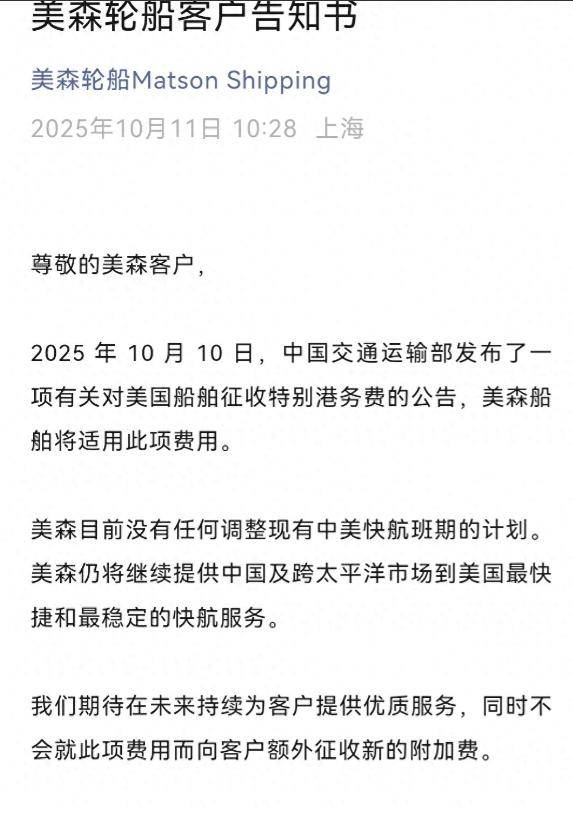
这家美国船运巨头公告,按中国要求缴费,费用不会转嫁客户
Sou Hu Cai Jing· 2025-10-14 08:14
Core Viewpoint - Matson Navigation Company announced it will comply with new regulations from China's Ministry of Transport, absorbing all special port fees without passing costs onto customers, maintaining stable freight rates and services [1][3]. Group 1: Business Strategy - Matson's decision reflects a calculated business strategy aimed at preserving customer loyalty amidst rising operational costs due to new port fees [3][5]. - The company has a competitive edge in speed and reliability, reducing shipping time from Chinese ports to the U.S. West Coast to just over ten days, which is crucial for high-value goods and e-commerce [3][5]. Group 2: Cost Implications - The additional port fees could significantly impact Matson's profitability, with estimates suggesting an increase in costs from approximately 20 million RMB in 2025 to 56 million RMB by 2028 for a single vessel making five trips a year [12][14]. - The company's commitment to not raising prices provides a sense of stability for foreign trade enterprises reliant on its services, alleviating immediate cost concerns [12][14]. Group 3: Industry Context - The port fee conflict originated from the U.S. Trade Representative's announcement of additional fees on Chinese-operated vessels, prompting a reciprocal response from China [6][8]. - The fee structure from China is set to increase incrementally, starting at 400 RMB per net ton in 2025 and rising to 1120 RMB by 2028, marking a significant escalation in the trade tensions [10][12]. Group 4: Future Considerations - The sustainability of Matson's price freeze is uncertain, as ongoing increases in port fees, fuel prices, and labor costs may challenge the company's ability to maintain this strategy long-term [14][16]. - The situation presents a dilemma for other shipping companies, weighing the options of following Matson's lead to retain market share or passing costs onto customers [14][16].