
振捣机器人

Search documents
机器人“组团上岗”,智能建造场景上新
Ke Ji Ri Bao· 2025-12-15 06:26
Core Insights - The construction industry is transitioning towards standardization, industrialization, intelligence, and sustainability through the integration of data elements and advanced technologies like BIM, prefabricated buildings, and robotic construction [1][7] Group 1: Technological Advancements - The use of robots in construction has significantly improved efficiency, with a plastering robot achieving a precision of 0.3 mm and completing 3 square meters per minute, which is four times faster than manual labor [1] - The competition showcased 146 innovative results from 109 units across over 20 provinces, highlighting the leap from "single-point technology breakthroughs" to "full-scene implementation" in smart construction [3] - Robots are now integrated into a systematic work network, utilizing BIM, FMS, and WMS systems to create a closed-loop of task execution and material delivery [3][4] Group 2: Collaborative Work Models - The collaborative operation of construction robots has transformed job sites, enhancing efficiency, quality, and safety while reducing reliance on human labor [4] - Advanced technologies are essential for the promotion of robots in construction, with modular intelligent controllers reducing development cycles by over 50% [5] Group 3: Smart Construction Applications - Smart construction is driven by data, enabling full-process collaboration and real-time monitoring of project design, production, and construction progress [6] - The integration of AI in construction has led to significant improvements, such as a 30% reduction in equipment failure rates and a 40% increase in yard turnover rates [7] Group 4: Expanding Application Scenarios - New application scenarios for smart construction are emerging, including drone inspections, wall-climbing robots for bridge diagnostics, and underwater robots for tunnel monitoring [8] - The city of Chongqing has developed ten typical applications in digital engineering, achieving a 70% reduction in pipeline damage incidents and a 100% digitalization rate in core business processes [8] Group 5: Policy and Investment - Chongqing is implementing a comprehensive policy approach to promote the intelligent and modern transformation of the construction industry, with a total investment of 37.4 billion yuan in signed projects [9] - The national strategy during the 14th Five-Year Plan period emphasizes the rapid development of smart construction and the application of advanced technologies and materials [9][10]


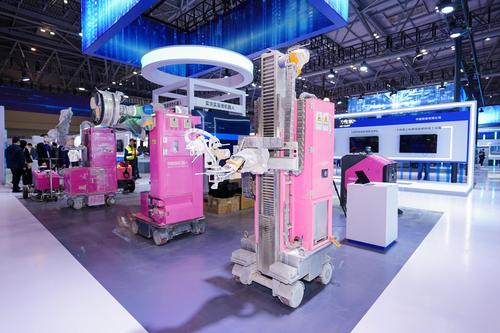
机器人“组团上岗” 智能建造场景上新
Ke Ji Ri Bao· 2025-12-15 00:33
Core Insights - The construction industry is undergoing a transformation towards standardization, industrialization, intelligence, and sustainability, driven by the integration of data elements and advanced technologies like BIM, prefabricated buildings, and robotic construction [1][5]. Group 1: Technological Advancements - The third National Construction Robot Competition showcased 146 innovative results from 109 units across over 20 provinces, highlighting the leap from "single-point technology breakthroughs" to "full-scene implementation" in intelligent construction [1]. - Robots such as the plastering robot can achieve a precision of 0.3 mm and complete 3 square meters of work per minute, which is four times more efficient than manual labor [1]. - The use of AI algorithms in robots, like the vibrating robot from Zhejiang Futike Technology Co., allows for optimal path planning and ensures concrete density meets the best standards, addressing quality issues in traditional manual processes [2]. Group 2: Collaborative Work Models - The collaborative work model of robots has changed the construction site landscape, with various robots working together to enhance efficiency, quality, and safety [3]. - The integration of BIM, FMS (robot collaborative management), and WMS (warehouse management) systems allows for seamless coordination among robots, transforming them from isolated tools into components of a systematic work network [2]. Group 3: Smart Construction and Data Utilization - Smart construction relies on data-driven processes for full-cycle collaboration, with real-time data on project design, component production, and construction progress displayed on large screens [4]. - The integration of QR codes with construction components allows robots to automatically identify, grab, and install parts, leading to standardized production and intelligent construction on-site [4]. Group 4: Expanding Application Scenarios - The application scenarios for intelligent construction are continuously evolving, with drones, wall-climbing robots, and underwater robots being deployed for risk inspection and monitoring of urban infrastructure [6]. - The development of a "digital twin community" model showcases the integration of smart renovation technologies and community governance data, enhancing residential services and security [6]. Group 5: Policy and Investment - As a national pilot city for intelligent construction, Chongqing is implementing a series of policies to promote the modernization of the construction industry, with a total investment of 37.4 billion yuan in signed projects [7]. - The Chinese government is actively promoting intelligent construction and advanced technology applications during the 14th Five-Year Plan period, aiming for accelerated transformation and high-quality development in the housing and urban construction sector [7].