数字芯片及相关晶圆

Search documents
2.92美元收购被撤销!特朗普强制中资剥离美国芯片资产!
Xin Lang Cai Jing· 2026-01-04 12:03
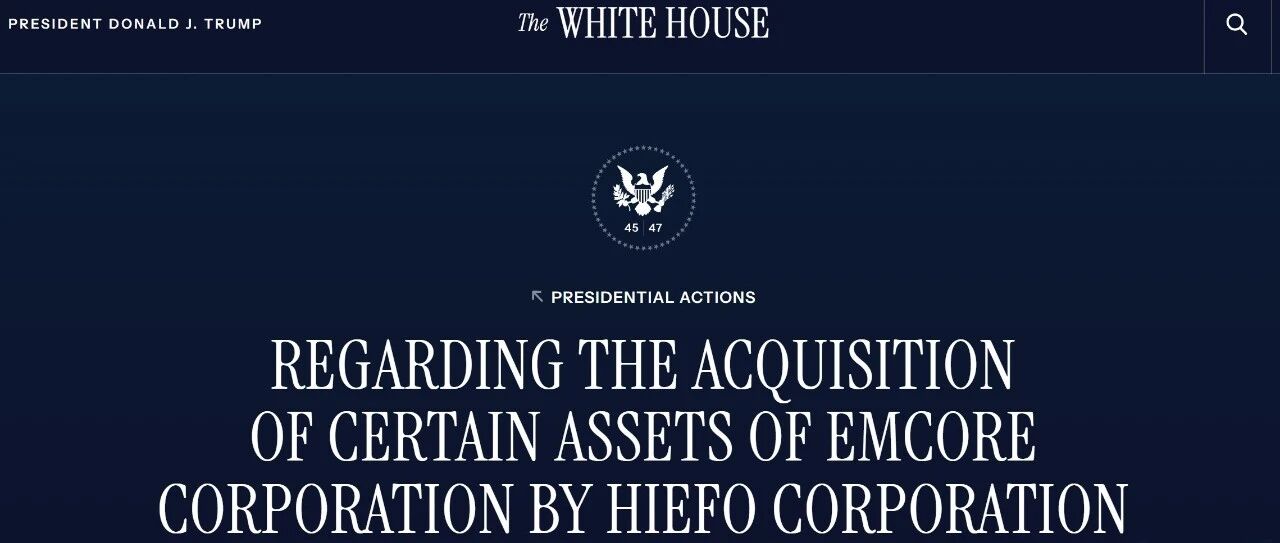
Core Viewpoint - The U.S. government has ordered the divestiture of HieFo's acquisition of EMCORE, valued at $292 million, citing national security concerns [2][11]. Company Overview - EMCORE, established in 1984 and headquartered in New Jersey, specializes in fiber optic communication and solar photovoltaic technologies, with core businesses including high-speed communication systems, satellite equipment, and efficient solar cells. The company has faced losses in recent years and was privatized by Charlesbank Capital Partners in 2025 [5][14]. - HieFo was founded by Dr. Genzao Zhang and Harry Moore, with Zhang previously serving as EMCORE's engineering vice president before becoming HieFo's CEO [5][14]. Acquisition Details - In September 2024, HieFo completed the acquisition of nearly all assets related to EMCORE's non-core, discontinued chip business and InP wafer manufacturing, with the transaction finalized on April 30, 2024. This included the transfer of equipment, contracts, intellectual property, and inventory from EMCORE's facility in Alhambra, California [7][16]. - HieFo has plans to lease the Alhambra facility and has successfully retained key scientists, engineers, and operational staff from EMCORE's discontinued chip business [7][16]. Government Action - President Trump issued an executive order to revoke HieFo's acquisition, citing credible evidence that the company, controlled by Chinese interests, poses a threat to U.S. national security. The order mandates HieFo to divest all rights and interests in EMCORE assets within 180 days [7][16]. - As part of the divestiture, HieFo and its affiliates are required to destroy any intellectual property related to EMCORE assets that they hold or have transferred to controlled affiliates [8][17]. Industry Context - Recent years have seen increased scrutiny and obstacles for Chinese companies attempting to acquire semiconductor firms abroad, with several cases of forced divestitures following acquisitions. Examples include: 1. In July 2021, Wintech completed the acquisition of the UK NWF wafer plant, only to be forced to sell it by the government in May 2022 [8]. 2. In November 2021, a subsidiary of Saimo Electronics announced an acquisition of a German chip manufacturer, which was subsequently banned by the German government in November 2022 [8]. 3. In August 2021, a Chinese investment firm planned to acquire a Scottish chip manufacturer, but was forced to divest its holdings in November 2024 due to national security concerns [8][17]. Conclusion - The ongoing U.S.-China trade tensions have led to heightened resistance from the U.S. and allied countries against Chinese investments in semiconductor firms, which may adversely affect future overseas investments by Chinese companies in this sector [9][18].

突发!特朗普否决涉华芯片交易,解密对华遏制“组合拳”
是说芯语· 2026-01-03 10:21
Core Viewpoint - The article discusses the recent intervention by the Trump administration requiring the Chinese-controlled U.S. company HieFo to divest its semiconductor assets, highlighting a systematic trend of the U.S. and its allies to curb Chinese semiconductor enterprises' overseas expansion [1][8]. Group 1: HieFo Acquisition Background - HieFo acquired EMCORE's digital chip and related wafer design, manufacturing, and processing business for approximately $2.92 million on April 30, 2024, as EMCORE faced severe operational pressures due to continuous losses in 2023 [3]. - EMCORE's core products, which include critical components for the U.S. military, embedded the company deeply within the defense supply chain, setting the stage for potential U.S. government intervention [3]. Group 2: U.S. Government Intervention - The intervention was triggered by HieFo's ownership structure, with control held by a Chinese national who previously served as EMCORE's engineering vice president. The U.S. claimed that HieFo did not proactively report the acquisition to the Committee on Foreign Investment in the United States (CFIUS) [4]. - CFIUS utilized enhanced monitoring powers under the Foreign Investment Risk Review Modernization Act (FIRRMA) to initiate a review of the non-reported transaction, revealing the expanded authority of CFIUS to retroactively review completed transactions [4]. Group 3: Broader Implications and Patterns - The HieFo incident is part of a broader pattern of interventions, including the Netherlands' ASML semiconductor case and the UK's FTDI equity divestment, all of which share a common theme of using "national security" as a pretext without substantial evidence [5][6]. - These interventions target the semiconductor sector, aiming to block Chinese access to critical technologies and maintain Western technological dominance [6]. Group 4: Impact on Global Semiconductor Industry - The forced divestiture of HieFo's assets could disrupt global contracts and intellectual property, affecting technology development and production capacity [7]. - Similar actions in the ASML and FTDI cases have already led to significant disruptions in the global semiconductor supply chain, highlighting the potential for increased costs and inefficiencies across the industry [7]. Group 5: Conclusion on U.S. Strategy - The article concludes that the U.S. and its allies are employing overt technology protectionism under the guise of national security, aiming to stifle the development of China's semiconductor industry and preserve their technological hegemony [8][9]. - This trend poses risks for Chinese enterprises seeking overseas investments and could hinder global technological innovation and cooperation, ultimately harming collective interests [9].