数据智能体

Search documents
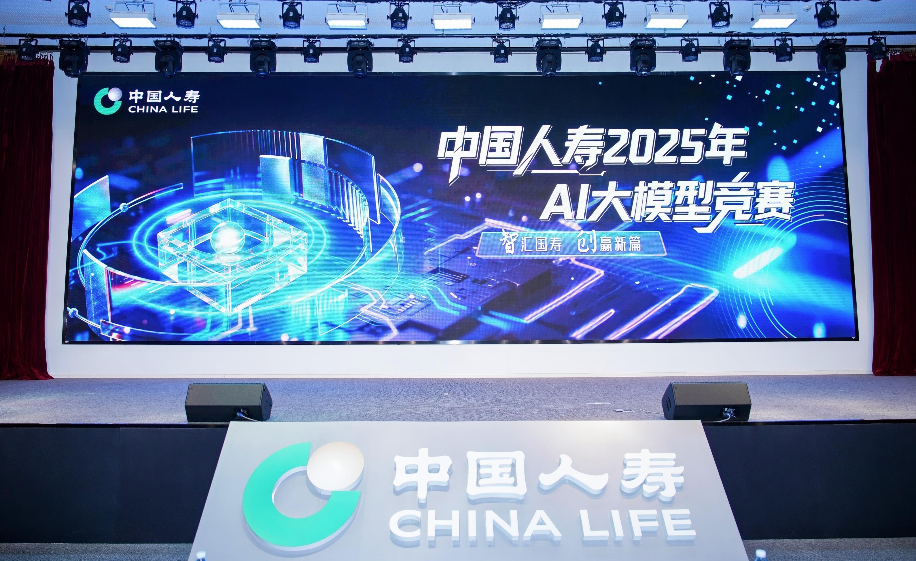
百名精英竞技:中国人寿AI大赛掀开“人工智能+保险”新篇章
Jin Rong Jie· 2025-12-25 04:18
Core Viewpoint - China Life Insurance Company successfully held its first AI model competition, aligning with national strategies for technological and financial advancement, and aiming to enhance its digital capabilities and productivity [1][3]. Group 1: Event Overview - The AI model competition featured 39 elite teams and 117 technology professionals from various branches of China Life, focusing on practical AI models and solutions relevant to the insurance industry [3]. - The event is part of China Life's "333 strategy" and aims to promote the integration of AI technology with insurance business, contributing to the development of a smart and efficient digital financial system [3][5]. Group 2: Competition Details - The competition lasted nearly 8 hours and was centered around the theme of "AI + Insurance," assessing teams on their understanding of large models, algorithm application, and engineering implementation [5]. - An automated online scoring platform was used to evaluate both technical proficiency and innovative problem-solving skills, promoting the efficient conversion of technical capabilities into business value [5]. Group 3: Industry Implications - The competition reflects the accelerating integration of AI technology across the entire financial insurance sector, with China Life focusing on building innovative mechanisms to enhance its unique productivity in life insurance [7]. - By hosting such competitions, the company aims to consolidate internal technical consensus, refine talent, and validate technology platforms, laying a solid foundation for the large-scale and in-depth application of AI [7].


报告下载丨2025数据智能体实践指南:技术架构、应用场景、实施路径
Sou Hu Cai Jing· 2025-11-27 13:14
Core Insights - The article presents a practical guide developed by Volcano Engine in collaboration with the China Academy of Information and Communications Technology, focusing on the end-to-end process of data intelligence implementation [1] - It breaks down the technical aspects into a core architecture of "data collection - processing - modeling - application," detailing the collaborative logic of modules such as multimodal data fusion and real-time inference engines [1] - The application scenarios cover vertical fields including manufacturing data monitoring, financial risk control, and government data governance, providing standards for scenario adaptation [1] - The implementation path is divided into three phases: "small-scale pilot - medium-scale expansion - large-scale deployment," offering resource allocation and evaluation metrics for enterprises of different sizes [1] - The guide addresses core pain points such as cross-system integration and privacy compliance, providing a standardized framework for data departments and digital transformation leaders [1] Section Summaries Section 1: Cognitive Reconstruction - The section discusses the current state of the industry, highlighting deep-seated challenges beneath the surface of apparent prosperity [3] - It identifies three common misconceptions about the essence of AI and emphasizes a paradigm shift from tool thinking to system thinking [3] Section 2: System Construction - This section defines the concept of data intelligence agents as "enterprise-level data experts" and introduces a six-dimensional capability model [4] - It also presents a maturity model for data intelligence agents, categorizing them into four levels (L1-L4) [4] Section 3: Value Realization - The section categorizes application scenarios and provides in-depth analysis of typical use cases, along with a value assessment system [4] - It outlines strategies for phased implementation and enterprise readiness evaluation [4] Section 4: Industry Outlook - This section discusses technological evolution trends and industry opportunities, including the evolution of industry patterns and key success factors [4] - It also suggests standards for capability maturity assessment and industry development recommendations [4]