数智红包

Search documents
90%的人不知道我店商家组团维权背后的真相
Sou Hu Cai Jing· 2026-01-14 10:52
Core Insights - The article discusses the challenges faced by the consumer incentive model in the digital transformation of physical businesses, highlighting issues such as fake transactions, imbalanced funding pools, and loss of user trust [1][7]. Industry Pain Points - The traditional "indiscriminate subsidy" model has led to a vicious cycle, detaching from real consumption scenarios and pushing the industry into a trap [5]. - This model encourages large-scale fake transactions, with over 60% of transactions being fraudulent in some platforms, leading to a decline in user trust and financial instability [7]. Key to Breakthrough - The company, 伯位数智, established a differentiated strategy focusing on "precise operations" by targeting 20% of high-value core consumers, moving away from broad traffic speculation [8][10]. Innovation Core - The "Smart Red Packet" system is a key mechanism that addresses the industry's pain points of "unreal incentives and funding mismanagement" [11]. - A restructured incentive weight system focuses on three core variables: repurchase frequency, merchant discount ratio, and new user acquisition, eliminating the single metric of "transaction amount" that can be exploited for fake transactions [12][15]. Ecological Value - 伯位数智's innovative model creates a sustainable three-way win ecosystem for consumers, merchants, and the platform [17]. - Consumers benefit from stable incentives for real consumption, merchants gain fair returns, and the platform reduces ineffective subsidies while ensuring financial security [17]. Conclusion - The article emphasizes that the vitality of the consumer incentive model lies in adhering to the principles of "real consumption and value equivalence," moving away from short-term speculative thinking to focus on genuine value service [19][20].

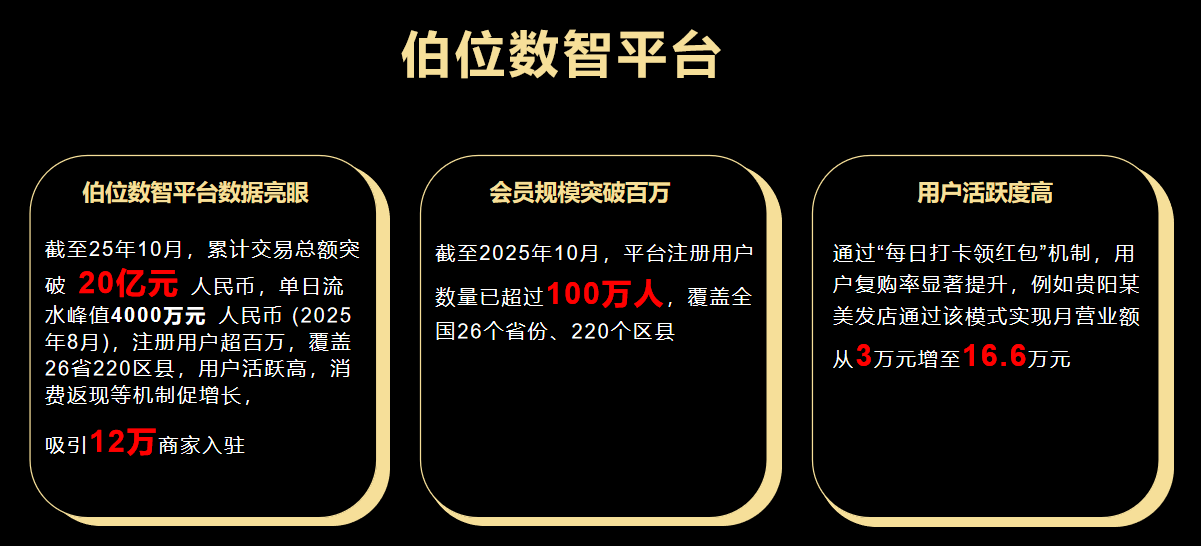
“数智红包”摘金大湾区:一套即时返利系统,如何连接12万商家与百万用户?
Sou Hu Cai Jing· 2025-12-18 10:38
Core Insights - The "Smart Red Packet" model by Berwei Digital has won a gold award at the Guangdong-Hong Kong-Macao Greater Bay Area Business Conference, showcasing its rapid growth and market acceptance in the digital commerce sector [1] - The model has expanded its operations to over 300 districts across 26 provinces in China, attracting more than 120,000 merchants and achieving over 1 million daily active members, with total transaction volume exceeding 2 billion yuan [1] Group 1: Innovative Model - The primary innovation of the "Smart Red Packet" model is transforming the rebate experience from a long-term promise to an immediate reward, enhancing user experience significantly [3] - The operational foundation is built on a triangular win-win model involving merchant discounts, platform empowerment, and user benefits [3] Group 2: Operational Mechanisms - Funding sources primarily come from voluntary discounts by merchants, typically ranging from 7% to 30% of the transaction amount, which directly contributes to the reward pool [4] - Users can receive cash red packets the day after their purchase by simply signing in on the platform, allowing for real-time withdrawals to WeChat Wallet, contrasting sharply with traditional points systems [4] - A weekend pause on red packet distribution is part of a dynamic risk control strategy, allowing the fund pool to stabilize and ensuring long-term operational sustainability [4] Group 3: Risk Control Systems - The core of the risk control system is a "circuit breaker" mechanism that automatically adjusts the release ratio of red packets if the daily distribution exceeds 30% of the fund pool balance [6] - An intelligent fund management system limits daily red packet releases to 20% of the total fund pool to prevent overdrawing [6] - A robust anti-cheating system and AI-driven real-time monitoring help identify and intercept suspicious transactions, ensuring rewards are directed towards genuine consumer activity [6] Group 4: Competitive Advantages - The dual-layered risk control through the "circuit breaker" and "weight algorithm" enhances the model's resilience and credibility, distancing it from unsustainable financial practices [9] - The straightforward cash experience and next-day withdrawal capability resonate well with users, driving higher participation and sharing compared to complex point systems [9] - For merchants, low fees represent cost savings, while cross-store revenue sharing creates a passive income stream, effectively aligning platform growth with merchant interests [9] Conclusion - The exploration of the "Smart Red Packet" model by Berwei Digital not only serves as an efficient business tool but also establishes a paradigm of "trustworthy incentives" in the digital age, fostering transparent, immediate, and sustainable value connections among consumers, physical merchants, and digital platforms [12]

数智红包模式:本地生活平台创新解决方案,破解四大行业痛点
Sou Hu Cai Jing· 2025-10-21 02:34
Core Insights - The "Smart Red Packet" model is an innovative solution in the local life service sector, addressing four major industry pain points through a funding pool design and a direct rebate mechanism, creating a win-win ecosystem for platforms, merchants, and consumers [1][9]. Mechanism Design - The model employs an "immediate rebate" incentive system where consumers receive rebates after spending at partner merchants, with the total rebate amount covering their spending over time [3]. - Merchants set discount rates based on industry characteristics, and rebates are distributed from a funding pool according to a weekday rebate mechanism [3]. - A cross-store consumption weighting mechanism encourages consumers to explore different merchants, enhancing consumption activity and driving traffic to merchants [3]. Pain Point Resolution - The model eliminates the motivation for fraudulent transactions by strictly limiting rebates to the merchant's discount range, thus addressing the issue of order inflation [7]. - It resolves the problem of diminishing rebate incentives in mature platforms by incentivizing continuous consumption through active user weighting [7]. - The design directly drives consumer exploration of new merchants, creating a positive cycle of "consumption - traffic generation - repurchase," which addresses the challenge of ineffective traffic generation in traditional platforms [7]. Value Innovation - The model establishes a sustainable ecosystem by ensuring credible distribution of commercial value, where consumers experience "consumption as investment," merchants achieve precise traffic generation, and platforms earn sustainable revenue through service fees and ecosystem operations [9]. - It signifies a shift in the consumption rebate model from "subsidy-driven" to "value co-creation," facilitating collaborative innovation in activating consumer vitality, empowering merchant operations, and optimizing platform management [9].