新能源汽车)

Search documents
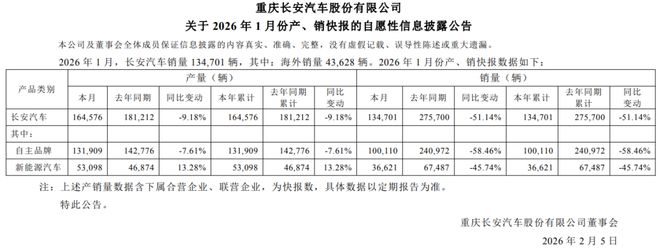
长安汽车1月销量腰斩
Di Yi Cai Jing Zi Xun· 2026-02-04 12:59
Summary of Key Points Core Viewpoint - Changan Automobile reported a significant decline in sales for January 2026, with total sales dropping by 51.14% year-on-year, indicating potential challenges in the market and operational performance [1][3]. Sales Performance - Total sales for Changan Automobile in January 2026 were 134,701 units, down from 275,700 units in the same month last year, reflecting a decrease of 51.14% [1][3]. - The sales of Changan's self-owned brands were 100,110 units, which is a 58.46% decline compared to 240,972 units in January 2025 [1][3]. - New energy vehicle sales reached 36,621 units, marking a 45.74% decrease from 67,487 units in the previous year [1][3]. Production Data - The production figures for Changan Automobile in January 2026 were 164,576 units, which is a 9.18% decrease from 181,212 units in January 2025 [3]. - The production of self-owned brands was 131,909 units, down 7.61% from 142,776 units year-on-year [3]. - New energy vehicle production increased by 13.28% to 53,098 units compared to 46,874 units in the same month last year [3].


长安汽车:1-7月销量156.59万辆,同比增长4.07%
Xin Lang Cai Jing· 2025-08-03 10:36
Core Insights - Changan Automobile reported a total sales volume of 210,604 units in July 2025, representing a year-on-year increase of 23.43% [1] - For the first seven months of 2025, the total sales reached 1,565,860 units, showing a growth of 4.07% compared to the same period last year, with overseas sales accounting for 348,825 units [1] - In July, the sales of domestic brands reached 177,689 units, marking a year-on-year increase of 27.69%, while the cumulative sales for the year stood at 1,328,331 units, up by 5.38% [1] - The sales of new energy vehicles in July reached 80,006 units, reflecting a significant year-on-year growth of 74.05%, with cumulative sales for the year at 531,720 units, an increase of 52.34% [1]
吴松泉:是时候彻底取消汽车限购了
Jing Ji Guan Cha Bao· 2025-07-29 03:46
Core Viewpoint - The necessity for comprehensive and thorough cancellation of car purchase restrictions and large-scale traffic control policies in major cities has become increasingly prominent, suggesting a shift from purchase management to usage management at the national level [4][10][11]. Group 1: Current Situation of Car Purchase Restrictions - Major cities like Beijing, Shanghai, Guangzhou, Shenzhen, Tianjin, and Hangzhou have implemented car purchase restrictions to alleviate traffic congestion and air pollution, which has been effective in slowing the growth of car ownership [2][5]. - The implementation of these policies has provided time and space for cities to enhance transportation infrastructure, optimize urban layouts, and improve traffic management [2][5]. Group 2: Improvements in Urban Traffic and Environmental Capacity - The traffic and environmental carrying capacity of major cities has significantly improved, with the market share of new energy vehicles (NEVs) gradually increasing, reducing the necessity for car purchase restrictions [5][6]. - Cities have adopted various measures, such as prioritizing public transport and enhancing infrastructure, which have led to a notable improvement in traffic congestion and air quality [6][8]. Group 3: International Experience and Governance Requirements - International experiences indicate that major cities in developed countries do not impose car purchase restrictions but instead focus on optimizing urban space and improving traffic management [7][8]. - The central government's requirements for modernizing governance systems and capabilities suggest that simple car purchase restrictions are inconsistent with broader governance goals [8][19]. Group 4: Economic Development and Domestic Demand Expansion - The current economic focus on expanding domestic demand contradicts the implementation of car purchase restrictions, which hinder the automotive industry's growth and the overall economy [11][18]. - The automotive industry plays a crucial role in driving domestic demand, and the limitations imposed by purchase restrictions are misaligned with national economic strategies [11][18]. Group 5: Legal Basis and Reform Requirements - The legal basis for car purchase restrictions has been controversial, and such policies are seen as a forced intervention in consumer behavior, conflicting with the principles of a fair market environment [19][20]. - The need for a more equitable market environment necessitates the removal of car purchase restrictions to align with legal and governance reforms [20][21].