无人机集群

Search documents
西安加速布局“新赛道” 培育新质生产力引领高质量发展
Zhong Guo Xin Wen Wang· 2026-02-04 14:18
Core Insights - Xi'an High-tech Zone has achieved steady economic growth since the 14th Five-Year Plan, with industrial output increasing from 203.5 billion to 421.1 billion, averaging a growth rate of 15% annually [1][2] Economic Performance - The industrial output of Xi'an High-tech Zone rose from 203.5 billion to 421.1 billion, with an annual growth rate of 15% [1] - The zone has ranked among the top ten in the national "High-Quality Development Top 100 Parks" for three consecutive years and is projected to be fifth in the national comprehensive evaluation of high-tech zones in 2024 [1] Technological Innovation - The zone has gathered advanced technologies, including femtosecond lasers and high-precision ground timing systems, and hosts the first national-level innovation platform in the new materials sector [2] - Over 6,000 national-level technology-based SMEs and high-tech enterprises have been cultivated, including 99 national-level specialized and innovative "little giant" enterprises [2] Industry Layout - Advanced manufacturing output has grown at an average rate of 15.6% during the 14th Five-Year Plan, with the digital economy's core industry scale surpassing 280 billion [2] - Emerging industries such as photonics, integrated circuits, new materials, and low-altitude economy are rapidly developing, with the photonics industry alone hosting 183 companies and generating over 20 billion in output [2] Key Sectors - The high-performance integrated circuit sector focuses on chip design and wafer manufacturing, leveraging leading companies like Samsung and ASE, and aims to create a world-class semiconductor industry cluster [2] - The high-end new materials sector, led by institutions like the Shaanxi Nonferrous Institute, aims to develop advanced rare metal materials and 3D printing materials [2] Low-altitude Economy - The low-altitude economy is centered around companies like Inno Aviation and Aerospace Power Research Institute, focusing on technologies such as turbofan engines and drone clusters [3] - The sector aims to establish a nationally influential low-altitude economic industrial cluster [3] High-end Medical Devices - The high-end medical device sector integrates technologies like 3D printing, photonics, and AI, collaborating with companies such as Juzhi Bio and Kangtuo Medical [3] - The goal is to create a comprehensive industrial base that facilitates the last mile of technology transfer [3] Support Measures - Five major support measures have been introduced to ensure the rapid growth of new tracks, including a dedicated mechanism for each track and annual funding of 100 million for future industries [3] - By 2028, the target for annual revenue growth in new tracks is set at 20%, aiming to strengthen technological breakthroughs and enterprise cultivation [3]
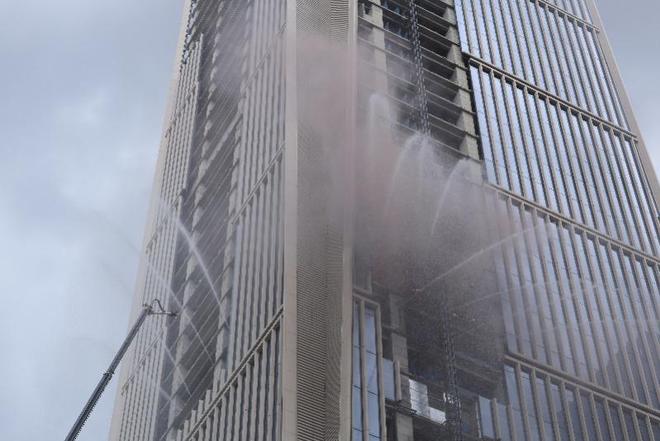
无人机灭火,AI赋能救援!多图直击广州高层建筑应急演练
Nan Fang Du Shi Bao· 2025-08-11 13:47
Core Viewpoint - The emergency drill held in Guangzhou focused on high-rise building fire rescue, showcasing the integration of advanced technologies such as drones, robots, and AI systems to enhance firefighting capabilities and ensure safety during the upcoming national sports event. Group 1: Emergency Drill Overview - The drill simulated a fire scenario caused by electrical faults on the 18th floor of the International Financial Trading Plaza, with flames spreading rapidly over 300 square meters within 10 minutes, leading to multiple individuals being trapped [3]. - The Guangzhou Fire Rescue Team activated a three-level fire alarm response, implementing a comprehensive action plan that included self-rescue, collaborative efforts, and professional intervention [3]. Group 2: Technological Integration - A combination of aerial and ground operations was established, utilizing a fleet of drones for various tasks: reconnaissance drones with thermal imaging to locate fire sources and trapped individuals, firefighting drones spraying foam from 150 meters high, and delivery drones providing essential supplies to victims [5]. - Ground operations featured robotic units, including quadruped robots and tracked firefighting robots, which conducted reconnaissance and firefighting tasks while ensuring a safe passage for human firefighters [7]. Group 3: AI and Communication Systems - An AI command system supported the rescue efforts by accessing 3D building models for decision-making, optimizing water supply routes, and maintaining communication across an integrated network to ensure effective coordination within the high-rise structure [10]. - The drill served as both a practical test of Guangzhou's high-rise firefighting capabilities and a preparatory exercise for the upcoming national sports event, emphasizing the commitment to safety and security [10].