日产Leaf

Search documents
油价暴涨的超级“赢家”:电动汽车
财联社· 2026-03-09 03:17
Core Viewpoint - The recent surge in oil prices may ultimately benefit electric vehicle (EV) manufacturers by enhancing the affordability of EVs, which is expected to be a key issue in 2026 [1][2]. Group 1: Oil Prices and EV Market Dynamics - As of last Friday, U.S. retail gasoline prices reached $3.25 per gallon, an increase of nearly $0.27 from the previous week, marking the largest increase since the Russia-Ukraine conflict four years ago [1]. - The cost of charging electric vehicles at public stations remains stable at approximately $0.39 per kilowatt-hour, with typical EVs able to travel about 33 miles per kilowatt-hour [1]. Group 2: Consumer Sentiment and Market Trends - The market initially anticipated a slowdown in U.S. EV sales by 2026, primarily due to the expiration of tax credit policies in September 2022, leading several automakers to reduce their EV investment plans [2]. - The average price of new electric vehicles in the U.S. dropped to $55,715 in January, a slight decrease from the previous year, while the average price of fuel vehicles rose by 1.9% to $49,191 [2]. Group 3: Consumer Adoption Challenges - Despite the interest in EVs, a survey indicated that only 16% of American adults are likely to purchase an electric vehicle as their next car, the lowest percentage in six years, with 63% expressing low likelihood of buying an EV [4]. - Among those interested in EVs, 77% cited fuel cost savings as their primary motivation, but concerns over costs, charging convenience, and range anxiety may limit short-term adoption [4]. Group 4: Industry Response and Future Outlook - Many automakers are making improvements to address consumer concerns, with agreements in place for EVs to utilize Tesla's extensive charging network, which is the largest in the U.S. [5]. - Companies like Ford and General Motors are also planning to offer more affordable electric vehicles to attract consumers [5].



“精简版”Model Y上线、定价3.999万美元,特斯拉欲借“平价车”冲销量
Bei Jing Shang Bao· 2025-10-08 08:58
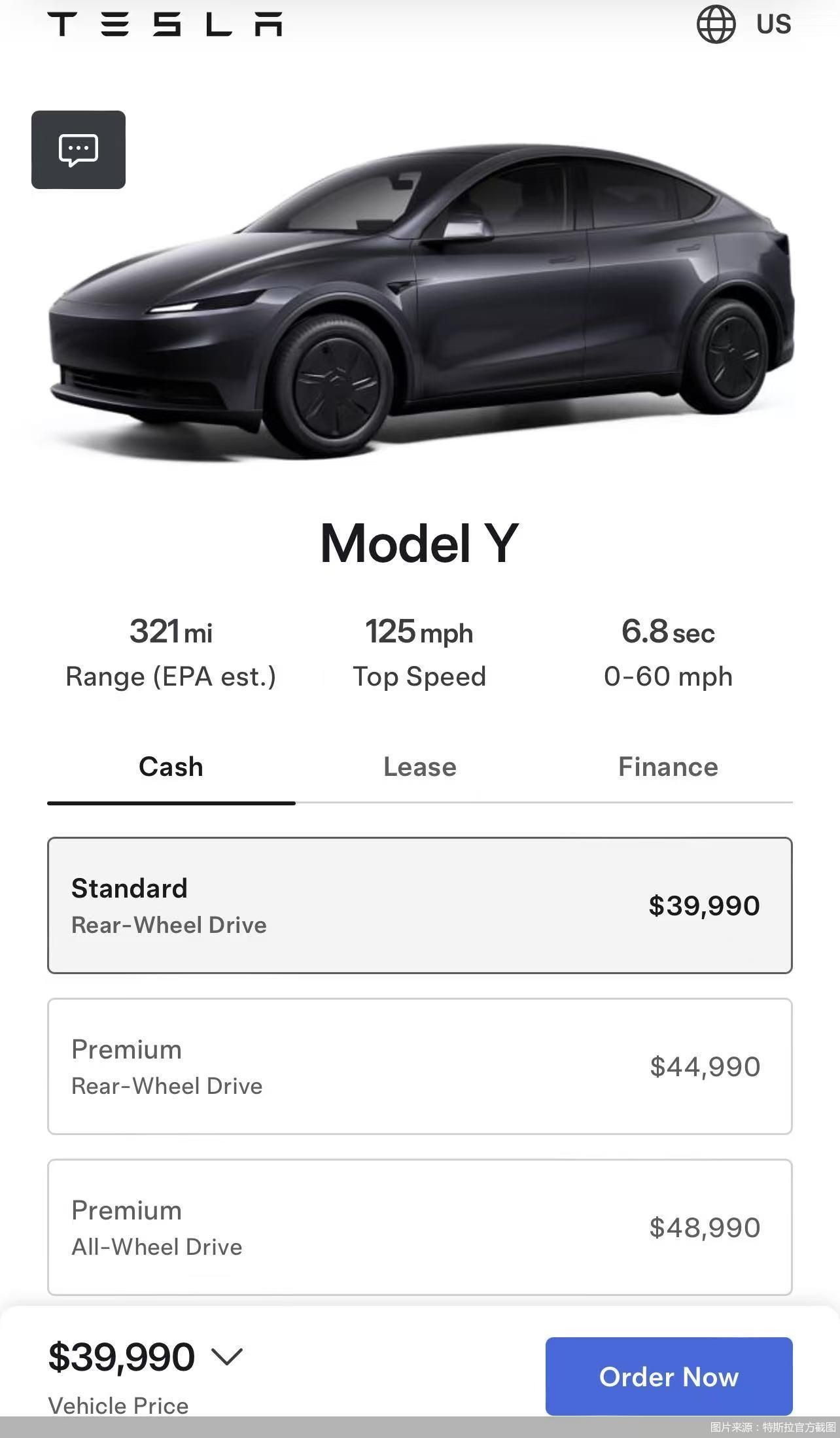
Core Insights - Tesla has launched the "Standard Version Model Y" and "Standard Version Model 3" in the U.S. market, priced at $39,990 and $36,990 respectively, marking a significant reduction in entry prices for these models [5][6] - The introduction of these models comes amid declining global deliveries, with a reported 384,000 units delivered in Q2, a 13% year-over-year decrease, indicating pressure on Tesla to boost sales [6][7] - The new models feature reduced specifications compared to previous versions, including a lower range and fewer premium features, leading to their classification as "simplified" versions [5][6] Pricing and Market Strategy - The Standard Version Model Y's price is $5,000 lower than previous models, with a range reduction from 357 miles to 321 miles, and several features downgraded [5][6] - The launch of these lower-priced models is seen as a strategic response to the recent removal of a $7,500 tax credit for electric vehicle purchases, which could impact Tesla's sales in the U.S. market [6] - Analysts have noted that while the new pricing is higher than the anticipated sub-$30,000 models, it still positions Tesla competitively against other affordable electric vehicles in the $30,000 to $40,000 range [6][7] Competitive Landscape - The introduction of the Standard Version Model Y and Model 3 places Tesla in direct competition with other manufacturers like Hyundai, Chevrolet, and Nissan, which have models priced within the same range [6][7] - Tesla's strategy to balance its model lineup and pricing reflects the increasing pressure from competitors as the electric vehicle market matures [7]