
日本国债(JGB)

Search documents
日本债市恐慌情绪重燃!高市早苗财政冒险遭遇投资者冷眼,市场担忧再度重演一月抛售潮
智通财经网· 2026-02-12 03:21
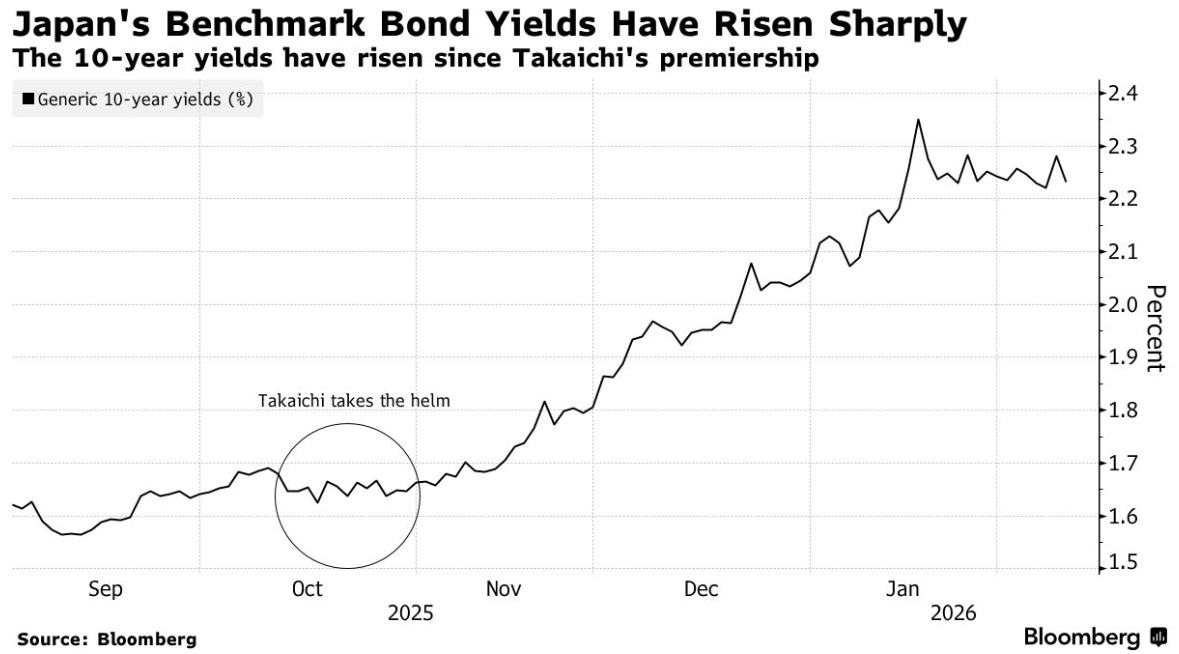
Core Viewpoint - Japanese Prime Minister Sanna Takashi's overwhelming election victory initially garnered positive investor reactions, but concerns remain regarding her expansionary spending plans potentially leading to market instability [1] Group 1: Economic Policies and Market Reactions - Takashi acknowledged market concerns about her plans to increase defense and strategic industry spending while also proposing a two-year suspension of the food sales tax [1][3] - Investors are wary of the potential for increased public debt, which previously caused bond yields to spike to multi-decade highs [1][2] - Ebury's market strategist Matthew Ryan noted that further spending and debt issuance could increase risk premiums and trigger a new round of bond sell-offs [2] Group 2: Funding Sources and Fiscal Responsibility - Takashi stated that her government would not fill spending gaps by issuing new bonds but would instead review subsidies and non-tax revenue sources for sustainable funding [3][6] - The Finance Minister pointed out that new bond issuance has been controlled below 30 trillion yen (approximately 195 billion USD) for the second consecutive year [6] - The estimated surplus from non-tax revenue for the current fiscal year is about 4.5 trillion yen, with 70% available for budget financing [6] Group 3: Debt and Economic Growth - Japan's debt exceeds twice its economic output, with debt servicing costs rising significantly, now accounting for a quarter of the annual budget [9] - The current debt-to-GDP ratio is approximately 230%, with the IMF predicting a budget deficit of 0.9% for last year, the lowest since 1992 [10] - The recent increase in tax revenue has more than doubled since the late 2000s, indicating a shift in fiscal health [15] Group 4: Market Dynamics and Central Bank Policies - The yield on Japan's benchmark 10-year government bonds has nearly doubled compared to the previous year, raising concerns about the government's cost burden due to higher interest rates [7][10] - The Bank of Japan's normalization of policies is increasing the vulnerability of long-term bonds, with global investors now accounting for 65% of monthly cash transactions in the Japanese bond market [16] - Takashi's government may face challenges in negotiating tax policies with opposition parties, potentially leaving room for alternative solutions to temporary tax cuts [16][17]

分析:日本国债收益率曲线可能在第四季度走陡
Xin Lang Cai Jing· 2026-02-02 06:44
Core Viewpoint - Morgan Stanley's research report indicates that the Japanese Government Bond (JGB) yield curve is likely to experience "bear steepening" in the fourth quarter due to strong U.S. economic growth and expectations of accelerated interest rate hikes by the Bank of Japan (BOJ) in 2026 [1][3]. Group 1: Economic Predictions - The U.S. economic team at Morgan Stanley has revised its growth forecast upward, citing strong signs of private consumption [1][3]. - The Japanese team anticipates that the BOJ will announce its next interest rate hike in June 2026 [1][3]. Group 2: Yield Forecasts - The firm expects the yield on 10-year Japanese government bonds to remain at 2.30% in the first and second quarters, rise to 2.45% in the third quarter, and then decrease to 2.40% in the fourth quarter [1][3]. - As of now, the 10-year JGB yield is reported at 2.270%, having increased by 2.5 basis points [2][4].
日债动荡之际 市场盯上1.8万亿美元“定海神针”:GPIF动向牵动全球市场
智通财经网· 2026-01-27 16:08
Core Viewpoint - The Japanese Government Pension Investment Fund (GPIF), with a size of $1.8 trillion, is being observed for potential adjustments in its asset allocation towards Japanese government bonds (JGB) to stabilize the market amid volatility and support the yen [1]. Group 1: GPIF's Role and Market Impact - GPIF is the largest pension fund globally and a significant indicator for Japanese institutional investors, with discussions around increasing JGB allocation to counter rising yields and support the yen [1][2]. - The fund currently holds approximately $400 billion in overseas bonds, and a shift towards JGB could signal a "funds return to Japan" theme, benefiting both JGB and the yen [1][3]. - Since Q4 2022, Japanese public pensions have net purchased about 28.2 trillion yen in government bonds, becoming a crucial stabilizing buyer in the domestic bond market as the Bank of Japan reduces its bond purchases [2]. Group 2: Asset Allocation and Strategy - GPIF typically evaluates its asset allocation every five years, maintaining a balanced structure of 50% in stocks and bonds, with equal distribution among Japanese and overseas assets [2]. - The fund's long-term target return is set to exceed nominal wage growth by 1.9 percentage points, with the possibility of strategic reassessment between evaluation periods [3]. - As of March 2025, 51.8% of GPIF's overseas bond holdings are U.S. Treasuries, the highest since 2015, indicating a trend of capital outflow driven by rising global yields and a weak yen [3]. Group 3: Market Sentiment and Future Considerations - Analysts suggest that even minor adjustments by GPIF could stabilize investor sentiment in the highly volatile long-term bond market [4]. - The presence of a clear "supporting force" in the bond market could help rebuild confidence among investors concerned about market volatility [5]. - There is caution among market experts regarding GPIF's potential large-scale increase in JGB holdings, emphasizing that investments should be based on risk-adjusted returns rather than currency competition [3].
日本国债与日元何时何故将迎来拐点?
Hua Er Jie Jian Wen· 2026-01-26 14:23
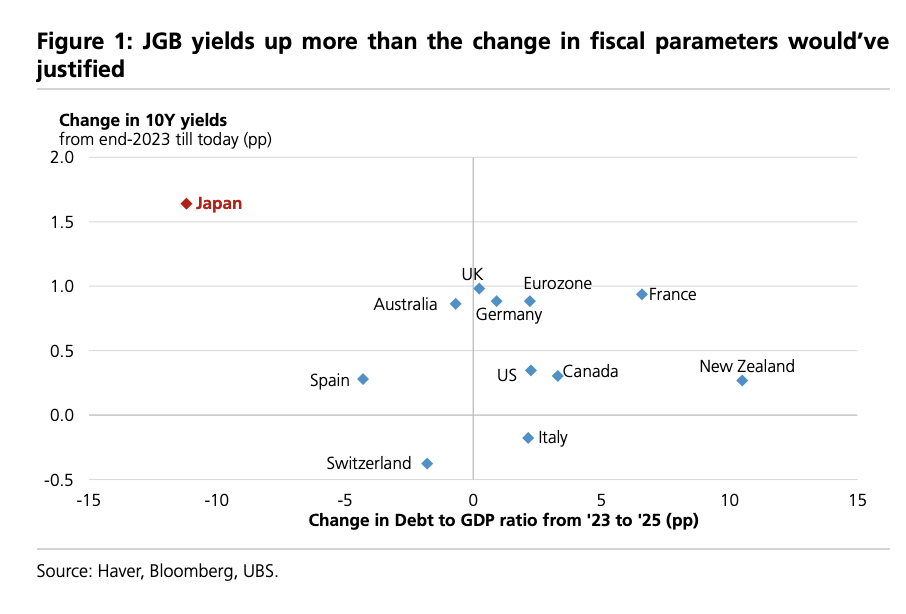
Core Viewpoint - UBS's latest global strategy report highlights that the recent sharp rise in Japanese Government Bond (JGB) yields has significantly exceeded what can be explained by fiscal fundamentals, primarily driven by a re-evaluation of inflation expectations. The report anticipates that inflation will cool to around 1.5% by mid-year, which will be a key turning point for JGB and yen trends [1][6][11]. Group 1: Market Signals - The volatility in JGB yields is not indicative of a systemic risk event similar to the UK's 2022 "Truss crisis," as the Japanese stock market remains resilient, suggesting investors should avoid panic selling in interest-sensitive sectors [1][20]. - With the attractiveness of JGB yields increasing, a significant repatriation of domestic funds from overseas bond markets is expected after the new fiscal year starts in April, leading to a reallocation towards Japanese government bonds [1][21]. - A decline in inflation will drive up real interest rates, providing support for the yen, as real rates have a more significant impact on exchange rates compared to nominal interest differentials [1][9][10]. Group 2: Fiscal Fundamentals - Despite concerns about Japan's fiscal situation, recent data shows a clear disconnect between the volatility in JGB yields and actual fiscal fundamentals. Japan's public debt as a percentage of GDP has decreased by 11 percentage points since 2023, while the average for developed economies has increased by 2 percentage points [2][5]. - Japan's fiscal deficit is projected to be around 2% of GDP by 2026, significantly lower than the developed economies' average of 4.9%. Additionally, Japan's government interest payments account for only 1.3% of GDP, compared to 3.3% for developed economies [2][5]. Group 3: Inflation and Interest Rates - The surge in JGB yields is primarily driven by market inflation expectations rather than fiscal deficit pressures. Current inflation in Japan is mainly influenced by structural factors such as food prices, while underlying service sector inflation remains around 1% [6][11]. - If inflation cools as expected, it will more effectively enhance real yields than the Bank of Japan's interest rate policies, thereby providing crucial support for both JGBs and the yen [9][16]. Group 4: Market Dynamics - The traditional correlation between the yen and nominal interest rate differentials has weakened, with real interest rate differentials now serving as the core anchor for pricing. The theoretical value of USD/JPY based on real interest differentials aligns closely with current market rates [13][16]. - Japan's external position remains robust, with a net international investment position of +92% of GDP, contrasting sharply with the UK's -2.6% during its crisis. Japan also maintains a current account surplus of 4.8% of GDP, providing a stronger buffer against market volatility [17][20]. Group 5: Investment Trends - The primary risk to the market is not foreign investors selling JGBs but rather the potential large-scale repatriation of domestic funds from overseas bond markets, as JGB yields have surpassed globally hedged bond yields [21]. - The Japanese stock market shows significant structural differentiation, with a few stocks contributing to the majority of the Nikkei 225 index's gains, indicating a concentrated market driven by foreign investors and corporate buybacks, while domestic investors remain net sellers [21].

“做多底特律”!美银Hartnett:以史为鉴,接棒黄金的最佳策略
Hua Er Jie Jian Wen· 2026-01-26 08:51
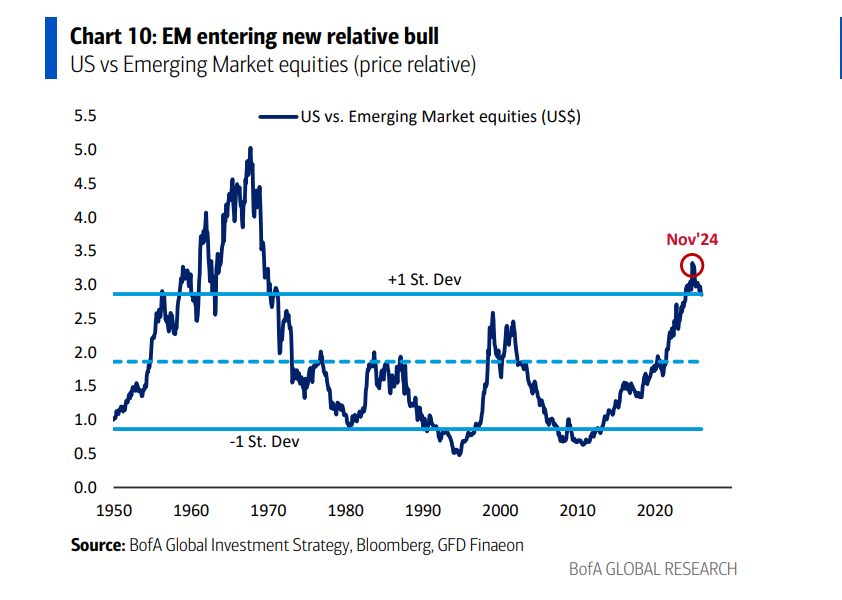
Core Viewpoint - Bank of America signals a tactical sell signal despite the "bull-bear indicator" being in an extremely bullish zone (9.2), suggesting investors should rotate rather than retreat, focusing on small-cap stocks and real economy sectors over large-cap and tech stocks [1][14]. Group 1: Market Trends - The current market sentiment indicates that while the selection of the new Federal Reserve Chair typically leads to yield fluctuations, it is believed that the new chair in 2026 will not allow the 30-year Treasury yield to exceed the 5% "safe haven" level due to interventions like quantitative easing (QE) and yield curve control (YCC) [2]. - The bond market is experiencing a severe bear market, with the price of 30-year U.S. Treasuries dropping by 50% and Japanese government bonds (JGB) falling by 45% since the beginning of the 2020s [3]. Group 2: Fund Flows - Despite rising yields, the bond market recorded an inflow of $15.4 billion, while gold saw inflows of $4.9 billion. Conversely, U.S. equities experienced an outflow of $16.8 billion, marking the first outflow in two weeks [4]. - The bear market in bonds has led to a bull market for U.S. tech stocks, European/Japanese bank stocks, and gold in the first half of the decade, while emerging markets (EM) and small-cap stocks are expected to benefit in the latter half [4]. Group 3: Investment Strategy - The core strategy of "buying Detroit and shorting Davos" emphasizes a bullish outlook on U.S. small-cap stocks until 2027, supported by four pillars: global macro trends, extreme capital outflows from Japan, undervaluation of small-cap stocks, and government interventions to control costs [10][11]. - Historical comparisons suggest that the current situation resembles the 1970s, where initially gold thrived, followed by small-cap stocks becoming the best-performing assets [7]. Group 4: Emerging Markets and Capital Flows - Capital is flowing from weak Asian currencies to U.S. and European assets, with South Korean retail investors having invested nearly $100 billion in U.S. stocks since 2019 [16]. - The long-term bull market for international stocks is entering its second year, driven by strong commodity prices and a strengthening of emerging market currencies, which is expected to lower emerging market bond yields and propel emerging market stocks into a new relative bull market [16].
加息难阻颓势 高市早苗政策被批动摇日元信用根基
Sou Hu Cai Jing· 2025-12-24 16:34
Core Viewpoint - The recent decline in support for Prime Minister Fumio Kishida's cabinet reflects growing concerns over Japan's economic policies and the effectiveness of the Bank of Japan's monetary strategies [1][5][6]. Group 1: Economic Indicators - The latest public opinion poll shows Kishida's cabinet support rate at 67.5%, down 2.4 percentage points from November, with a disapproval rate of 20.4% [1]. - The Japanese yen has been on a downward trend, recently trading at 157.76 yen per dollar, marking a significant depreciation of 20% compared to three years ago [1]. - Following a 25 basis point interest rate hike by the Bank of Japan, the 10-year government bond yield rose to 2.020%, the highest since August 1999 [3]. Group 2: Monetary Policy and Market Reactions - Economists note that the recent interest rate hike was conservative, failing to instill confidence in the market regarding the government's policies [2][3]. - The Bank of Japan's commitment to maintaining loose financial conditions has led to skepticism about the effectiveness of its monetary policy in controlling inflation and stabilizing the yen [3][4]. - The yield on long-term Japanese government bonds has reached a 26-year high, indicating a lack of investor confidence in domestic bonds [4]. Group 3: Fiscal Policy Concerns - Kishida's government has approved an additional budget of 18.3 trillion yen to support economic stimulus, with 11.7 trillion yen financed through new bond issuance, raising concerns about Japan's fiscal health [5][6]. - There is apprehension among investors regarding Japan's public debt, with projections suggesting that the debt-to-GDP ratio could rise from 215% to 230% by 2030 if current fiscal policies persist [6]. - The government's lack of a clear plan for debt repayment has led to market skepticism about its fiscal responsibility [6]. Group 4: Future Outlook - Analysts predict that the Bank of Japan may raise interest rates twice next year, potentially reaching 1.25%, but any significant intervention in the foreign exchange market may depend on the yen's performance against the dollar [8]. - The finance minister has indicated that the government has room to take decisive action in response to currency fluctuations, hinting at possible direct market interventions [7].
Market analysts reaction to Japan's ruling coalition split
Yahoo Finance· 2025-10-10 09:26
Core Viewpoint - The breakup of Japan's ruling coalition raises uncertainty regarding the political landscape and economic outlook, particularly concerning the premiership bid of Sanae Takaichi, the new hardline leader of the Liberal Democratic Party [1] Market Reaction - The yen strengthened by up to 0.5% to 152.38 per dollar following the coalition split, although it was last trading at 152.73 [2] - The yield on the two-year Japanese government bond (JGB) decreased by 2 basis points to 0.905%, while the 30-year JGB yield increased by 5 basis points to 3.225% [2] Analyst Comments - Shoki Omori from Mizuho Securities indicated that if Takaichi fails to become Prime Minister and a pro-BOJ tightening candidate emerges, the market may start to price in the risk of a reversal, potentially pushing USD/JPY down, although the yen is expected to remain a funding/carry currency [2][3] - Bart Wakabayashi from State Street noted that aggressive selling of the yen occurred based on Takaichi's campaign, and the market will react if there is no consensus on her approval as Prime Minister [3] - Naka Matsuzawa from Nomura Securities mentioned that the immediate market reaction involves unwinding Takaichi trades, with two potential scenarios: the LDP retaining a solo cabinet or forming a coalition with the DPP, which could lead to a resurgence of Takaichi trades if fiscal expansion is supported [4]
日本央行加息“急刹车”?52%经济学家:2026年前别指望了
Jin Shi Shu Ju· 2025-06-11 09:57
Core Viewpoint - The Bank of Japan is likely to delay its interest rate hike plans for this year due to uncertainties surrounding U.S. tariff policies, with economists predicting the next rate increase will occur in the first quarter of 2026, with a potential increase of 25 basis points [1][2]. Group 1: Interest Rate Predictions - A slight majority of economists (52%) expect that the Bank of Japan will maintain borrowing costs at 0.50% by the end of this year, a shift from previous expectations of a rise to 0.75% [1]. - Over three-quarters of respondents (40 out of 51) predict at least one rate hike by the end of March next year, with 37% forecasting the next hike in January 2025 [2]. - The interest rate futures market currently reflects an expectation of approximately 17 basis points of rate increases within this year [1]. Group 2: Government Bond Purchases - A majority of economists (17 out of 31) believe that the Bank of Japan will slow down its current quarterly reduction of approximately 4 trillion yen in government bond purchases after April next year [2][3]. - The Bank of Japan still holds about half of the outstanding Japanese Government Bonds (JGB), but has begun to reduce its purchases to move away from decades of large-scale stimulus [3]. Group 3: Long-term Bond Issuance - 75% of economists (21 out of 28) anticipate that the government will reduce the issuance of ultra-long-term bonds, with concerns over rising debt levels and declining demand from traditional buyers [3]. - The government is reportedly considering repurchasing some ultra-long-term bonds issued during low-interest periods and plans to cut the issuance of these bonds in response to rapidly rising yields [3][4].