
易方达纳斯达克100ETF

Search documents
SpaceX即将上市,“七巨头”变“八巨头”!纳指基金是否要布局?
Sou Hu Cai Jing· 2025-12-12 09:13
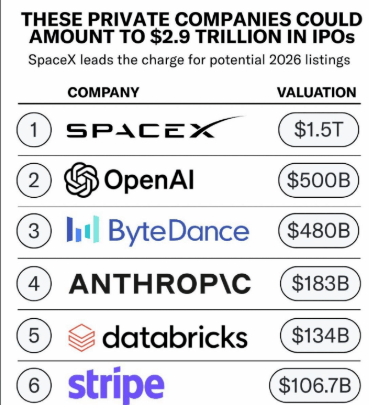
Group 1 - The "Nasdaq Seven Giants" refers to the seven largest tech growth companies in the US stock market, including Apple, Google, Amazon, and Nvidia, which collectively account for over 40% of the Nasdaq 100 index weight, making them core assets of Nasdaq [1] - Elon Musk confirmed that SpaceX plans to raise hundreds of billions through an IPO in 2026, with a target valuation of $1.5 trillion, potentially making it the largest IPO in history, surpassing Saudi Aramco's record [1][3] - If SpaceX successfully goes public, it is expected to drive the Nasdaq 100 index to unprecedented heights, especially with the recent interest rate cuts by the Federal Reserve, indicating continued favorable market liquidity [4] Group 2 - Current market capitalizations of the Nasdaq Seven Giants include Nvidia at approximately 4.396 trillion, Apple at 4.108 trillion, Google Class C at 3.785 trillion, and Microsoft at 3.593 trillion, among others [4] - Historical performance of the Nasdaq 100 index shows resilience, having recovered from significant downturns during the dot-com bubble, the 2008 financial crisis, and the COVID-19 pandemic, indicating the enduring value of the tech sector [5] - Various Nasdaq 100 index funds have been analyzed, with the top performers over the past year being E Fund Nasdaq 100 ETF (159696) with a return of 14.57% and China Merchants Nasdaq 100 ETF (159659) with a return of 14.54% [9][10] Group 3 - The analysis of Nasdaq 100 index funds highlights that E Fund Nasdaq 100 ETF has the best performance among peers, while China Merchants Nasdaq 100 ETF shows good tracking error control, making them suitable for investors seeking high returns with moderate risk [9][10] - The report emphasizes the importance of considering fund liquidity and management fees when selecting Nasdaq 100 index funds, with several funds having over 40 billion in assets [8] - Investors are advised to be cautious of potential premiums and restrictions on daily subscription amounts for certain Nasdaq ETFs due to foreign exchange quota limitations, suggesting a strategic approach to investment [12]

别忙着“抄底”!多只QDII-ETF临时停牌,溢价率仍在高位
Xin Lang Cai Jing· 2025-11-28 04:00
Core Viewpoint - The QDII funds are experiencing a surge in demand despite multiple warnings about high premium risks, with many funds suspending subscriptions to protect existing investors [1][3]. Group 1: QDII Fund Premium Risks - On November 27, 15 public funds issued 38 warnings regarding high premium risks for QDII funds, affecting over 20 products, primarily linked to indices like the Nasdaq 100 and S&P 500 [1]. - The Huaxia Nikkei 225 ETF issued 32 premium risk warnings in November, while the Invesco Nasdaq Technology ETF issued over 20 warnings [1]. - As of November 27, 50 out of 85 QDII-ETF funds remained in a premium state, with the highest premium rate at 17.52% for the Invesco Nasdaq Technology ETF [1][2]. Group 2: Subscription Suspensions and Fund Management - A total of 165 QDII funds have suspended subscriptions or large subscriptions as of November 27, with some funds implementing strict purchase limits due to limited QDII quotas [3]. - The Huazhong Mitsubishi Nikkei 225 ETF has progressively reduced its daily purchase limit from 100 yuan to 10 yuan [3]. - The limited QDII quotas have led to strict allocation based on fund performance, with high premium products facing tighter purchase restrictions to prevent losses for new investors [3]. Group 3: Market Dynamics and Investor Behavior - The high premium rates are attributed to the disappearance of the arbitrage mechanism for QDII-ETFs, as the redemption process involves additional costs and uncertainties [4]. - Investors are advised to remain calm and avoid panic buying due to product subscription limits, focusing instead on products with open subscription channels and lower premium rates [5]. - The recent volatility in the U.S. stock market, influenced by Federal Reserve signals and concerns over AI bubbles, may continue to affect market dynamics in December [5].
