智利冰鲜三文鱼

Search documents
杭州空港口岸进口冰鲜水产品“鲜”速直达
Mei Ri Shang Bao· 2026-01-09 02:32
Core Insights - The import of fresh Chilean salmon through Hangzhou Xiaoshan International Airport has significantly increased, with a focus on efficient customs supervision and logistics systems [1][2] - The airport has established a scale of operations for importing fresh seafood, with a new regulatory site set to enhance customs efficiency by 2025 [1] - The core competitiveness of fresh products lies in speed and freshness, which directly impacts quality and market reputation [1] Industry Developments - Hangzhou Xiaoshan International Airport currently operates 20 dedicated cargo routes, with approximately 120 flights per week, facilitating cross-border transport of fresh seafood [2] - The airport's import of fresh seafood has seen explosive growth, with 1,492 batches and 5,606 tons imported in 2025, representing a year-on-year increase of 61 times and 81 times, respectively [2] - Future plans include optimizing regulatory processes to support the growth of cross-border logistics and enhance the quality of imported goods [2]
新年首批智利三文鱼 飞抵杭州
Hang Zhou Ri Bao· 2026-01-06 02:50
Core Viewpoint - The import of fresh salmon from Chile to Hangzhou has significantly increased, highlighting the efficiency of customs operations and the importance of maintaining product quality for market competitiveness [1] Group 1: Import Operations - A shipment of 5.36 tons of fresh salmon from Chile arrived at Hangzhou Xiaoshan International Airport, emphasizing the importance of speed and freshness for ice-fresh products [1] - The customs operations at Hangzhou Xiaoshan Airport are designed to ensure zero delay in the transfer of goods from landing to inspection, with a dedicated regulatory area set to be fully operational by 2025 [1] Group 2: Quality Control - Inspections are conducted in a temperature-controlled environment at 4 degrees Celsius, adhering to strict cold chain management requirements to ensure food safety and product quality [1] - The efficient customs experience is attributed to the continuous improvement of the airport's functions and the development of its cargo network [1] Group 3: Growth in Fresh Produce Imports - In 2025, the Hangzhou airport customs supervised a total of 1,492 batches of imported ice-fresh seafood, weighing 5,606.39 tons, representing a year-on-year increase of 61 times in batches and 81 times in weight [1] - The enhancement of port efficiency has directly contributed to the growth of the imported fresh produce business [1]
特稿丨一“桥”飞架助联通——中国阿根廷直航航线首周运营观察
Xin Hua She· 2025-12-15 06:46
Core Insights - The newly launched direct flight route between China and Argentina has successfully completed its first week of operations, marking a significant milestone in enhancing trade and cultural exchanges between the two regions [1][2]. Group 1: Operational Efficiency - The new route, operated by China Eastern Airlines, connects Shanghai to Buenos Aires via Auckland, reducing travel time from nearly 30 hours to approximately 25 hours, thus improving travel efficiency [2]. - The first flight recorded a high passenger load factor of 96%, indicating strong market interest, which has now shifted from initial curiosity to practical business planning [2]. Group 2: Logistics and Trade Opportunities - The inaugural return flight transported 2.1 tons of Argentine cherries and 10.5 tons of Chilean salmon, showcasing the potential for high-value logistics along this route [3]. - Subsequent flights have seen a 70% increase in cargo volume compared to the inaugural flight, with significant growth in e-commerce goods and precision instruments [3]. - The direct flight has enabled Argentine exporters to view Shanghai as a logistics hub for accessing the broader Asian market, enhancing their export capabilities [3]. Group 3: Collaborative Potential - The opening of this route is seen as a starting point for deeper cooperation, with plans for over 50 coordinated routes between China Eastern Airlines and Aerolineas Argentinas [5]. - The direct flight is expected to boost tourism from China to Argentina, particularly during the Southern Hemisphere's summer, creating new opportunities for the tourism industry [5]. - The route is positioned as a multi-dimensional bridge that fosters personnel exchanges, trade reciprocity, and cultural understanding, with the potential for further integration into global aviation and economic systems [5].

一“桥”飞架助联通——中国阿根廷直航航线首周运营观察
Bei Jing Ri Bao Ke Hu Duan· 2025-12-13 04:54
Core Insights - The launch of the direct flight route between China and Argentina marks a significant development in enhancing trade and cultural exchanges, with the route being recognized as the longest commercial flight globally [1][5]. Group 1: Flight Operations and Market Response - The new route operated by China Eastern Airlines connects Shanghai, Auckland, and Buenos Aires, reducing travel time from nearly 30 hours to approximately 25 hours, thus improving travel efficiency [2]. - The inaugural flight achieved a remarkable 96% seat occupancy, indicating strong market interest, which has now shifted from initial excitement to practical business planning [2]. - Increased inquiries from South American business professionals for market visits and exhibitions in China have been noted, highlighting the route's role in facilitating business interactions [2]. Group 2: Logistics and Supply Chain Benefits - The first return flight transported 2.1 tons of cherries from Argentina and 10.5 tons of Chilean salmon, showcasing the route's potential for high-value logistics [3]. - Subsequent flights have seen a 70% increase in cargo volume compared to the inaugural flight, with significant growth in e-commerce goods and precision instruments [3]. - The direct flight has enabled Argentine exporters to view Shanghai as a logistics hub for accessing the broader Asian market, enhancing supply chain reliability and reducing product loss risks [3]. Group 3: Broader Economic and Cultural Implications - The opening of the route is seen as a starting point for deeper cooperation, with plans for over 50 coordinated routes between China Eastern Airlines and Aerolineas Argentinas [4]. - The direct flight is expected to boost tourism from China to Argentina, particularly during the Southern Hemisphere's summer, providing new opportunities for the tourism industry [5]. - The route is positioned as a bridge for promoting personnel exchanges, trade reciprocity, and cultural understanding, with expectations for increased flight frequency and collaborative efforts [5].
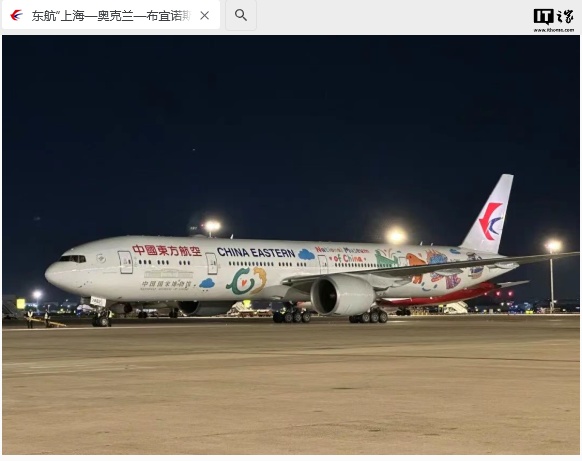
全球最长单程航线首个回程航班落地上海,运回 2.1 吨车厘子和 10.5 吨三文鱼
Xin Lang Cai Jing· 2025-12-07 22:24
Core Viewpoint - China Eastern Airlines has launched the world's longest one-way flight route from Shanghai to Buenos Aires via Auckland, establishing a new air corridor for cross-border fresh produce between China and Latin America [1][4] Group 1: Route Details - The new route covers a distance of 20,000 kilometers, filling the gap for direct flights from Shanghai to key cities in South America [1] - The inaugural return flight transported 2.1 tons of Argentine cherries and 10.5 tons of Chilean salmon back to Shanghai [1] - The route is operated by a Boeing 777-300ER aircraft, with flights scheduled twice a week in each direction [4] Group 2: Operational Efficiency - The new "southbound corridor" via Auckland optimizes the previous "northbound route" that required layovers in Europe or North America, reducing the travel time from nearly 30 hours to about 25 hours [4] - The flight schedule includes departures from Shanghai on Mondays and Thursdays, and from Buenos Aires on Tuesdays and Fridays, enhancing convenience for travelers [4]