
智能养老家居产品

Search documents
八部门发文促进银发经济发展 这些赛道迎来风口
Mei Ri Jing Ji Xin Wen· 2026-01-13 16:17
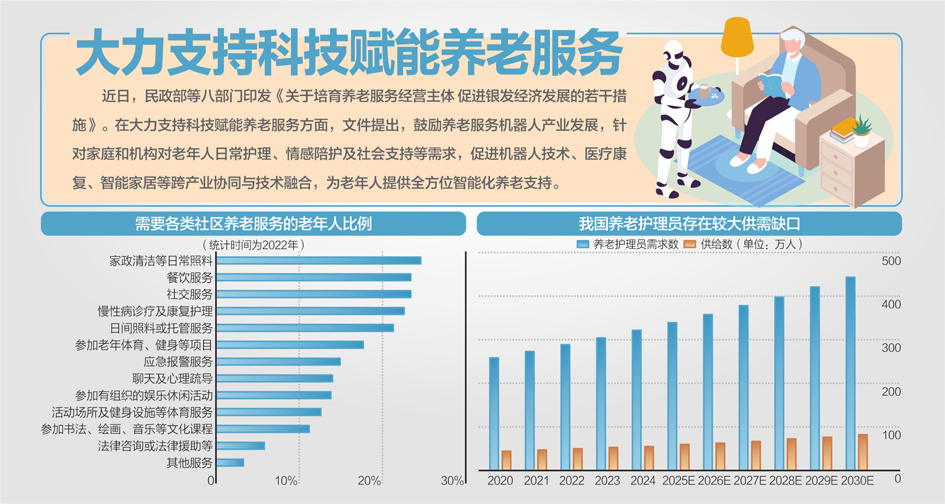
Core Viewpoint - The Ministry of Civil Affairs and eight other departments have jointly issued measures to stimulate the vitality of various elderly care service providers, create a favorable investment environment, and promote the development of the silver economy to better meet the diverse needs of the elderly [1][3] Group 1: Policy Measures - The measures aim to optimize the supply of elderly care services and age-friendly products, encouraging community-based operations and integration of resources to enhance service delivery [4] - The initiative supports the development of home care services for the elderly, including professional medical accompaniment and mobile bathing services [4] - There is a focus on promoting smart rehabilitation aids and age-appropriate food and clothing products, enhancing the living environment for the elderly [4] Group 2: Market Dynamics - By the end of 2025, there will be 41,700 elderly care institutions in China, with 722,000 employees, reflecting a 12.2% year-on-year increase, and 52.2% of these institutions will be privately owned [5] - Social forces are becoming the main contributors to the diversified supply of elderly care services, indicating a shift in the service landscape [5] Group 3: Technological Support - The measures encourage technological advancements in elderly care, integrating big data, AI, and other technologies for health monitoring and personalized services [6] - There is a push for the development of elderly care robots and smart home technologies to meet the daily care and emotional support needs of the elderly [6] - The market is expected to see new opportunities driven by the integration of technology in elderly care, with a focus on smart home products and AI solutions [7]

八部门发文促进银发经济发展
Mei Ri Jing Ji Xin Wen· 2026-01-13 12:33
Core Viewpoint - The Ministry of Civil Affairs and eight other departments have jointly issued measures to stimulate the vitality of various elderly care service providers, promote the development of the silver economy, and better meet the diverse needs of the elderly population [1] Group 1: Policy Measures - The measures aim to create a favorable environment for investment and entrepreneurship in the elderly care sector, encouraging the development of community-based services through chain operations [1][2] - The initiative emphasizes the importance of home care services for the elderly, promoting the integration of resources within communities to enhance service delivery [2] Group 2: Market Dynamics - By the end of 2025, there will be approximately 41,700 elderly care institutions in China, with 722,000 employees, reflecting a year-on-year growth of 12.2% [3] - Private elderly care institutions account for 52.2% of the total, indicating that social forces are becoming the mainstay of diversified elderly care service supply [3] Group 3: Technological Support - The measures encourage technological advancements in elderly care, including the application of big data, cloud computing, and artificial intelligence for health monitoring and personalized services [4] - There is a focus on developing smart elderly care products and robotics to meet the daily care and emotional support needs of the elderly [4] Group 4: Investment Opportunities - The push for technology-enabled elderly care services is expected to create new investment opportunities in the capital market [5] - Research indicates that the demand for smart elderly care products is increasing, driven by policy support and the advancement of AI technology [6]