
新兴材料技术

Search documents
财政部等部委明确:杜绝“玻璃门”排斥这类主体
Xin Lang Cai Jing· 2026-02-02 14:56
Core Viewpoint - The joint measures issued by multiple government departments aim to cultivate the elderly care service industry and promote the silver economy, ensuring fair competition and market vitality in the sector [1][3]. Group 1: Brand Development - Support for the establishment of distinctive branding for chain elderly care service providers to enhance brand recognition [4]. - Encouragement for elderly care service providers to implement trademark strategies and protect their brands [4]. - Promotion of quality elderly care brands through various initiatives to create leading enterprises in the sector [4]. Group 2: Market Supply and Demand - Optimization of elderly care services and products to meet community needs, including home care services and specialized medical assistance [6]. - Development of platforms for supply and demand matching in the elderly care market, enhancing resource utilization and facilitating connections among stakeholders [6]. Group 3: Technological Empowerment - Encouragement for technological advancements in elderly care, including the use of AI, big data, and robotics to enhance service delivery [7]. - Support for the application and testing of smart elderly care products within service institutions to improve user experience [7]. Group 4: Development Environment Optimization - Creation of a fair competitive environment by prohibiting restrictive clauses in government procurement processes for elderly care services [8]. - Establishment of standards and certification systems for elderly care products and services to ensure quality and safety [8]. Group 5: Support Measures - Improvement of government services for elderly care providers, including streamlined licensing processes and access to information on policies and resources [11]. - Provision of land and operational support for elderly care facilities, prioritizing areas based on local aging population needs [11].
光伏出口退税将取消,谷歌为苹果AI提供支持 | 财经日日评
吴晓波频道· 2026-01-14 00:29
Group 1: Photovoltaic Industry - The export tax rebate for photovoltaic products will be fully canceled starting April 1, 2026, increasing export costs for companies [2] - The export tax rebate for photovoltaic silicon wafers, batteries, and modules was previously reduced from 13% to 9% in December 2024, indicating a trend of declining export tax rates [2] - The Chinese photovoltaic industry has seen a decrease in export prices since 2024, leading to a "volume increase, price decrease" situation, with some companies passing on rebate amounts to foreign buyers, resulting in profit loss [2][3] - The cancellation of export tax rebates aims to promote rational competition in the photovoltaic industry and curb excessive price declines [3] Group 2: Elderly Care Robotics - Eight departments, including the Ministry of Civil Affairs, have issued measures to encourage the development of the elderly care robotics industry, promoting technological integration across various sectors [4] - The initiative aims to provide comprehensive intelligent support for the elderly, leveraging technologies such as embodied intelligence and new materials [4][5] - The market for elderly care technology products and services is expected to expand rapidly, although current technology maturity remains insufficient [5] Group 3: Real Estate Market in Tianjin - Tianjin will tighten control over new housing prices, limiting price changes to within 10% of the registered price for new sales permits [6] - The city has previously implemented price control measures to stabilize housing prices, with over 20 cities having introduced similar "price drop limits" [6][7] - The new management approach aims to control both price increases and decreases, although enforcing price decreases may face challenges [6] Group 4: AI and Technology Collaborations - Google and Apple have entered a strategic partnership, with Google's Gemini model being used to support Apple's AI developments, including Siri [8] - Apple is expected to pay approximately $1 billion annually to Google for technology licensing, indicating a significant investment in AI capabilities [8] - Nvidia and Eli Lilly have announced a $1 billion collaboration to establish a research lab focused on AI applications in the pharmaceutical industry, highlighting the growing intersection of AI and healthcare [10][11] Group 5: ByteDance's Stock Options - ByteDance's stock option price has increased from $44 in 2019 to $226.07 in January 2024, representing a rise of over 4 times [14] - The company is reportedly raising its valuation to between $350 billion and $370 billion as it continues to enhance employee compensation and stock option incentives [14][15] - ByteDance's strong financial performance and aggressive AI application strategy position it as a leading player in the tech industry, despite facing increasing policy risks in overseas markets [15]





上市公司竞相“抢风口” 谁能驶入银发经济蓝海
Shang Hai Zheng Quan Bao· 2026-01-14 00:12
Group 1 - The government is promoting the integration of technology in elderly care services, emphasizing the use of big data, cloud computing, artificial intelligence, and other advanced technologies for health monitoring and personalized services [1] - There is a strong growth in the silver economy, particularly in industries catering to both disabled and semi-disabled individuals, as well as active elderly consumers, driven by advancements in AI, robotics, and IoT [2] - Companies are focusing on rehabilitation and elderly care services, with significant investments planned in smart elderly care projects to capitalize on the silver economy [3] Group 2 - The development of smart and digital products for the elderly is a primary focus, with companies creating multi-layered, scenario-based smart elderly care products and services [4] - Companies are launching various rehabilitation robots and smart solutions for elderly care, with ongoing pilot tests in real-life scenarios [5] - Cross-industry collaborations are emerging, with companies in education and real estate exploring opportunities in the silver economy to enhance their service offerings [6]

八部门发文促进银发经济发展 这些赛道迎来风口
Mei Ri Jing Ji Xin Wen· 2026-01-13 16:17
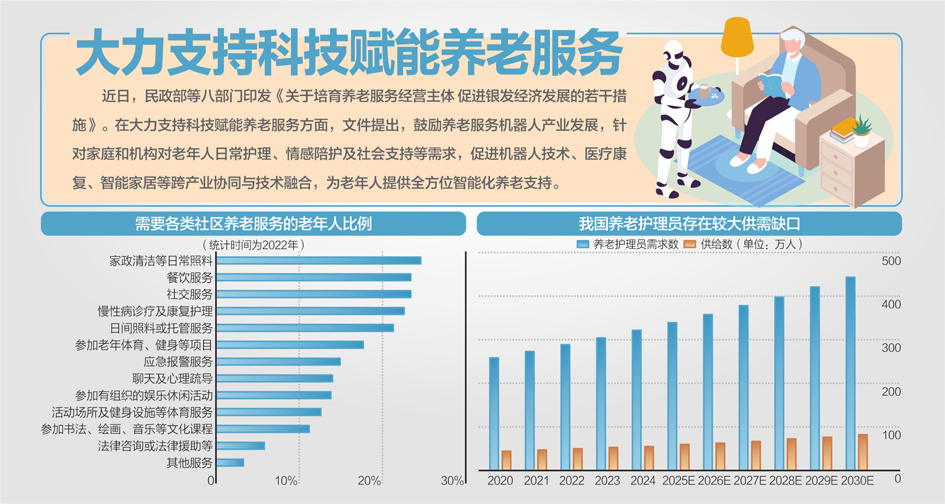
Core Viewpoint - The Ministry of Civil Affairs and eight other departments have jointly issued measures to stimulate the vitality of various elderly care service providers, create a favorable investment environment, and promote the development of the silver economy to better meet the diverse needs of the elderly [1][3] Group 1: Policy Measures - The measures aim to optimize the supply of elderly care services and age-friendly products, encouraging community-based operations and integration of resources to enhance service delivery [4] - The initiative supports the development of home care services for the elderly, including professional medical accompaniment and mobile bathing services [4] - There is a focus on promoting smart rehabilitation aids and age-appropriate food and clothing products, enhancing the living environment for the elderly [4] Group 2: Market Dynamics - By the end of 2025, there will be 41,700 elderly care institutions in China, with 722,000 employees, reflecting a 12.2% year-on-year increase, and 52.2% of these institutions will be privately owned [5] - Social forces are becoming the main contributors to the diversified supply of elderly care services, indicating a shift in the service landscape [5] Group 3: Technological Support - The measures encourage technological advancements in elderly care, integrating big data, AI, and other technologies for health monitoring and personalized services [6] - There is a push for the development of elderly care robots and smart home technologies to meet the daily care and emotional support needs of the elderly [6] - The market is expected to see new opportunities driven by the integration of technology in elderly care, with a focus on smart home products and AI solutions [7]
全球新材料行业发展趋势及前景预测
研精毕智调研报告网· 2025-05-08 14:45
Investment Rating - The report does not explicitly provide an investment rating for the new materials industry Core Insights - The new materials industry is experiencing rapid technological innovation driven by interdisciplinary integration, particularly in fields like biomedical materials and smart materials [2] - Green and environmentally friendly manufacturing processes are becoming crucial, focusing on reducing environmental impact and improving resource efficiency [3] - Advanced computational techniques and artificial intelligence are transforming material design, significantly shortening development cycles and reducing costs [4] - The demand for high-performance materials is expected to grow, particularly in aerospace and electronics, where materials with superior properties are required [6][7] - The market is shifting towards multifunctional materials that can meet complex application needs across various sectors [6][8] Summary by Sections 1. Technological Innovation Trends - New materials technology is evolving towards interdisciplinary integration, combining physics, chemistry, materials science, and biomedical engineering [2] - Innovations in biomedical materials, such as bioactive nanocomposites, are providing new treatment methods [2] - Smart materials, like shape memory alloys, are being developed to respond intelligently to environmental changes [2] 2. Market Demand Trends - The demand for high-performance materials in aerospace is increasing, with new high-temperature alloys and carbon fiber composites being developed [6] - The electronics sector is pushing for semiconductor materials with higher electron mobility and lower power consumption [6] - Multifunctional materials are gaining traction, offering various capabilities in construction and electronics [6][8] 3. Industry Policies and Development Opportunities - Government policies are providing significant support for the new materials industry, including financial subsidies and tax incentives [10][11] - Strategic planning identifies new materials as a key area for development, with initiatives like "Made in China 2025" emphasizing the importance of advanced materials [11] - Policy support is expected to enhance innovation capabilities and attract more investment into the sector [11][12] 4. Challenges and Response Strategies - The industry faces technological bottlenecks, particularly in high-end materials where domestic capabilities lag behind international standards [12][13] - Market competition is intensifying, with foreign companies dominating high-performance segments [12] - Resource dependency and environmental concerns are significant challenges, necessitating improved recycling and sustainable practices [13][14] - Collaborative efforts between enterprises and government are essential to overcome these challenges and promote sustainable development [14]