银发经济

Search documents
中国银发经济市场调研报告2026:新老人·新渠道·新品类-解数咨询
解数咨询· 2026-03-31 06:35
Investment Rating - The report does not explicitly state an investment rating for the industry Core Insights - The policy focus has shifted from addressing shortcomings to promoting consumption and nurturing main players, with a dense rollout of policies for the silver economy from 2024 to 2026, encouraging e-commerce platforms to optimize the "elderly model" [6] - The "new elderly" born in the 1960s are becoming the main force in upgrading silver consumption, enjoying the benefits of economic reforms with an average annual income of 47,000 yuan, high education levels, and strong digital literacy, shifting their consumption mindset from survival to quality [6] - Short videos and live streaming have become the core entry points for silver consumption, with 75% of elderly consumers impulsively buying due to phrases like "free experience" and "limited-time benefits"; the Douyin grandparents topic has accumulated over 10 billion views, with nearly 70% of young viewers [6] - Traditional nutritional brands are capturing the market through strong channel strategies, with Qili Xiang becoming a top player in Douyin's traditional nutritional products by combining high-cost performance products (average price 50-100 yuan) with 2,847 influencers and 18,000 self-broadcasts [6] - Three major sectors are experiencing explosive growth: smart health monitoring, AI companion robots, and food-medicine probiotics, with products evolving from "technology for the elderly" to "emotional understanding of the elderly" [6] Summary by Sections Research Background Assessment - The research is conducted by Jieshu Consulting, a recognized institution in e-commerce big data analysis, serving over 300 brands and institutions in the consumer goods sector [4] - The report is based on data from the National Bureau of Statistics, Qianwen platform, and Douyin platform, covering the period from 2015 to 2024, with some data updated to February 2026 [4] Scope and Boundaries Confirmation - The report focuses on the silver economy, analyzing traditional nutritional supplements, smart health products, food-medicine probiotics, and AI companion robots [5] - The geographical focus is on mainland China, primarily analyzing online e-commerce channels such as Douyin and instant retail [5] - The target user group is the "new elderly" aged 60 and above, particularly those born in the 1960s, as well as their children who are indirect consumers [5] Key Data Capture and Presentation - By the end of 2024, the number of internet users aged 60 and above is expected to reach 156 million [8] - The average annual income of urban elderly individuals is 47,000 yuan, which is roughly on par with the national average [8] - The proportion of elderly individuals living independently has risen to 53% [8] - The Douyin grandparents topic has garnered over 10 billion views, with young viewers making up nearly 70% of the audience [8] - 75% of elderly consumers have made impulsive purchases due to promotional tactics [8] - Qili Xiang collaborated with 2,847 influencers and conducted 18,000 self-broadcasts on Douyin [8] - 21% of quality-leading consumers contribute to 74% of online consumption [8]
专家带你读政策-两会医药政策及长护险制度解读
2026-03-30 05:15
Summary of Conference Call Notes Industry Overview - The conference call discusses the **biomedical industry** and the **long-term care insurance (LTCI)** system in China, highlighting its significance as a pillar of the national economy and its evolution into a new phase of development [2][4]. Key Points and Arguments Biomedical Industry - The **2026 Two Sessions Report** elevates the biomedical industry to a new status, categorizing it alongside integrated circuits, aerospace, and low-altitude economy as a **national emerging pillar industry** [2][3]. - The report emphasizes **full-chain support for innovative drugs**, addressing the challenges of hospital access for new medications, with over **700 new drugs** added to the medical insurance directory in the past five years [2][3]. - The **"Three Medical Coordination"** mechanism is adjusted to prioritize healthcare, indicating a shift towards meeting public medical needs as the core directive of healthcare reform [3]. Long-Term Care Insurance (LTCI) - LTCI is established as the **sixth independent insurance type** in the social security system, aimed at addressing the aging population and promoting the **"silver economy"** [4][5]. - The **funding rate** for LTCI is set at **0.3%**, with reimbursement ratios of **70% for employees** and **50% for residents**, reflecting a **"pay more, get more"** principle [6][9]. - The **implementation timeline** for LTCI spans three years, focusing on establishing a nationwide system and framework, although not all citizens will be covered immediately [5][6]. Funding and Sustainability - LTCI will operate as an **independent insurance** with separate accounts, avoiding confusion with basic medical insurance funds [7][8]. - The funding mechanism will involve contributions from employers, individuals, and government support, with a potential for **differentiated financial sharing** based on regional fiscal capacities [10][11]. - The **dynamic adjustment of the funding rate** is not explicitly outlined but may be considered after the three-year observation period based on actual data [9][10]. Impact on Related Industries - The rollout of LTCI is expected to significantly benefit the **elderly care market**, with a surge in demand for nursing services and community care [13]. - There will be a notable increase in the need for **supportive assistive devices** and **smart technology** in elderly care, as policies may include these in the payment scope [12][13]. - The development of **training programs** for caregivers and the establishment of **LTCI industry parks** are anticipated, indicating a trend towards industry cluster development [13]. Additional Considerations - The **dynamic adjustment mechanism** for the service directory of LTCI will be established, allowing for periodic updates based on economic conditions and public needs, although specific timelines are not yet defined [12][13]. - The integration of **commercial long-term care insurance** is expected to follow the establishment of the LTCI system, with potential policy support to encourage product development [11]. This summary encapsulates the critical insights from the conference call, focusing on the biomedical industry and the long-term care insurance system, their implications, and the anticipated developments in related sectors.
亚洲老人数量将超过世界其他国家的总和
经济观察报· 2026-03-28 02:02
Group 1: Aging Population Challenge - The aging population is a significant challenge not only for China but also for many Asian countries, including Japan and South Korea, with Asia being the region with the largest and fastest-growing elderly population globally [2][3] - By around 2031, the number of elderly individuals aged 60 and above in China is expected to exceed 400 million, accounting for 29.2% of the population, entering a severe aging phase by 2032 [2] - The United Nations Population Fund representative highlighted that in the next 25 years, Asia's elderly population will surpass the total of the rest of the world, with one in every eleven people in Asia being 65 years or older by 2050 [2] Group 2: Care Services and Market Opportunities - There is a growing demand for elderly care services in China, with a projected shortage of over 5 million caregivers in the next five years [5] - The Chinese government is expanding community elderly care services, with one-third of counties establishing comprehensive management platforms and around 350,000 community service points set up [6] - The Ministry of Civil Affairs is focusing on inclusive elderly care, enhancing services for the disabled elderly, and addressing rural care service gaps [6] Group 3: Silver Economy Development - The "silver economy" is recognized as a crucial area for economic growth, with policies being implemented to support its development, including specific guidelines from the central government [8] - The elderly population is becoming the largest consumer group globally, with significant demand in healthcare, housing, finance, services, tourism, and digital technology, leading to a market size in the trillions [8] - To harness the potential of the silver economy, proactive government policies are needed to support investments and establish standards to avoid market chaos [9]


2025年中国NMN行业研究报告
艾瑞咨询· 2026-03-28 00:08
Core Viewpoint - NMN (β-Nicotinamide Mononucleotide) is gaining attention in the global health industry for its potential anti-aging, DNA repair, and metabolic regulation benefits, with significant developments in regulatory approval and market potential expected by 2025 [1][2]. Industry Development - The NMN industry has evolved from laboratory research to commercial applications, with major markets like the US, Japan, Canada, and Australia recognizing its legal status through various regulatory pathways [1][2]. - China is currently the largest producer of NMN raw materials, with leading companies building competitive barriers through technological innovation and industry chain layout [2]. NMN Definition and Function - NMN is a direct precursor to NAD+ (Nicotinamide Adenine Dinucleotide), crucial for delaying aging and enhancing physiological functions [3][4]. - Supplementing NMN can quickly elevate NAD+ levels in the body, playing a vital role in anti-aging, cardiovascular health, and metabolic improvement [4]. Synthesis Pathways - NMN supplementation shows significant advantages in NAD+ synthesis pathways compared to other precursors, with the highest conversion efficiency and no known adverse effects [6][7]. Natural Sources and Supplementation - Natural food sources of NMN are limited, making NMN supplements, which can provide up to 300 times the intake from dietary sources, more effective [8]. Synthesis Technology - The NMN synthesis process has shifted from chemical methods to fully enzymatic methods, which are safer, more efficient, and environmentally friendly [10][11]. - Leading companies are innovating in full enzymatic synthesis technology, creating competitive advantages through patent applications [12]. Market Trends and Drivers - The demand for NMN is driven by an aging population and increasing awareness of anti-aging among younger demographics, creating a dual market push [19]. - Technological advancements in synthesis, quality testing, and delivery methods are driving the NMN industry towards scale, standardization, and efficiency [21][22]. Application Areas - NMN is primarily used in health supplements and cosmetics, with potential future applications in pet nutrition, medical health, and agricultural technology [24][28]. - The NMN market in China is expected to exceed 3 billion yuan by 2025, with significant growth anticipated as regulatory barriers are lifted [28]. Sales Channels - NMN products are mainly sold through cross-border e-commerce and private channels, with cross-border platforms accounting for 60%-70% of market share [35]. Certification and Compliance - The "blue hat" certification for health supplements in China represents the highest standard for NMN products, with strict approval processes that could reshape the market landscape if achieved [37]. Challenges and Opportunities - The NMN industry faces challenges such as exaggerated claims, lack of consumer awareness, and technological iterations, necessitating compliance and innovation for long-term competitiveness [61][63]. - Companies are encouraged to innovate their business models, extending from raw material supply to comprehensive service providers across the entire industry chain [66].



国内“词元”激活数字经济新动能,美伊谈判或一波三折
Southwest Securities· 2026-03-27 08:03
Domestic Developments - The long-term care insurance system is accelerating its implementation, aiming for nationwide coverage by the end of 2028, benefiting approximately 35 million disabled elderly individuals[15] - The "Token" has been officially named "词元," marking a significant step in the digital economy, with daily usage surpassing 140 trillion, a growth of over 1000 times since early 2024[11] - The 2026 Boao Forum predicts Asia's economic growth rate at 4.5%, slightly lower than 2025's 4.7%, but still leading globally amid uncertainties[13] International Developments - Trump announced negotiations with Iran, but significant differences in conditions may lead to a complicated negotiation process, with Brent crude oil prices dropping by 10.9% to $99.94 per barrel following his statements[17] - Japan's February CPI growth slowed to 1.3%, the lowest since March 2022, while the manufacturing PMI for March fell to 51.4, indicating a cooling economic sentiment[18] - The Eurozone's March composite PMI dropped to 50.5, the lowest since May 2022, with the European Central Bank signaling a strong likelihood of interest rate hikes due to rising energy prices[22] High-Frequency Data - Brent crude oil and iron ore prices increased by 1.19% and 1.14% week-on-week, while copper prices fell by 3.28%[24] - Real estate sales rose by 16.37% week-on-week, indicating a rebound in the housing market[24] - The price of domestic polysilicon dropped by 8.49% week-on-week, reflecting volatility in emerging industries[24]
营收利润双创新高,海尔智家2025年持续转型韧性尽显
Zhong Guo Zheng Quan Bao· 2026-03-26 15:58
Core Insights - Haier Smart Home reported record revenue and profit for 2025, with revenue exceeding 300 billion yuan for the first time, reaching 302.35 billion yuan, a year-on-year increase of 5.71%, and net profit attributable to shareholders of 19.55 billion yuan, up 4.39% [2] - The company is increasing shareholder returns by raising the dividend payout ratio from 48% in 2024 to 55% in 2025, with plans to increase it to 60% over the next three years [2] - Haier is launching a new share buyback plan, intending to spend 3 billion to 6 billion yuan on repurchasing shares [2] Financial Performance - The net cash flow from operating activities reached 26 billion yuan, which is 1.33 times the net profit, indicating strong cash quality [2] - The company achieved a year-on-year revenue growth of 8.3% in overseas markets, outperforming industry growth [8] Market Position and Product Development - Haier maintains a leading market share in various segments, including 47.7% in refrigerators and 32.5% in water heaters, while also achieving a 14.8% increase in global sales of home air conditioners [5] - The company is actively exploring new opportunities in artificial intelligence and the silver economy, launching new products in home robotics and smart care during the 2025 AWE [5] Brand Performance - The Casarte brand has maintained its position as the top high-end market player for ten consecutive years, achieving double-digit growth in 2025 [6] - The Leader brand saw a 30% year-on-year increase in revenue, with sales of a new washing machine model exceeding 300,000 units [6] Global Supply Chain and Market Expansion - Haier's global supply chain strategy has led to significant growth in various regions, with the European market seeing a 19.9% revenue increase and the Southeast Asian market growing by 13.4% [8] - The company has initiated 12 new projects globally, including new manufacturing facilities in the U.S. and Egypt, to support ongoing overseas growth [8] Digital Transformation and Efficiency - The integration of AI and digital transformation has improved operational efficiency, with a 0.23 percentage point optimization in overall expense ratios [11] - The company has enhanced customer experience through a comprehensive platform, resulting in a 57% increase in direct delivery orders and improved service quality [11] Future Outlook - Looking ahead to 2026, Haier plans to deepen its AI and digital transformation efforts, strengthen its HVAC business, and expand into emerging fields such as health care and robotics [11]

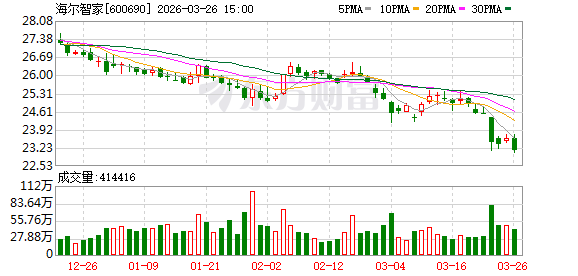
海尔智家拟斥资30-60亿元回购股份,分红提升至55%,未来预计提升到60%
Jin Rong Jie· 2026-03-26 15:14
Core Insights - Haier Smart Home reported its annual revenue exceeding 300 billion yuan for the first time, reaching 302.35 billion yuan, a year-on-year increase of 5.71% [1] - The net profit attributable to shareholders was 19.55 billion yuan, up 4.39% year-on-year, marking a historical high [1] - The company announced a cash dividend of 8.867 yuan per 10 shares, totaling 8.25 billion yuan, with a dividend payout ratio of 55% of net profit [1] Financial Performance - The net cash flow from operating activities reached 26 billion yuan, 1.33 times the net profit, indicating solid cash quality and operational resilience [1] - Since its listing, Haier Smart Home has distributed approximately 48.6 billion yuan in dividends, with a payout ratio of 36% [3] - The dividend payout ratio has increased over the past three years, reaching 45% in 2023, 48% in 2024, and 55% in 2025, with plans to further increase it to 60% [3] Market Position and Strategy - Haier Smart Home leads the market with a 47.7% share in the large kitchen ecosystem and a 32.5% share in water heaters, maintaining its industry-leading position [3] - The company has seen a 14.8% growth in global air conditioning sales, leading the industry, and has achieved double-digit growth in commercial air conditioning [3] - In the overseas market, Haier Smart Home's revenue grew by 8.3% in 2025, with significant growth in various regions, including a 19.9% increase in Europe and a 55.8% increase in the Middle East and Africa [6] Future Development Directions - The company aims to enhance operational efficiency and user experience through AI and digital transformation, focusing on a global rollout of its customer platform [7] - Haier Smart Home plans to restructure its HVAC strategy, aiming to increase the revenue share of its HVAC segment from one-fourth to one-third or even half of total revenue [7] - The company will continue to invest in household robots and smart health care, exploring new growth potential in smart home scenarios [7]

海尔智家去年营收首破3000亿元,家电行业在存量竞争中加速洗牌
Di Yi Cai Jing· 2026-03-26 14:54
Core Viewpoint - The home appliance industry is experiencing a divergence in performance among listed companies, with leading firms becoming stronger amid increasing uncertainties such as trade tariffs and rising costs [1] Company Performance - Haier Smart Home (600690.SH) reported its revenue for 2025 exceeded 300 billion yuan, reaching 302.347 billion yuan, a year-on-year increase of 5.715% [3] - The net profit attributable to shareholders was 19.553 billion yuan, reflecting a year-on-year growth of 4.39% [3] - The net cash flow from operating activities was 26.003 billion yuan, and the company proposed a dividend of 8.867 yuan per 10 shares, totaling 8.248 billion yuan [3] Market Trends - According to AVC, the retail sales of all home appliance categories (excluding 3C) in China for 2025 were 893.1 billion yuan, a year-on-year decline of 4.3%, with the second half of the year seeing a 16% drop [3] - The "silver economy" is creating new opportunities in the aging population segment for home appliances [3] - Euromonitor data indicates a stable global home appliance market with structural differentiation, where developed markets remain stable while emerging markets show strong growth [3] Product Performance - Haier's air conditioning and water appliance segments saw revenue growth of around 10%, while refrigerator, washing machine, and kitchen appliance segments experienced stable growth [3] - Domestic revenue for Haier was 146 billion yuan, up 3.05% year-on-year, while overseas revenue reached 154.5 billion yuan, growing 8.15% [3] Strategic Initiatives - Haier is developing three growth curves: traditional white goods, HVAC (heating, ventilation, and air conditioning), and the aging industry, while seizing opportunities in globalization and smart technology [4] - The company has established new production facilities for air conditioners in Thailand and water heaters in Russia, focusing on regional depth, multi-point layout, and self-control in its globalization strategy [5] - Haier is integrating home appliances with robotics, showcasing various robots at AWE, including companion, cleaning, and household robots, along with aging-friendly products [5] Competitive Landscape - In contrast to leading companies like Haier, smaller kitchen appliance firms faced performance challenges, with Joyoung Co., Ltd. (002242.SZ) reporting a revenue decline of 7.23% to 8.2 billion yuan and a net profit drop of 3.85% to 118 million yuan [5] - Joyoung is working to optimize its product structure amid intensified competition in the home appliance market, focusing on high-end products and expanding into new categories [5]

【招银研究|区域深度】2026年经济大省如何扩大内需?——重点区域发展战略系列研究
招商银行研究· 2026-03-26 09:23
Core Viewpoint - Expanding domestic demand is a strategic foundation for China's long-term economic growth and a key focus of current macroeconomic policies [2][5]. Group 1: Review of Domestic Demand in 2025 - In 2025, the top six provinces achieved a total retail sales of consumer goods of 23.2 trillion yuan, accounting for 46.3% of the national total, an increase of 1.3 percentage points from 2021 [7]. - Service consumption showed high growth overall, with only Henan experiencing a decline in service expenditure share among the six provinces [7]. - Fixed asset investment saw rare negative growth, with only Henan achieving positive growth; however, structural highlights emerged, particularly in equipment upgrades and high-tech industry investments [7]. Group 2: Policy Orientation for 2026 - The policy focus for 2026 has shifted from "stabilizing growth and expanding total volume" to "expanding growth space and tapping economic potential" for long-term structural optimization [3][14]. - The approach has transitioned from demand-side stimulation to supply-demand coordination, emphasizing supply upgrades and scenario innovation to drive demand release [3][14]. - The 2026 policies reflect three major changes in promoting consumption: deepening policy implementation, scenario-based consumption, and precision targeting of consumer groups [3][14]. Group 3: Investment Expansion Trends - Investment goals are now emphasizing project quality and investment efficiency while maintaining high investment intensity, with a focus on "government investment process management" as a key reform direction [4][36]. - The investment structure is increasingly optimized, with new infrastructure, industrial investments, and "investment in people" becoming important sources of stable investment [4][36]. - There is a growing emphasis on collaboration between government investment and private capital, expanding private sector participation and enhancing project implementation capabilities [4][36]. Group 4: Insights on Consumption Promotion - The "Two New" policy is central to boosting consumption, with a focus on enhancing ecological and usage aspects of consumption rather than merely expanding the scale [18][20]. - Scenario-based consumption is gaining traction, integrating consumption behaviors into specific life scenarios to stimulate service consumption potential [20][21]. - Targeting different demographic groups based on age and consumption patterns is crucial for activating domestic demand, with tailored services for each group [25][31]. Group 5: Investment Quality and Structure - The investment strategy for 2026 emphasizes quality, efficiency, and sustainability, moving away from merely expanding scale [36][42]. - New infrastructure investments are highlighted as a key growth area, with a focus on digital and clean energy infrastructure [45][46]. - The investment focus is also extending to human development, with increased public resources directed towards education, healthcare, and elderly care [46].


老年人到底需要什么样的AI课?
腾讯研究院· 2026-03-26 08:53
Core Viewpoint - The article emphasizes the importance of AI literacy among the elderly as a fundamental capability to enhance their participation in society and the economy, especially in the context of an aging population and the increasing integration of AI in various sectors [2][4]. Group 1: AI Learning Among the Elderly - A year-long initiative was launched to teach 100 elderly individuals how to use AI, resulting in interviews with 237 elderly people and community workers across 48 communities, providing empirical data on their needs and preferences [4]. - The learning motivations of elderly individuals extend beyond mere entertainment, with over half of the respondents expressing desires for skill enhancement, value realization, and social re-engagement [6]. Group 2: Types of Elderly AI Learners - The article identifies six types of elderly AI learners, each with distinct motivations and learning goals, ranging from practical applications to creative expression [6]. - The "Old Scholar" type actively engages with AI for educational purposes, while the "Old Playful" type uses AI for creative enjoyment and social interaction [7][8]. - The "Old Star" seeks to enhance their online presence through AI, while the "Old Money-Maker" is driven by the desire to monetize their skills using AI [10]. - The "Pragmatic Elder" uses AI for practical daily tasks, and the "Fellow Elder" learns AI through social influence, reflecting a spectrum of engagement with technology [11][12]. Group 3: Learning Needs and Implications - Learning new technologies in later life serves as a means of compensating for past educational opportunities, providing a sense of purpose and identity [16][18]. - The need for self-expression and the desire to combat monotony in daily life are significant motivators for elderly individuals to engage with AI [17][19]. - The pursuit of financial independence and the cultural expectation of contributing to family dynamics drive many elderly individuals to seek AI learning opportunities [20]. Group 4: Requirements for AI Courses - AI courses for the elderly should be grounded in real-life scenarios, focusing on immediate benefits and practical applications [24]. - A tiered teaching approach is essential to accommodate the varying levels of digital literacy and learning motivations among elderly learners [25]. - Continuous and stable course structures are necessary to provide a coherent learning journey, avoiding fragmented teaching experiences [29]. Group 5: Current Learning Pathways - Elderly universities remain the primary venue for AI learning, but most courses are still traditional and do not adequately address AI education [32]. - Community lectures often lack continuity and depth, leading to fragmented learning experiences for elderly participants [38]. - Online paid courses often exploit the learning anxieties of the elderly, presenting risks such as safety concerns and lack of personalized support [42]. Group 6: Standards for Effective AI Courses - Effective AI courses for the elderly should be small in scope, allowing for digestible content and interactive learning environments [51]. - The teaching staff should ideally consist of peers or community members who understand the specific needs and contexts of elderly learners [52]. - Safety education must be integrated throughout the course, ensuring that learners are aware of potential risks associated with AI usage [53].