智能爬楼梯轮椅

Search documents
科技全运 精彩纷呈
Ren Min Ri Bao· 2025-11-21 23:31
Core Insights - The Guangdong Provincial Committee for the 15th National Games recently held a press conference focusing on "Technology for the National Games," showcasing over 130 high-tech products aimed at enhancing sports through technology [1] - The integration of technology spans four key areas: opening ceremony, smart venues, event support, and technology for assisting the disabled, creating a new paradigm of technology-enabled sports [1] Group 1: Technological Innovations - High-tech elements include deep-sea fire retrieval by the "Haimai" submersible, humanoid robots for torch relay, and naked-eye 3D displays, highlighting the role of technology in enriching the event [1] - Smart features are evident in the Guangzhou venue with nano-modified rubber tracks that are both practical and environmentally friendly, while the Shenzhen venue employs a comprehensive sensing network that captures football trajectories in 0.05 seconds [1] - Technologies such as 5G, artificial intelligence, and the Internet of Things are enhancing venue operations, showcasing Guangdong's innovative capabilities [1] Group 2: Social Impact and Sustainability - Over 20 assistive technology products will be featured at the Special Olympics, including smart stair-climbing wheelchairs and brain-controlled devices, aimed at providing support for athletes [1] - Innovations like energy-saving cooling coatings developed by Hong Kong University of Science and Technology and recyclable bamboo-plastic award platforms demonstrate a commitment to sustainability [1] - The advancements in food traceability and spectator experiences through technology are making progress tangible and accessible [1] Group 3: Economic and Collaborative Development - The integration of technology and sports is being positioned as a new engine for urban development, as stated by the Deputy Director of Shenzhen's Cultural, Radio, Television, Tourism, and Sports Bureau [1] - The 15th National Games serves not only as a testing ground for sports technology but also as a vivid practice of collaborative innovation within the Greater Bay Area [1]
高科技产品助力 科技全运 精彩纷呈
Ren Min Ri Bao· 2025-11-21 22:24
Core Insights - The Guangdong delegation for the 15th National Games is leveraging over 130 high-tech products to enhance the event, focusing on four key areas: "Opening Ceremony Technology, Smart Venues, Event Support, and Assistive Technology" [1] Group 1: Technological Innovations - The event features advanced technologies such as the "Haima" deep-sea fire retrieval system and humanoid robots for torch relay, showcasing a blend of entertainment and innovation [1] - Smart solutions include nano-modified rubber tracks in Guangzhou for practicality and environmental sustainability, and a comprehensive sensing network in Shenzhen that captures football trajectories in 0.05 seconds [1] - Technologies like 5G, artificial intelligence, and the Internet of Things are enhancing venue operations, exemplified by Southern Power Grid's unmanned inspection devices and autonomous service lines [1] Group 2: Assistive Technologies - Over 20 assistive technology products will be showcased at the Special Olympics, including smart stair-climbing wheelchairs and brain-controlled devices to support athletes [1] - Innovations such as energy-saving cooling coatings developed by Hong Kong University of Science and Technology and recyclable bamboo-plastic award platforms highlight the commitment to sustainability [1] Group 3: Broader Implications - The integration of technology and sports is seen as a new engine for urban development, with the 15th National Games serving as a testing ground for sports technology and a practical example of collaborative innovation in the Greater Bay Area [1]
2025年全球与中国智能爬楼梯轮椅市场现状及未来发展趋势
QYResearch· 2025-05-20 09:04
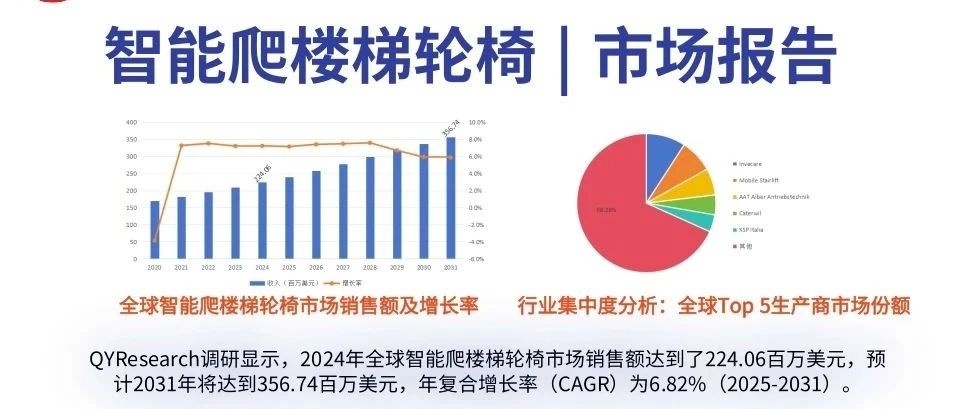
Core Viewpoint - The smart stair-climbing wheelchair market is experiencing rapid growth due to global aging and improved accessibility policies, with a projected market size of $224.06 million in 2024 and $356.74 million by 2031, reflecting a CAGR of 6.82% from 2025 to 2031 [3]. Market Overview - The smart stair-climbing wheelchair is designed for individuals with mobility impairments, enabling safe and smooth movement on stairs and flat surfaces, significantly enhancing user independence and quality of life [1]. - The market is driven by the increasing elderly population and the demand for assistive devices, with the elderly population in China expected to exceed 300 million by the end of the "14th Five-Year Plan" [8]. Product Segmentation - In 2024, the market share by product type shows that track-type wheelchairs account for 59.63% of sales, with over 59,070 units sold, followed by star-wheel type at 29.27% with over 28,990 units sold [4]. Competitive Landscape - The market features both international brands with technological advantages and emerging Chinese companies offering cost-effective products and localized services. Invacare leads the market with a revenue share of 9.17% in 2024 [5]. Technological Advancements - The industry is undergoing rapid upgrades through breakthroughs in lightweight materials, smart control systems with multi-modal sensors, and high-performance battery technologies, enhancing portability and user experience [9]. Policy Support - Various countries are implementing policies to encourage the construction of accessible facilities, creating a favorable environment for the smart stair-climbing wheelchair market [9]. Market Challenges - The complexity of after-sales maintenance poses significant risks, as users heavily rely on manufacturer support due to the high technical demands of the devices [9]. - Price sensitivity is a notable barrier to market penetration, with high-end products averaging $25,000, which exceeds the willingness to pay for many households [9]. - The competitive landscape is intensifying, with established brands and alternative assistive devices posing challenges for new entrants [9].