未锻造黄金

Search documents
加拿大2025年贸易逆差扩至313亿加元 连续三年逆差 对美依赖度明显下降
Sou Hu Cai Jing· 2026-02-20 04:52
Core Insights - Canada experienced a significant trade deficit of 31.3 billion CAD in 2025, marking the largest deficit since 2020 and the highest annual deficit since 1988, excluding the impact of public health measures in 2020 [1][2] Trade Performance - This marks the third consecutive year of trade deficits for Canada, with deficits of 933 million CAD in 2023 and 7.2 billion CAD in 2024 [2] - In 2025, Canada's total exports slightly decreased by 0.2%, with seven out of eleven major product categories experiencing declines, particularly in energy products due to falling prices [2] - Exports of unrefined gold, silver, and platinum group metals surged by 41.7%, which partially offset declines in other product exports; without this category, the annual export decline would have been 3% [2] - Total imports in Canada grew by 2.8% in 2025, driven mainly by increases in metal ores, non-metallic minerals, electronic and electrical equipment, and consumer goods [2] Trade Relations - Canada's trade dependency on the United States decreased significantly in 2025, with exports to the U.S. declining by 5.8% and imports decreasing by 2.9%; the trade surplus with the U.S. narrowed from 101.3 billion CAD in 2024 to 81.6 billion CAD [2] - In contrast, trade with non-U.S. partners showed strong performance, with exports to non-U.S. partners increasing by 17.2% and imports rising by 12.4% in 2025 [2]
加拿大2025年贸易逆差扩大至313亿加元,创近年最高水平
Sou Hu Cai Jing· 2026-02-19 15:35
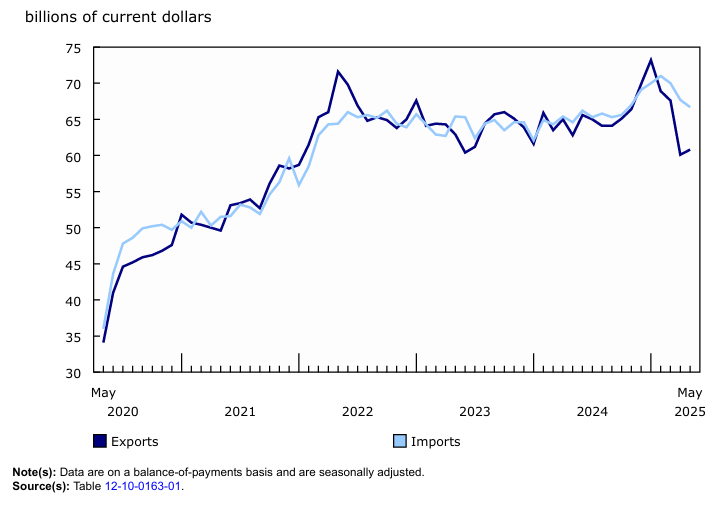
Core Insights - Canada's trade deficit for 2025 is projected to reach 31.3 billion CAD, marking the highest annual deficit since 1988, excluding the pandemic year of 2020 [1] - Overall exports from Canada are expected to decline by 0.2% year-on-year, with most product categories experiencing varying degrees of decline [1] - The strong performance of precious metals, particularly unrefined gold, silver, and platinum group metals, has somewhat masked the true impact of trade tensions on Canadian exports, with this category seeing a significant increase of 41.7%. Excluding this category, the actual decline in exports would be 3% [1] Trade Relations - The trade relationship between Canada and its largest trading partner, the United States, has been notably disrupted, with Canadian exports to the U.S. decreasing by 5.8% and imports from the U.S. down by 2.9% [1] - This reciprocal contraction has led to a reduction in Canada's trade surplus with the U.S. from 101.3 billion CAD in 2024 to 81.6 billion CAD in 2025, a decrease of nearly 20% [1] Monthly Data - In December 2025, Canada's exports amounted to 65.63 billion CAD, while imports were 66.93 billion CAD, resulting in a trade deficit of 1.31 billion CAD, which is a narrowing from the 2.2 billion CAD deficit recorded in November [1]
加拿大11月贸易逆差骤扩至22亿加元 黄金出口锐减成主因
Xin Hua Cai Jing· 2026-01-30 00:55
Core Viewpoint - Canada's trade deficit in November 2025 reached 2.2 billion CAD, significantly exceeding market expectations of 690 million CAD and the revised previous value of 400 million CAD [1]. Group 1: Trade Performance - In November, Canada's total exports amounted to 63.94 billion CAD, a decrease of 2.8% from the revised previous month's value of 65.78 billion CAD [1]. - Total imports were 66.14 billion CAD, remaining relatively stable compared to the revised previous value of 66.18 billion CAD [1]. - The significant decline in exports, particularly in the category of metal and non-metal mineral products, was a major factor contributing to the widening trade deficit [1]. Group 2: Export Dynamics - The drop in exports was primarily driven by a 24.4% month-on-month decrease in metal and non-metal mineral products [1]. - Exports of unrefined gold, silver, platinum, and their alloys saw a substantial reduction of 36%, becoming the largest drag on overall export performance [1]. - The volatility in gold exports has been a persistent trend affecting Canada's overall export dynamics in recent months [1]. Group 3: Import Trends - The import of motor vehicles and parts also saw a simultaneous decline, further suppressing trade performance [1]. - Despite the stability in total import values, the sharp contraction in key export categories exacerbated the trade imbalance [1].
加拿大贸易逆差大幅缩减 非美市场成出口增长新引擎
Xin Hua Cai Jing· 2025-07-03 13:52
Core Insights - Canada's merchandise trade showed an increase in exports and a decrease in imports in May, leading to a narrowing trade deficit [1][3] - The trade deficit improved from a record 7.6 billion CAD in April to 5.9 billion CAD in May, indicating a marginal improvement in Canada's trade situation [3] Export Performance - Merchandise exports grew by 1.1% to 60.81 billion CAD, marking the first increase in four months, driven by demand in key sectors [1] - Unrefined gold exports surged by 30.1% to a record 5.9 billion CAD, primarily directed to the UK, influenced by international gold price fluctuations and strong UK demand [5] - Exports of consumer goods increased by 2.6%, with significant contributions from meat (up 13.1%) and processed seafood (up 52.9%), reflecting Canada's competitive edge in agricultural processing [6] - Exports to countries outside the US rose by 5.7%, reaching a historical high, indicating progress in diversifying trade partners [6] Import Trends - Imports fell by 1.6% to 66.66 billion CAD, marking the third consecutive month of decline [1][8] - The decline in imports was led by a 16.8% drop in metal and non-metal mineral products, particularly unrefined gold and silver, which saw a 43.2% decrease [7] - Consumer goods imports increased by 4.3%, driven by demand for video game consoles and pharmaceuticals, reflecting a recovery in domestic consumption [8] Trade Partner Dynamics - Trade with the US showed a slight increase in surplus from 3.1 billion CAD in April to 3.2 billion CAD, despite continuous declines in both exports and imports [9] - Exports to China decreased by 21.3%, primarily due to reduced canola and crude oil exports, while imports from China grew by 3.0%, leading to an expanded trade deficit of 3.72 billion CAD [10] - Exports to the UK surged by 28.9%, driven by gold exports, resulting in a trade surplus of 4.55 billion CAD, while imports from the UK fell by 49.2% [12] - Exports to Italy increased by 73.8%, indicating deepening trade cooperation in specific product areas [13]