机器人城管

Search documents
深圳机器人城管上岗 成功劝离流动摊贩 机器人城管管什么?怎么管?
Yang Guang Wang· 2025-08-31 00:43
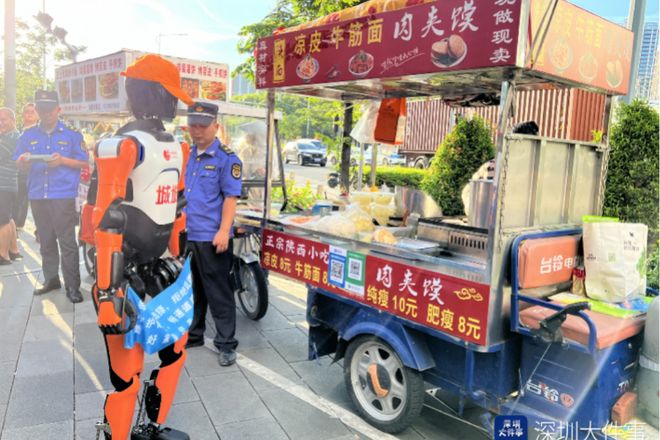
Core Insights - The introduction of robots "Chengcheng" and "Guanguan" in Shenzhen's Longgang District represents a novel approach to urban management, focusing on guidance rather than enforcement [1][2] - The robots are designed to assist human city management personnel by providing a friendly and engaging way to encourage compliance among street vendors and citizens [1][2] - The initiative aims to enhance the efficiency of urban management by utilizing robots for tasks traditionally performed by human workers, thereby addressing labor shortages and improving operational effectiveness [2][3] Group 1: Robot Implementation - The robots are approximately 1.5 meters tall and equipped with features to engage with the public, including playful audio messages and visual expressions [1] - They have been operational for about a week and have successfully encouraged many street vendors to vacate public spaces, demonstrating a positive impact on urban order [1][2] - The robots operate under the supervision of human city management staff, who can intervene if the robots are unable to persuade vendors to comply [2] Group 2: Efficiency and Technology - Traditional city management relies heavily on human patrols, which are limited in scope and efficiency; robots can work longer hours and cover more ground [2] - Currently, Shenzhen has 350 robots deployed in urban management, with some capable of performing multiple functions, such as cleaning while monitoring for compliance issues [2] - The city has been exploring the use of robots in urban management for three years, with the current phase focusing on expanding their roles beyond cleaning to include guidance and compliance [2][3] Group 3: Future Prospects - The initiative is seen as a mid-stage explosion in the adoption of robots for urban management, with plans for broader implementation to reduce labor intensity and enhance efficiency [3][4] - Experts suggest that while robots can assist in urban management, they cannot perform enforcement actions, highlighting the need for a collaborative approach between humans and machines [4][5] - The Chinese government has expressed support for integrating artificial intelligence into public governance, indicating a potential for future growth in this sector [4][5]

城管机器人,发挥作用不能只靠说话好听
Nan Fang Du Shi Bao· 2025-08-25 15:38
Core Viewpoint - The introduction of robot city management in Shenzhen represents a significant innovation in urban governance, showcasing the potential for technology to enhance the enforcement of regulations in a more approachable manner [2][5]. Group 1: Robot City Management Features - The robot city managers, named "Cheng Cheng" and "Guan Guan," utilize engaging communication methods, such as playful gestures and humorous expressions, to ease tensions during enforcement activities [2]. - The robots are designed to replace human city managers in certain tasks, particularly in promoting compliance among street vendors through non-confrontational interactions [3][4]. Group 2: Public Reception and Effectiveness - Initial feedback from street vendors indicates a positive reception, with many expressing a willingness to cooperate due to the novelty of the robots, suggesting that their acceptance may stem from curiosity rather than long-term effectiveness [3][4]. - The robots currently handle simple tasks like public awareness and guidance, which raises questions about their ability to manage more complex enforcement scenarios in the future [3][4]. Group 3: Challenges and Considerations - The effectiveness of robot city managers in urban governance will depend on their ability to foster cooperation among vendors, as well as their capacity to handle conflicts and enforce regulations without traditional punitive measures [4][5]. - Key challenges include ensuring that the robots can maintain a level of authority and deterrence comparable to human city managers, as well as addressing potential conflicts that may arise during enforcement [5].