
机械智心

Search documents
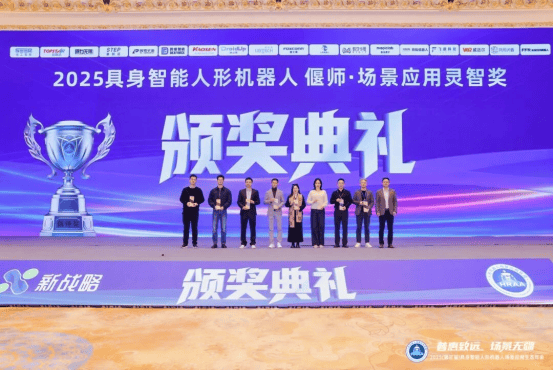
网易伏羲凭具身智能创新荣膺 2025 “偃师·场景应用灵智奖”
Sou Hu Cai Jing· 2025-12-09 11:51
Core Insights - The conference on embodied intelligence and humanoid robots in Hefei, Anhui, highlighted the integration of technology and practical applications in the industry, with over 60 supply chain companies and 40 industry chain enterprises participating [1] - NetEase Fuxi received the "Yanshi·Scene Application Intelligence Award" for its outstanding technological innovation and practical applications in the field of embodied intelligence [1] - The industry is entering a phase of practical implementation, with government policies supporting the development of embodied intelligence, and trends indicating a rise in humanoid robots and decreasing costs [5] Industry Trends - Embodied intelligence has been included in government work reports, indicating strong policy support for its development [5] - The industry is experiencing a shift with industrial leadership, an increase in humanoid robots, and advancements in technology such as generalized brain functions and refined motor control [5] - Despite advancements, the industry faces challenges such as data scarcity, the gap between simulation and reality, and ethical concerns [5] Company Innovations - NetEase Fuxi aims to reshape productivity in embodied intelligence through "virtual-real integration," focusing on human-machine collaboration and leveraging AI technology to enhance labor productivity [5][6] - The company has introduced an innovative platform based on AOP (Agent-Oriented Programming) to organize individual intelligence into efficient collaborative networks, addressing high data collection costs and low efficiency [6] - The platform supports various task types and includes automatic quality inspection and dynamic evaluation capabilities, enhancing data production efficiency and accessibility [6] Technological Advancements - NetEase Fuxi is applying its gaming AI expertise to the field of embodied intelligence, providing robots with emotional and life-like qualities through advanced data and algorithms [7] - Technologies such as expression AI and action transfer enable robots to exhibit natural emotional expressions and learn complex skills efficiently [7] - The company has developed a digital twin simulation system for real-world environment reconstruction, enhancing training for embodied remote operations and intelligent machinery [7] Practical Applications - The "Mechanical Intelligence" framework for the engineering machinery sector has demonstrated significant efficiency improvements, achieving 80% of human efficiency with minimal human intervention in real-world tests [8] - The technology has potential applications across various sectors, including agriculture, unmanned factories, smart warehousing, and environmental monitoring [8] - NetEase Fuxi's platform aims to create a global multi-agent collaboration system, integrating dispersed resources to enhance collective intelligence [8] Future Outlook - The future of embodied intelligence lies in integration rather than replacement, with NetEase Fuxi committed to transforming cutting-edge technology into practical productivity [9]


网易发布工程机械具身智能模型和训练框架,可延伸至农业、智能制造、物流仓储多领域
Sou Hu Wang· 2025-07-30 09:53
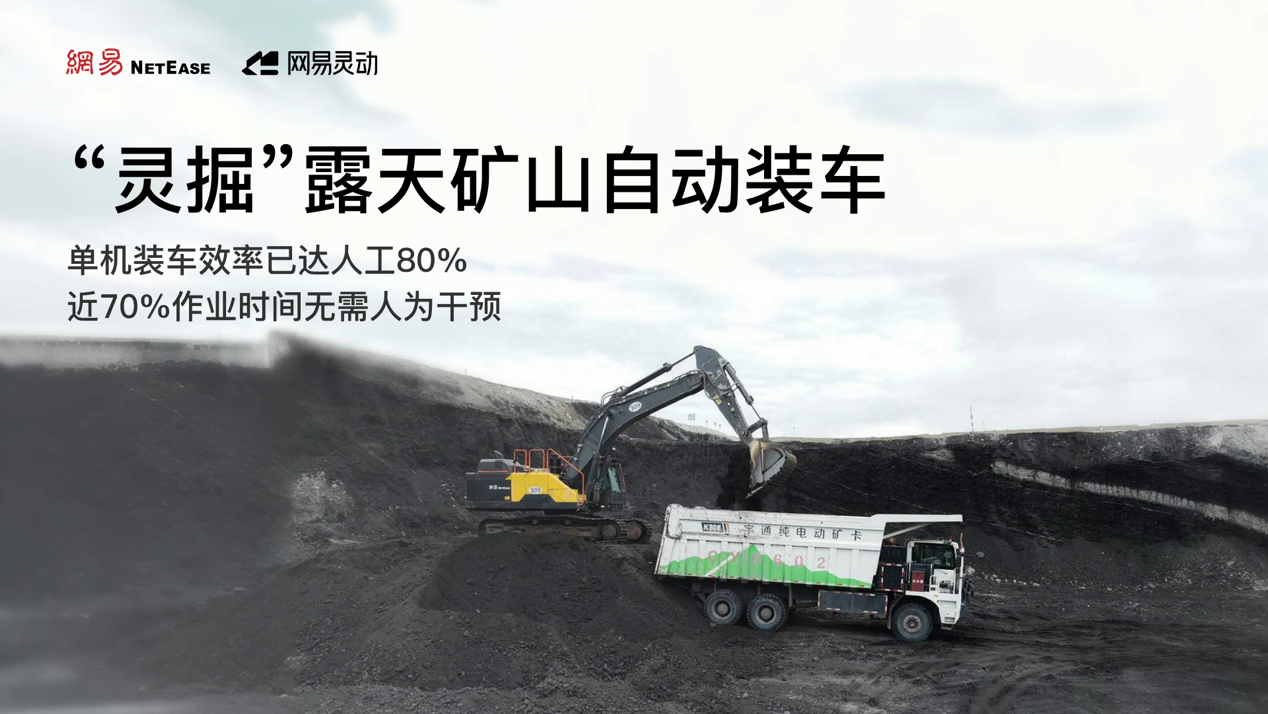
Core Viewpoint - The launch of the "Lingjue" model by NetEase Lingdong represents a significant advancement in autonomous operations for open-pit mining, aligning with national goals for intelligent and unmanned coal mining by 2025 [1][12]. Group 1: Technological Innovations - "Lingjue" is the world's first end-to-end engineering machinery embodiment model, revolutionizing traditional development methods [6]. - The model utilizes real mining operation data for training, overcoming challenges faced by simulation data [6]. - The technology is fully domestically developed, ensuring control over core algorithms and hardware, which enhances security and supply chain stability [6]. Group 2: Operational Efficiency - In harsh conditions at the Hohhot North open-pit coal mine, "Lingjue" achieves an 80% efficiency rate compared to manual loading, with nearly 70% of operation time requiring no human intervention [8]. - The technology significantly improves loading precision and continuity, providing new pathways for safety and efficiency in the industry [8]. Group 3: Industry Collaboration - NetEase Lingdong announced the open-sourcing of the "Lingjue" dataset and initiated the "2027 Industry Collaboration Plan" to promote joint research and standard setting across the industry [9]. - The plan aims to achieve unmanned operations in over 30 mines by 2027 through collaborative efforts with major manufacturers and mining companies [9]. Group 4: Expanding Intelligent Boundaries - The "Mechanical Zhixin" framework, which supports "Lingjue," integrates video learning, expert demonstration, and reinforcement learning, enabling dynamic evolution of machines [10]. - This framework has successfully transitioned to over 10 different scenarios, with future applications planned in agriculture and smart manufacturing [10]. Group 5: Global Leadership in Smart Solutions - NetEase Lingdong has collaborated with over 30 leading enterprises to address labor shortages and safety risks in the industry [12]. - The release of the "Lingjue" model marks a shift from remote control to fully autonomous operations in engineering machinery, positioning China as a leader in global industrial intelligence [12].
工业AI迈向“知行合一”具身智能重构制造边界
Zhong Guo Zheng Quan Bao· 2025-07-28 21:05
Core Insights - The article highlights the transition of industrial AI from cognitive capabilities to autonomous execution, exemplified by the operation of unmanned excavators at the 2025 World Artificial Intelligence Conference (WAIC) [1][2][3] Group 1: Industrial AI Development - Industrial AI is undergoing a significant transformation, showcasing high autonomy and efficiency in complex tasks, such as loading operations in harsh environments [1][2] - The emergence of "Lingju," a model developed by NetEase for unmanned excavators, demonstrates the shift towards end-to-end integrated models that enhance performance and adaptability [2][4] - The collaboration of multiple intelligent agents in industrial settings is redefining production efficiency and flexibility, reducing operation times from hours to minutes [3][5] Group 2: Technological Innovation and Ecosystem - The rise of industrial AI in China is supported by self-innovated foundational technologies, emphasizing the importance of security and stability in the supply chain [3][4] - NetEase's "Lingju" is built on a domestically developed framework, ensuring technological safety and supply chain reliability [4] - Initiatives like the "2027 Industry Collaboration Plan" aim to achieve unmanned operations in over 30 mines by 2027, showcasing a commitment to technological diffusion and ecosystem collaboration [4][5] Group 3: Future of Industrial AI - The concept of a "universal team" of industrial AI agents is emerging, with each agent specializing in different tasks while collaborating to solve complex challenges [5] - The potential for industrial AI to expand into various sectors, including agriculture and smart manufacturing, indicates a redefinition of traditional industry boundaries [5] - The deep integration of AI with the real economy is seen as a key pathway for developing new productive forces [5]
网易灵动发布工程机械具身智能模型,已在内蒙露天矿山部署测试
Xin Lang Ke Ji· 2025-07-26 10:07
Core Insights - The World Artificial Intelligence Conference (WAIC) witnessed the launch of "Lingjue," the world's first embodied intelligence model specifically designed for open-pit mining excavators, aligning with China's strategic goal for intelligent continuous operations and unmanned transportation by 2025 [1][2] - "Lingjue" represents a significant innovation in engineering machinery, utilizing a unique end-to-end model that leverages multi-modal data-driven autonomous learning technology, marking a departure from traditional modular development [1] - The model has achieved an 80% efficiency rate compared to human operators and requires minimal human intervention, adapting successfully to harsh environments [1] Company Initiatives - NetEase Lingdong announced the open-sourcing of the "Lingjue" dataset and initiated the "2027 Industry Collaboration Plan," aiming to achieve unmanned operations in over 30 mines by 2027 through collaboration with major manufacturers and mining companies [2] - The foundational training framework for "Lingjue," named "Mechanical Wisdom," integrates video learning, expert demonstration, and reinforcement learning, enabling dynamic evolution of machines [2] - The release of "Lingjue" and "Mechanical Wisdom" signifies a shift in engineering machinery from remote control to fully autonomous operations, addressing challenges related to labor shortages and safety risks [2]