柔性AMOLED智能手机面板

Search documents
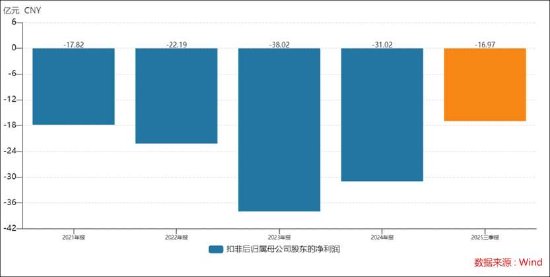
维信诺亏损百亿之谜 国资接盘面临降杠杆压力?担保比例高达339.36%
Xin Lang Cai Jing· 2026-01-23 10:09
Core Viewpoint - Visionox has been experiencing a long-term revenue-cost inversion, reflecting significant challenges within the company, including a notably low gross margin compared to peers and a high depreciation and amortization expense ratio. Additionally, the company's debt ratio continues to rise, with guaranteed net assets exceeding three times, raising concerns about potential deleveraging pressure following state-owned capital acquisition [1][17][28]. Financial Performance - Visionox announced an expected net loss for the fiscal year 2025, with cumulative losses exceeding 10 billion yuan over the past five years [3][18]. - In the first half of 2025, the company achieved a revenue of 4.121 billion yuan, with OLED product revenue accounting for approximately 3.994 billion yuan, representing over 90% of total revenue [4][20]. Market Position - In the AMOLED smartphone panel market, Visionox ranks third globally and second domestically, with a market share of 13.7% as of Q3 2025, despite a significant increase in shipments [5][21]. - The company has seen its market share grow from 6.8% in 2022 to 9% in 2023, and is projected to reach 11.2% in 2024 [7][23]. Gross Margin and Cost Structure - Visionox's gross margin has been negative for most of the past five years, with a severe cost-revenue inversion leading to a gross margin of -35.29% in 2023 [7][23]. - The company's depreciation and amortization expense ratio is significantly higher than that of peers, ranging from 33% to 44%, compared to 12% to 20% for competitors like BOE and Tianma [9][25]. Production Efficiency - The production yield of Visionox's G6 full-flexible production line is at the lower end of the industry standard, with a yield of 80% [8][24]. - The company has invested heavily in production lines, with over 100 billion yuan in investments and seven production lines currently operational [28]. Industry Dynamics - The panel industry is characterized by cyclical attributes influenced by supply-demand dynamics and technological iterations, with a typical production line construction cycle of 2-3 years [10][26]. - Visionox is lagging behind competitors like BOE and Samsung in the deployment of next-generation production lines, which are expected to significantly reduce costs and improve yields [11][27]. Debt and Financing - Visionox's debt level has surged from 54.6% in 2021 to 84.36% by Q3 2025, with short-term debt exceeding 13 billion yuan while cash reserves are below 8 billion yuan [12][28]. - Following the acquisition by state-owned capital, the company faces potential pressure to reduce leverage, with a guarantee ratio reaching 339.36% of its audited net assets [15][31].


CINNO Research:三季度全球AMOLED手机面板出货量约2.5亿片 同比增长11.7% 环比增长20.3%
智通财经网· 2025-10-28 23:52
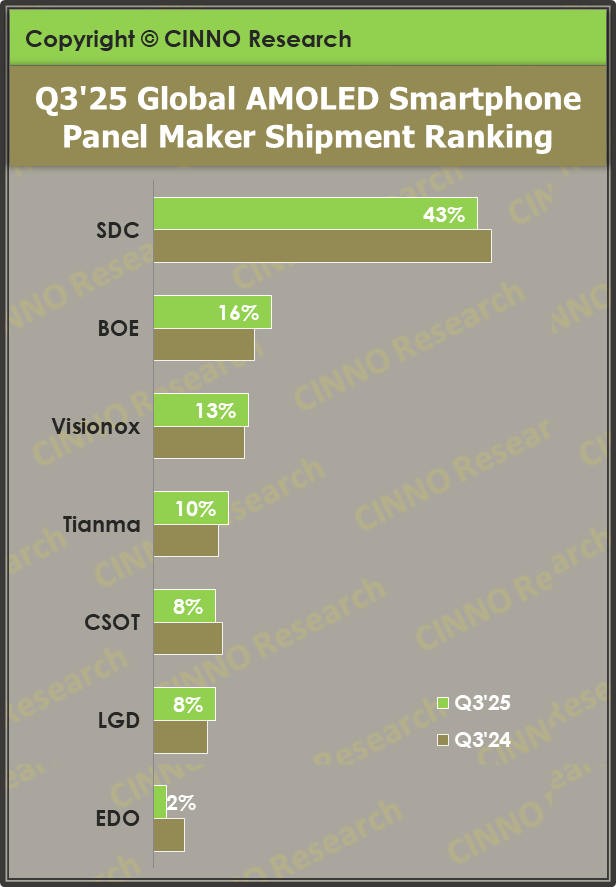
Core Insights - The upcoming third quarter is expected to see a significant increase in demand for OLED panels due to the launch of flagship products by Apple and major domestic brands, with a projected shipment of approximately 250 million AMOLED smartphone panels globally, marking a year-on-year growth of 11.7% and a quarter-on-quarter growth of 20.3% [1] Market Overview - In the third quarter of 2025, the global AMOLED smartphone panel shipment from South Korea is expected to account for 51.6% of the total, showing a year-on-year decrease of 0.8 percentage points but a quarter-on-quarter increase of 4.2 percentage points, primarily driven by short-term demand from Apple’s new device preparations; domestic manufacturers will hold a 48.4% share [4] - Samsung Display (SDC) is projected to see a year-on-year shipment growth of 7.1%, with its market share decreasing from 45.2% to 43.4%, reflecting a 1.8 percentage point decline; despite its technological advantages in LTPO backplanes, SDC is losing orders in the mid-range market [5] - BOE's AMOLED smartphone panel shipments are expected to grow by 30.8% year-on-year, with its market share increasing by 2.3 percentage points to 15.7%, benefiting from penetration in the mid-range market and continued breakthroughs in the high-end market [5] - Visionox's AMOLED smartphone panel shipments are anticipated to grow by 16.7% year-on-year, with a market share increase of 0.5 percentage points to 12.7%, attributed to effective operational strategies and stable demand in the mid-range market [5] - Tianma's AMOLED smartphone panel shipments are projected to grow by 28.4% year-on-year, with a market share increase of 1.3 percentage points to 10.0%, driven by stable demand from key customers and improvements in production technology and yield [5] Flexible Panel Insights - In the third quarter of 2025, flexible AMOLED smartphone panels are expected to account for 80.1% of total AMOLED smartphone panel shipments, reflecting a year-on-year increase of 3.6 percentage points and a quarter-on-quarter increase of 3.1 percentage points; South Korea's share will be 43.8%, down 1.4 percentage points year-on-year, while domestic manufacturers will hold 56.2% [6] - SDC's flexible AMOLED smartphone panel shipments are projected to grow by 9.3% year-on-year and 40.4% quarter-on-quarter, with a market share of 33.5%, down 2.3 percentage points year-on-year, facing increasing competition from domestic manufacturers [6] - BOE's flexible AMOLED smartphone panel shipments are expected to grow by 30.8% year-on-year and 9.3% quarter-on-quarter, with a market share of 19.7%, reflecting a 2.1 percentage point increase year-on-year, driven by significant growth in high-end flexible screen orders [8] - Visionox's flexible AMOLED smartphone panel shipments are anticipated to grow by 16.2% year-on-year and 54.2% quarter-on-quarter, with a market share of 13.7%, significantly above the industry average in terms of production line utilization [8] - Tianma's flexible AMOLED smartphone panel shipments are projected to grow by 28.4% year-on-year and 8.3% quarter-on-quarter, with a market share of 12.5%, reflecting a 1.1 percentage point increase year-on-year [8]


Q3’25全球AMOLED手机面板出货量同比、环比双增长
CINNO Research· 2025-10-28 23:42
Core Viewpoint - The global AMOLED smartphone panel shipment in Q3 2025 reached approximately 250 million units, showing a year-on-year growth of 11.7% and a quarter-on-quarter growth of 20.3%, indicating a continuous recovery in market conditions [1][2]. Market Demand and Trends - The arrival of the traditional sales peak in Q3, along with the launch of flagship products by Apple and major domestic brands, significantly boosted the demand for OLED panels [2]. - The market for AMOLED smartphone panels is experiencing a dual growth trend both year-on-year and quarter-on-quarter, reflecting a sustained recovery in market conditions [2]. Regional Shipment Analysis - In Q3 2025, the shipment share of AMOLED smartphone panels in South Korea accounted for 51.6%, showing a year-on-year decline of 0.8 percentage points but a quarter-on-quarter increase of 4.2 percentage points, primarily driven by short-term demand from Apple’s new device preparations [3]. - Domestic manufacturers held a shipment share of 48.4% in the same period [3]. Company Performance - Samsung Display (SDC) saw a year-on-year shipment growth of 7.1%, but its market share decreased from 45.2% to 43.4%, indicating a 1.8 percentage point decline, attributed to intensified order losses in the mid-range market despite its technological advantages in LTPO backplanes [3]. - BOE's AMOLED smartphone panel shipments grew by 30.8% year-on-year, marking the largest increase among major manufacturers, with its market share rising by 2.3 percentage points to 15.7%, driven by penetration in the mid-range market and breakthroughs in the high-end market [3]. - Tianma's AMOLED smartphone panel shipments increased by 28.4% year-on-year, with its market share rising by 1.3 percentage points to 10.0%, supported by stable demand from key customers and continuous improvements in production technology and yield [5]. Flexible Panel Shipment Insights - In Q3 2025, flexible AMOLED smartphone panels accounted for 80.1% of total shipments, reflecting a year-on-year increase of 3.6 percentage points and a quarter-on-quarter increase of 3.1 percentage points [8]. - SDC's flexible AMOLED panel shipments grew by 9.3% year-on-year and 40.4% quarter-on-quarter, but its market share fell by 2.3 percentage points to 33.5%, facing competitive pressure from domestic manufacturers [9]. - BOE's flexible AMOLED panel shipments increased by 30.8% year-on-year and 9.3% quarter-on-quarter, with its market share rising by 2.1 percentage points to 19.7%, driven by significant growth in high-end flexible screen orders [9].