栀子黄

Search documents
FDA合成色素禁令后,哪些生物合成色素企业在涌入赛道?
合成生物学与绿色生物制造· 2026-01-29 06:36
Core Viewpoint - The article discusses the increasing demand for natural food colorants driven by regulatory changes and consumer preferences, particularly in light of the FDA's plan to phase out certain synthetic colorants by the end of 2026, creating a significant market opportunity for natural alternatives [2][5]. Group 1: Regulatory Changes and Market Impact - The FDA plans to eliminate eight synthetic colorants, including Tartrazine (E102), by the end of 2026, prompting major food and beverage companies to reformulate their products [2][4]. - This regulatory shift is expected to accelerate the transition towards natural colorants, with the global natural food colorant market projected to grow from approximately $2 billion in 2025 to over $4 billion by 2030 [5]. Group 2: Challenges and Technological Innovations - Key challenges in adopting natural colorants include stability, cost, and supply chain issues, with technologies such as microencapsulation, fermentation engineering, and plant cell culture being explored to address these challenges [6][8]. - Various natural colorant alternatives are being developed, including Lutein, Curcumin, Safflower Yellow, and Beet Red, which have shown progress in application within food products [6]. Group 3: Industry Players and Developments - Several companies are entering the natural colorant space, including Michroma, which uses filamentous fungi for fermentation to produce heat-stable red colorants, and Chromologics, focusing on natural red colorants through fungal fermentation [9][10]. - In China, companies like ZhiNuo Technology and DaoSheng Bio are making strides in microbial colorants, with ZhiNuo achieving significant growth in fermentation capacity and DaoSheng's blue colorant receiving FDA registration [12][13]. Group 4: Future Outlook and Competitive Landscape - The dual drivers of policy and consumer demand are pushing the industry towards natural colorant solutions, with companies needing to establish supply chains and participate in international standard-setting to remain competitive [13]. - The competition in the natural colorant market will not only focus on replacing synthetic options but also on technology, sustainability, and brand trust [13].


(乡村行·看振兴)江西安福统战赋能“黄栀子” 铺就乡村振兴“金色路”
Xin Lang Cai Jing· 2025-12-22 11:05
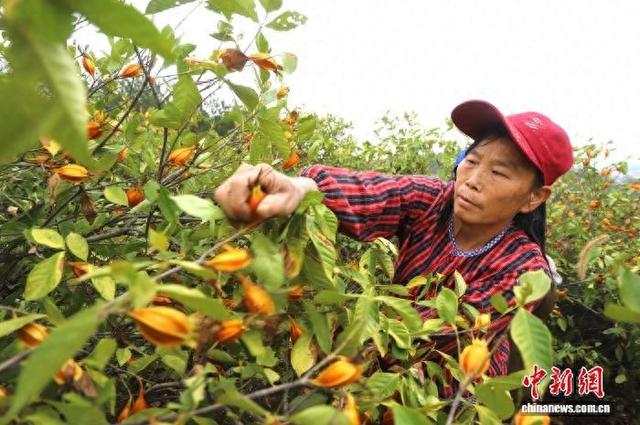
Core Insights - The article highlights the successful cultivation of the "Alishan No. 1" variety of yellow fruit in Jiangxi Province, which has a high economic value and market potential [1] - The project has significantly increased local employment and income, with over 96 farmers participating and generating more than 500,000 yuan in additional income [1] Group 1: Agricultural Development - The yellow fruit cultivation spans over 3,000 acres, with an expected yield of 300 to 400 tons this year, translating to a total output value of over 3 million yuan [3] - The cultivation model involves a cooperative approach, integrating farmers, a base, and local government support to facilitate land transfer and resource allocation [1][3] Group 2: Economic Impact - The average income for workers in the area is projected to exceed 10,000 yuan, showcasing the economic benefits of the yellow fruit industry [3] - The local government has played a crucial role in establishing industry alliances and providing policy support, which has helped streamline operations and enhance productivity [1][3] Group 3: Future Prospects - There are plans to further develop the yellow fruit industry by integrating deep processing and cultural tourism, aiming to elevate the product's value and contribute to local prosperity [3]