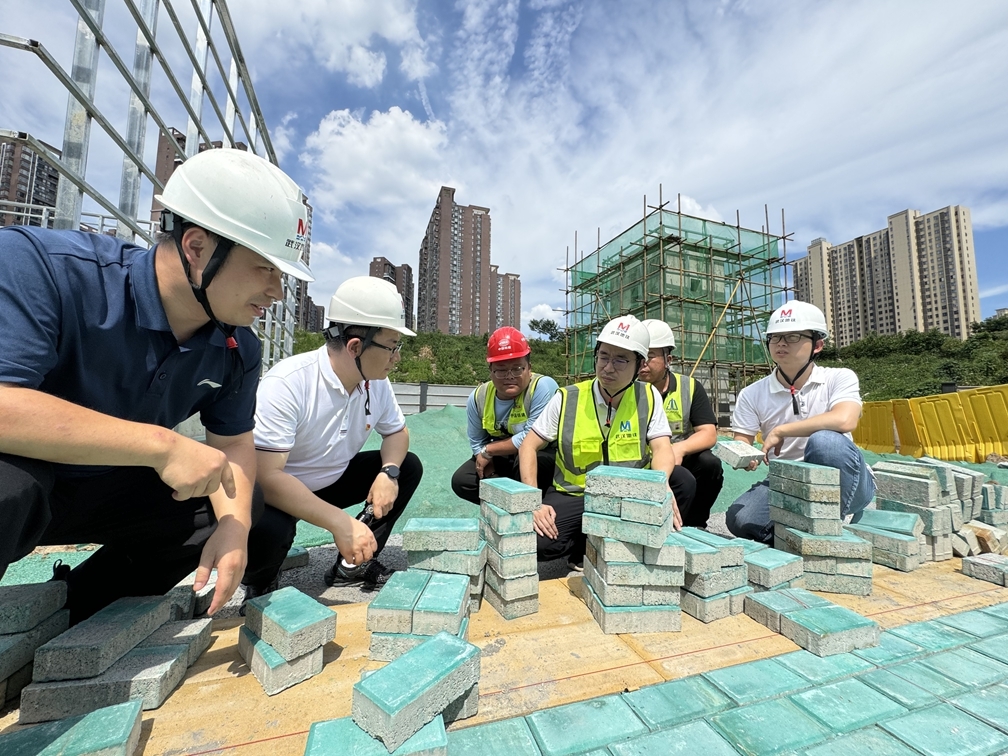
武汉地铁12号线

Search documents
轨道交通排行:北京领跑,南京有变化
Jing Ji Ri Bao· 2026-01-22 10:20
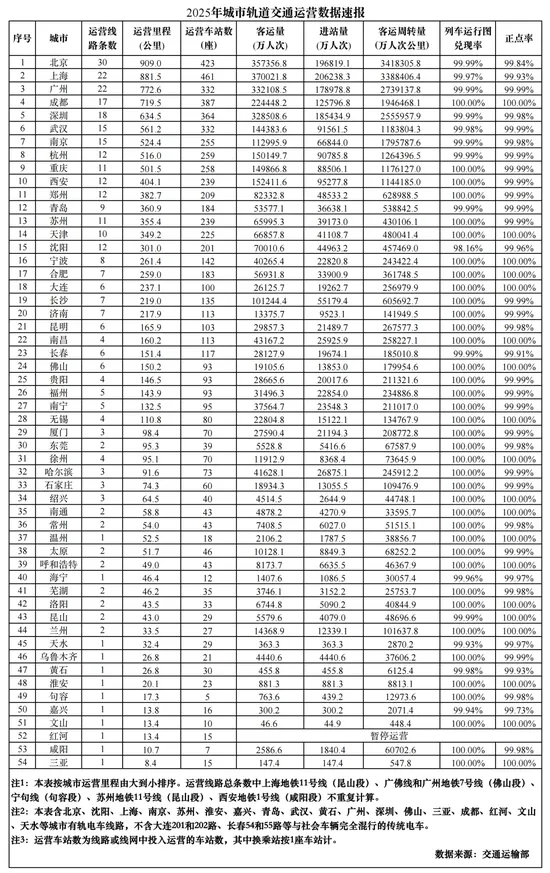
Group 1 - The core viewpoint of the article highlights the growth and changes in urban rail transit systems across major Chinese cities, with a specific focus on Nanjing's rising ranking in operational mileage [3][4]. - As of December 31, 2025, a total of 54 cities in China will have 343 urban rail transit lines in operation, covering 11,710.3 kilometers and 6,680 stations, with an addition of 18 new lines and 764.7 kilometers of new operational mileage in 2025 [2]. - Beijing continues to lead the nation in urban rail transit operational mileage, with 30 lines and 909 kilometers, while Nanjing has moved up to the seventh position, surpassing Hangzhou and Chongqing, due to the opening of new lines [4]. Group 2 - Several major cities are set to open new rail transit lines this year, including Beijing's first interprovincial line, which will span approximately 81.2 kilometers, and Shanghai's line expected to be operational by the end of the year [5]. - Nanjing is preparing for the opening of two lines, the 6th line and the Ningma line, which will connect Jiangsu and Anhui provinces, with the 6th line measuring about 32.35 kilometers and the Ningma line about 54.23 kilometers [5]. - The urban rail transit landscape is expected to continue evolving as cities announce progress on ongoing projects, potentially leading to further changes in rankings by the end of the year [6].

千万人口城市迈进地铁“环线时代”
3 6 Ke· 2026-01-22 02:42
Core Insights - Wuhan is a large city with a land area of 8,569 square kilometers, ranking ninth in built-up area in China at 885 square kilometers, slightly higher than Nanjing but lower than Shenzhen [1][3] - The Wuhan Metro Line 12, set to be completed this year, will become the second longest circular metro line in the world and the longest in Asia, connecting 18 transit lines and featuring approximately 70% transfer stations [1][4] - The circular metro design aims to improve transportation efficiency by allowing peripheral areas to connect without routing through the city center, thus alleviating congestion [1][6] Urban Development - The circular metro line connects the three historical towns of Wuhan—Wuchang, Hankou, and Hanyang—addressing the unique spatial layout of the city and enhancing cross-regional transportation [3][4] - The development of the circular metro is part of a broader strategy to promote transportation integration and attract population and industry to Wuhan, positioning it as a leader in the central region of China [4][5] Infrastructure and Connectivity - The circular metro will complement existing high-speed rail connections, such as the recently completed high-speed rail loop that links Wuhan, Xiangyang, and Yichang, facilitating regional economic development [6] - The metro line is designed to enhance network accessibility and passenger attraction by creating an interwoven rail network in the central urban area [6][8] National Trends - Circular metro lines are increasingly being implemented in major cities across China, with a total of 9 circular lines in operation across 8 cities, indicating a trend towards multi-center urban structures [7][8] - By 2030, it is projected that at least 12 cities will have circular metro lines, reflecting the correlation between urban scale, economic development, and the need for efficient transportation systems [8][10] Economic Implications - The presence of circular metro lines is often associated with cities that have a population exceeding 10 million and are part of the trillion GDP club, highlighting the economic significance of such infrastructure [9][10] - As cities evolve from single-center to multi-center structures, circular metro lines play a crucial role in optimizing urban spatial organization and reducing congestion in central areas [10][11]
科技日报:武汉地铁12号线双线同步穿越汉江
Ke Ji Ri Bao· 2025-11-03 11:10
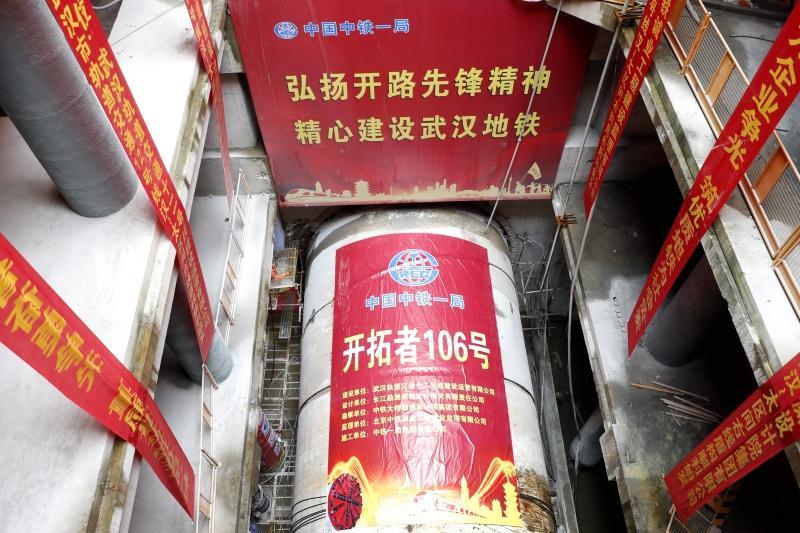
Core Points - The Wuhan Metro Line 12 has reached a critical milestone with the successful launch of the right-line tunnel boring machine, entering the dual-line synchronous excavation phase between Hangang Station and Hanxi Road South Station [1][3] - Once completed, the metro will allow passengers to cross the Han River in approximately 2 minutes, enhancing the efficiency of cross-river transportation in Wuhan [1] Construction Details - The tunnel section is a key control project, constructed by China Railway's subsidiary, China Railway Construction Investment, with China Railway First Group as the contractor [3] - The left tunnel is 1,372 meters long, and the right tunnel is 1,379 meters long, requiring the boring machine to operate approximately 30 meters underground through a clay layer and under 10 significant structures, including the Han River and Metro Line 1 [3] - To minimize ground disturbance during the dual-line excavation, a staggered launch plan was implemented, with the left line starting on October 20 and the right line on October 31 [3] Geological Challenges - The construction site presents complex geological conditions, including thick mud layers, loose sand layers, hard bedrock, and fractured zones, particularly under the Han River [3] - The underwater segment of the tunnel spans 347 meters, accounting for over 25% of the total length, with challenges such as a maximum cover depth of 41.2 meters and a maximum water pressure of 0.4 MPa [3] Safety and Quality Control - The construction team employs real-time monitoring of river surface dynamics, optimized boring tools, and a composite reinforcement technique to ensure safety and precision during excavation [3][4] - The project manager, a young professional with ten years of experience, emphasizes a "five no" quality standard: no pollution, no misalignment, no damage, no leakage, and no exceedance, which is integrated throughout the construction process [4][5]
挑战极限控沉降 达到盾构施工新高度 地铁12号线顺利下穿运营线路
Chang Jiang Ri Bao· 2025-07-30 02:16
Core Points - The Wuhan Metro Line 12 is the city's first circular metro line, connecting seven central urban areas and enhancing urban transportation and resource flow [1] - As of now, 33 out of 37 stations have completed their main structures, with ongoing renovations and installations [1] - The project emphasizes the integration of party leadership and engineering excellence, showcasing a model of "Party Building + Engineering Construction" [1][7] Construction Techniques - The construction of the Line 12 section between Hoh Lake Fourth Road and Xingye Road achieved "zero settlement," indicating minimal impact on existing metro lines [2] - Advanced monitoring techniques are employed, with automated monitoring every three minutes to control tunnel settlement and ensure safety [3] - Technologies such as ultrasonic testing and seepage monitoring are utilized to maintain the integrity of underground structures [3][4] Quality Control and Standardization - A comprehensive quality control manual for the electrical and mechanical systems has been developed to ensure material and process standardization [6] - The project team has created a "pocket book" and training videos to facilitate understanding of quality standards among construction personnel [6] - The complexity of urban metro construction necessitates a multidisciplinary approach, requiring personnel to be proficient across various fields [6] Organizational Commitment - The Wuhan Metro Company emphasizes the integration of party work with operational goals, aiming to enhance the city's transportation capabilities [7] - The project is seen as a significant contributor to the high-quality development of Wuhan's urban transit system [7]