毛竹

Search documents
住“别墅”、吃毛竹 五只大熊猫抵榕后“组团”亮相
Yang Shi Xin Wen Ke Hu Duan· 2026-01-19 08:22
Core Viewpoint - The Chengdu Research Base of Giant Panda Breeding collaborates with Fuzhou Panda World to promote giant panda education, with five pandas recently arriving and being introduced to the public after a brief adaptation period [1]. Group 1: Panda Introduction and Habitat - Five giant pandas named "Jingliang," "Ailun," "Hongrong," "Qicheng," and "Qihang" have successfully arrived at Fuzhou Panda World and are now on display to the public [1]. - Each panda has its own spacious "villa" exceeding 700 square meters, designed to simulate their natural habitat with varied terrain and abundant vegetation [1]. Group 2: Enrichment and Care - The facility includes various enrichment measures to meet the physiological and psychological needs of the pandas, such as climbing structures and water pools [2]. - Indoor areas are equipped with central air conditioning, fresh air systems, and temperature control alarms to ensure the pandas remain comfortable even during hot weather [4]. Group 3: Diet and Nutrition - The pandas' diet consists of bamboo, with each panda consuming an average of 100 pounds daily, while "Ailun" and "Jingliang" consume up to 120 pounds [5]. - A temperature and humidity-controlled cold storage facility has been established to ensure a steady supply of food for the pandas [5]. Group 4: Visitor Engagement - In addition to the five giant pandas, twelve red pandas are also present at the facility and will be introduced to the public in stages [6]. - Fuzhou Panda World has become a popular destination for local residents and tourists, establishing itself as a new landmark in Fuzhou [6].


余杭百丈村民“喜提”1390余万元
Hang Zhou Ri Bao· 2026-01-13 02:54
Group 1 - The core viewpoint of the articles highlights the successful implementation of a systematic policy in Yuhang District to promote the collective management of bamboo forests, resulting in significant financial benefits for local villagers [1][2] - Over 3,000 households in villages such as Banshan, Shizhu Garden, Baizhang, Xianyan, and Xikou have received a total of over 13.9 million yuan in subsidies, with individual households receiving up to 30,000 yuan [1] - The district has achieved a large-scale transfer of bamboo forests covering 143,700 acres, generating approximately 34.58 million yuan in rental payments to farmers, providing them with a stable income source [1] Group 2 - Yuhang District is continuously exploring high-quality development in the bamboo industry, forming a comprehensive industrial chain from nurturing bamboo on the mountain to processing and operating it in the valley [1] - The establishment of the first bamboo material physical decomposition point in Sixi Village has led to over 60,000 tons of initial bamboo processing, positioning the bamboo industry as a key driver of regional green development [1] - Yuhang's bamboo industry system is being recognized for its innovative achievements, with the approval of the first provincial pilot for forestry ecological product value projects, aiming to transform ecological resources into financial assets [2]
浙江深化集体林权制度改革 拓宽山区共富路径
Xin Lang Cai Jing· 2025-12-19 14:22
Core Viewpoint - Zhejiang Province is deepening the collective forest rights system reform to transform resources into assets, live trees into cash, and farmers into shareholders, thereby promoting green transformation in the forestry industry and common prosperity in mountainous areas [1][3]. Group 1: Reform Mechanisms - The reform focuses on four innovative mechanisms: cooperative shareholding operation, efficient land use, socialized forestry services, and financial support for forestry [3][4]. - An example of the cooperative shareholding mechanism includes a model that integrates "cooperative shares + storage platform + trading platform," facilitating the transfer of forest land management rights [4]. - In Xinchang County, 95,000 acres of inefficient forest land have been transferred, leading to the establishment of 80 large-scale fragrant nut bases, generating over 16 million yuan annually for the county [3]. Group 2: Achievements of the Reform - The reform has led to continuous growth in forest resources, steady enhancement of the forestry industry, increased income for farmers in mountainous areas, and further release of development potential [4]. - In Yuhang District, the unified transfer of bamboo resources has resulted in an average annual income increase of 718.5 million yuan for village collectives and over 2,000 yuan for individual farmers [4]. Group 3: Development of Under-Forest Economy - Zhejiang is promoting the under-forest economy through large-scale, characteristic, and full-chain development, focusing on various industries such as medicinal plants, fungi, and special breeding [5]. - The comprehensive output value of the under-forest economy is expected to exceed 117 billion yuan in 2024, with over 1,000 demonstration bases established, covering more than 310,000 acres and benefiting 1.07 million farmers [5].
集体林权制度改革|江西:亿亩山林“点翠成金”
Zhong Guo Zi Ran Zi Yuan Bao· 2025-11-28 06:16
Core Viewpoint - Jiangxi Province is actively implementing collective forest rights reform, enhancing the economic value of forest resources and improving the livelihoods of local communities through innovative policies and practices [5][14]. Group 1: Forest Rights Reform - Jiangxi has over 60% of its land as forest, with more than 85% of forest land owned collectively, making collective forest land a crucial production resource for farmers [7]. - The province has extended the contract period for collective forest land, ensuring long-term stability for land rights, with 8.74 million acres of contracts extended [7]. - Innovative management systems and databases have been established, resolving historical issues and issuing over 63,400 property rights certificates [7][8]. Group 2: Economic Activation of Forest Resources - Jiangxi has introduced a forest management rights certificate system, allowing for the transformation of dormant assets into liquid capital, with 2,301 certificates issued covering 900,200 acres [8]. - The quantification of collective forest land income rights has led to significant income increases for villagers, with some households receiving over 50,000 yuan [9]. - The province has optimized logging methods, resulting in a 9% increase in collective timber harvesting from January to August 2025 [11]. Group 3: Sustainable Development and New Industries - Jiangxi is developing a modern forestry industry system focusing on oil tea, bamboo, and under-forest economy, with over 15 specialized industrial parks established [15]. - The total forestry output value reached 713 billion yuan, with a year-on-year growth of 9.7%, positioning Jiangxi among the top provinces in the country [15]. - The province has initiated a financial support policy for new forestry operating entities, with 5,988 new entities established, covering 31 million acres of land [13]. Group 4: Financial Innovations and Carbon Trading - Jiangxi has developed a mechanism for forest rights collateral and financial support, raising 1.367 billion yuan for fragmented forest rights [16]. - The province is engaging in carbon trading projects, with 256,540 tons of carbon credits approved, transitioning from timber sales to carbon credits and ecological products [17]. - The establishment of trading scenarios for ecological products is expected to generate a cumulative transaction volume of 15 billion yuan [17].
江西抚州绿水青山变“幸福靠山”
Jing Ji Ri Bao· 2025-11-01 23:10
Core Insights - Jiangxi Province's Fuzhou City has successfully revitalized its bamboo forests through innovative forestry reforms, significantly increasing productivity and profitability [1][2] - The city has implemented a series of groundbreaking forestry measures, achieving a dual win of ecological protection and economic development, aiming for a transition from "millions of forestry resources" to "hundreds of billions in output value" [1][3] Group 1: Forestry Reform Initiatives - Fuzhou has pioneered the extension of land contracting rights, allowing farmers and operators to secure long-term investments, with over 31,200 contracts completed covering 412,300 acres [2] - The city has resolved over 790,000 historical issues related to land rights and issued 26,800 land rights certificates, covering 1,893,600 acres [2] Group 2: Financial Innovations and Business Environment - The establishment of the first "Two Mountains Bank" in the country has integrated various forestry resources, enabling the issuance of forestry operating income rights certificates, with one company receiving a bank credit of 7.8 million yuan [3] - The city has streamlined administrative processes for logging, significantly improving the business environment for forestry enterprises [3] Group 3: Development of Forestry Technology and Economy - Fuzhou has initiated the construction of ten forestry technology industrial parks, fostering 376 new business entities and promoting industries such as forest medicine and forestry fragrances [3] - The total output value of the under-forest economy has reached 36.5 billion yuan, involving 260,000 households [3] Group 4: Forest Health and Tourism - Fuzhou has established a comprehensive network of forest health tourism bases, with 10 national and 27 provincial bases, enhancing local income opportunities through eco-tourism [4]
5.3公里的承诺让7000亩毛竹出山不再难
Hang Zhou Ri Bao· 2025-10-16 02:38
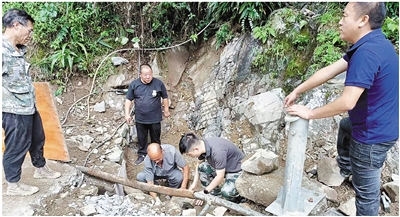
Core Viewpoint - The renovation of the "Mao Bamboo Road" in Shigu Village is a significant step towards improving local transportation and enhancing the economic prospects of the villagers, enabling better access for agricultural products [4][5][8]. Group 1: Project Overview - The "Mao Bamboo Road" is a 5.3-kilometer cement road connecting Jinjiling to Dakengyuan, which was previously a narrow and poorly maintained path [4][5]. - The road renovation project was initiated due to the deteriorating condition of the existing road, which had become a bottleneck for villagers' travel and agricultural development [5][6]. Group 2: Community Involvement - Wang Qidong, a cadre from Hangzhou Jiaotou Construction Management Group, played a crucial role in identifying the road's issues and advocating for its repair [6][7]. - The local community, including village leaders and residents, formed a voluntary supervision team to oversee the construction quality during the renovation [7][10]. Group 3: Technical Aspects - Wang Qidong conducted a thorough investigation of the road's condition, documenting over 200 photos of damages and identifying 37 critical sections needing repair [7]. - The final decision was made to upgrade the road to a cement surface instead of asphalt due to local climatic conditions that could cause ice formation in winter [7][8]. Group 4: Funding and Support - The Hangzhou Jiaotou Construction Management Group contributed 1 million yuan (approximately 0.15 million USD) to support the road renovation project [7]. - The project officially commenced on August 29, with an expected completion date in mid-November [7][8].