
林业

Search documents
国泰君安期货商品研究晨报:黑色系列-20260326
Guo Tai Jun An Qi Huo· 2026-03-26 02:08
1. Report Industry Investment Rating No information provided in the report. 2. Core Viewpoints of the Report - The report provides investment outlooks and strategies for various commodities in the black series, including iron ore, rebar, hot - rolled coil, ferrosilicon, silicomanganese, coke, coking coal, thermal coal, and logs. Each commodity has its own market situation and price trend, with most showing wide - range fluctuations or price adjustments [2]. 3. Summary by Commodity Iron Ore - **Price Trend**: Negotiations have a缓和 expectation, and the price is in a回调 state. The futures price of I2605 is 806.5 yuan/ton, down 17.5 yuan/ton or 2.12% from the previous day. The spot prices of various types of iron ore have also declined to varying degrees [2][4]. - **Fundamentals**: The price increase is driven by cost and inventory structural contradictions, including rising energy costs and freight, low available port inventory, and restricted deliverable products. The 247 steel enterprises' daily average hot metal output is 228.18 million tons, a 6.95 - million - ton increase from the previous period [4][5]. - **Trend Intensity**: 0, indicating a neutral trend [6]. Rebar and Hot - Rolled Coil - **Price Trend**: Both are in a wide - range fluctuation state. The closing prices of RB2605 and HC2605 are 3,132 yuan/ton and 3,313 yuan/ton respectively, with decreases of 13 yuan/ton and 8 yuan/ton [8]. - **Fundamentals**: In March 2026, the steel inventory of key steel enterprises increased. The daily output of steel products decreased. The production and sales data of steel products in January - February 2026 also showed a downward trend. The real estate investment decreased, while the industrial added value and fixed - asset investment increased. The import and export volumes of steel and iron ore also changed [8][10]. - **Trend Intensity**: 0 for both, indicating a neutral trend [10]. Ferrosilicon and Silicomanganese - **Price Trend**: Ferrosilicon is affected by sector sentiment and shows wide - range fluctuations. Silicomanganese has a firm manganese ore market, and its intraday fluctuations intensify. The prices of futures contracts have changed slightly, and the spot prices of ferrosilicon and silicomanganese have decreased [12]. - **Fundamentals**: There are industry news about price changes and production adjustments. Some silicon - manganese plants plan to start production cuts on April 1, but as of now, they are still in a high - production state. Some silicon - iron furnaces have resumed production [12][14]. - **Trend Intensity**: 0 for both, indicating a neutral trend [14]. Coke and Coking Coal - **Price Trend**: Both are in a wide - range fluctuation state due to Indonesia's levy of windfall taxes on coal exports. The futures prices of JM2605 and J2605 have decreased, and the spot prices of some types of coking coal and coke have changed [15][16]. - **Fundamentals**: The CCI metallurgical coal index has changed. The price difference between Australian coking coal and domestic coking coal has narrowed, and the Australian coking coal price is still inverted. The domestic market has a good trading atmosphere, and most coal prices have increased [16]. - **Trend Intensity**: 0 for both, indicating a neutral trend [18]. Thermal Coal - **Price Trend**: The market sentiment is strong, and port transactions have moved up. The prices of coal in different regions and ports have increased to varying degrees [19]. - **Fundamentals**: The port market sentiment is average, with more upstream offers and weak downstream demand. The cost - side support is strong, and the short - term price increase may slow down or stabilize. The national raw coal output from January - February 2026 decreased slightly [19][20]. - **Trend Intensity**: 1, indicating a relatively strong trend [20]. Logs - **Price Trend**: The cost expectation is weakening, and the price is in a回调 state. The prices of futures contracts and spot logs have changed, with some showing price decreases and some showing small increases or no changes [21]. - **Fundamentals**: The government work report focuses on stabilizing expectations, adjusting the structure, preventing risks, and promoting reforms, with a more pragmatic GDP growth target and an increase in the scale of policy - based financial instruments [23]. - **Trend Intensity**: 0, indicating a neutral trend [24].
国泰君安期货商品研究晨报:黑色系列-20260316
Guo Tai Jun An Qi Huo· 2026-03-16 01:59
Report Industry Investment Rating - Not provided in the content Core Viewpoints - The report analyzes the market trends of various commodities in the black series, including iron ore, rebar, hot - rolled coil, ferrosilicon, silicomanganese, coke, coking coal, thermal coal, and logs. Each commodity has its specific price trend and influencing factors, such as cost changes, supply - demand relationships, and macro - industry news [2][4][7][11][14][15][18][20] Summary by Commodity Iron Ore - **Price Trend**: Near - term strong, long - term weak, with a positive spread arbitrage opportunity. The I2605 contract rose 2.01% to 811.5 yuan/ton, and the open interest decreased by 9,239 hands. Spot prices of imported and domestic ores mostly rose [4] - **Influencing Factors**: Near - term, the escalation of the US - Iran conflict increased energy costs, and potential restrictions on BHP iron ore purchases drove up prices. The 2026 government work report adjusted the GDP growth target and increased the scale of policy - based financial instruments. The daily average pig iron output of 247 steel enterprises decreased by 6.39 tons [4][5] Rebar and Hot - Rolled Coil - **Price Trend**: The cost center has risen, and prices are in a wide - range oscillation. The RB2605 contract of rebar rose 0.58%, and the HC2605 contract of hot - rolled coil rose 0.52%. Spot prices in different regions showed varying degrees of increase [7] - **Influencing Factors**: According to the weekly data of Steel Union on March 12, rebar production increased by 21.99 tons, hot - rolled coil production decreased by 5.85 tons. Total inventory of rebar increased by 18.49 tons, and hot - rolled coil decreased by 0.1 tons. Apparent demand for both increased. In February 2026, China's steel imports decreased, exports increased, and relevant macro - policies were introduced [8][9] Ferrosilicon and Silicomanganese - **Price Trend**: The market's long and short sentiments continue to compete, and prices are oscillating. Futures prices of ferrosilicon decreased, while those of silicomanganese increased [11] - **Influencing Factors**: The prices of ferrosilicon and silicomanganese in different regions were reported by Ferrous Alloys Online. Some silicon - iron plants resumed production, and steel mills' procurement prices and quantities for ferrosilicon and silicomanganese varied [11][13] Coke and Coking Coal - **Price Trend**: The enthusiasm for downstream replenishment is fermenting, and prices are in a wide - range oscillation. The JM2605 contract of coking coal rose 2.2%, and the J2605 contract of coke rose 0.6%. Some spot prices of coking coal increased [15] - **Influencing Factors**: On March 13, the CCI metallurgical coal index of some coking coals changed. The coking coal online auction had no unsold lots, with an average premium of 47.85 yuan/ton, and most prices rose [15] Thermal Coal - **Price Trend**: Supply and demand are loosening, and coal prices are回调. The prices of coal in production areas, ports, and overseas showed different trends, and the long - term agreement prices in March changed slightly [18] - **Influencing Factors**: The port thermal coal market continued to be weak on March 13. Port inventory accumulated, and downstream demand was weak due to the seasonal off - peak. China's coal imports from January to February 2026 increased year - on - year, with Mongolian coal imports being the main support [19] Logs - **Price Trend**: Supply has recovered, inventory has accumulated, and log prices have回调. Futures prices of different contracts showed small increases, and trading volumes mostly decreased [20] - **Influencing Factors**: On the demand side, port departure was slow; on the supply side, port arrival recovered rapidly, leading to inventory accumulation. The 2026 government work report adjusted the GDP growth target, and Shanghai optimized real - estate policies [22]
天风证券总裁被罚款140万!此前刚被公布罚款300万
梧桐树下V· 2026-03-14 06:28
Core Viewpoint - Tianfeng Securities and its president Wang Linjing have faced administrative penalties for failing to disclose significant shareholding changes and for major omissions in annual reports from 2020 to 2022, leading to fines totaling 1.4 million yuan and 3 million yuan respectively [1][2][6]. Group 1: Administrative Penalties - On March 13, 2026, the Fujian Securities Regulatory Bureau issued a penalty against Wang Linjing for failing to timely disclose Tianfeng Securities' shareholding changes in Yong'an Forestry, which amounted to 41,372,005 shares, representing 12.29% of the total shares [1][4][5]. - Wang Linjing was fined 1.4 million yuan and received a warning for his direct responsibility in the failure to disclose this information [6]. - On March 12, 2026, the Hubei Securities Regulatory Bureau also penalized Tianfeng Securities and five individuals, including Wang Linjing, for significant omissions in annual reports from 2020 to 2022, resulting in a total fine of 3 million yuan for Wang Linjing [2][6]. Group 2: Disclosure Violations - Tianfeng Securities failed to disclose its financing activities with its major shareholder, the Contemporary Group, which included providing 5.502 billion yuan in financing from 2020 to 2022 [17][18]. - The company also did not disclose significant non-operating fund occupations by the Contemporary Group, which amounted to 1.475 billion yuan in 2020 and 695 million yuan in 2021, representing 12.17% and 3.98% of Tianfeng Securities' net assets respectively [21]. - The company was found to have issued 13 bonds from 2020 to 2023, with related disclosures referencing the annual reports that contained significant omissions [26].



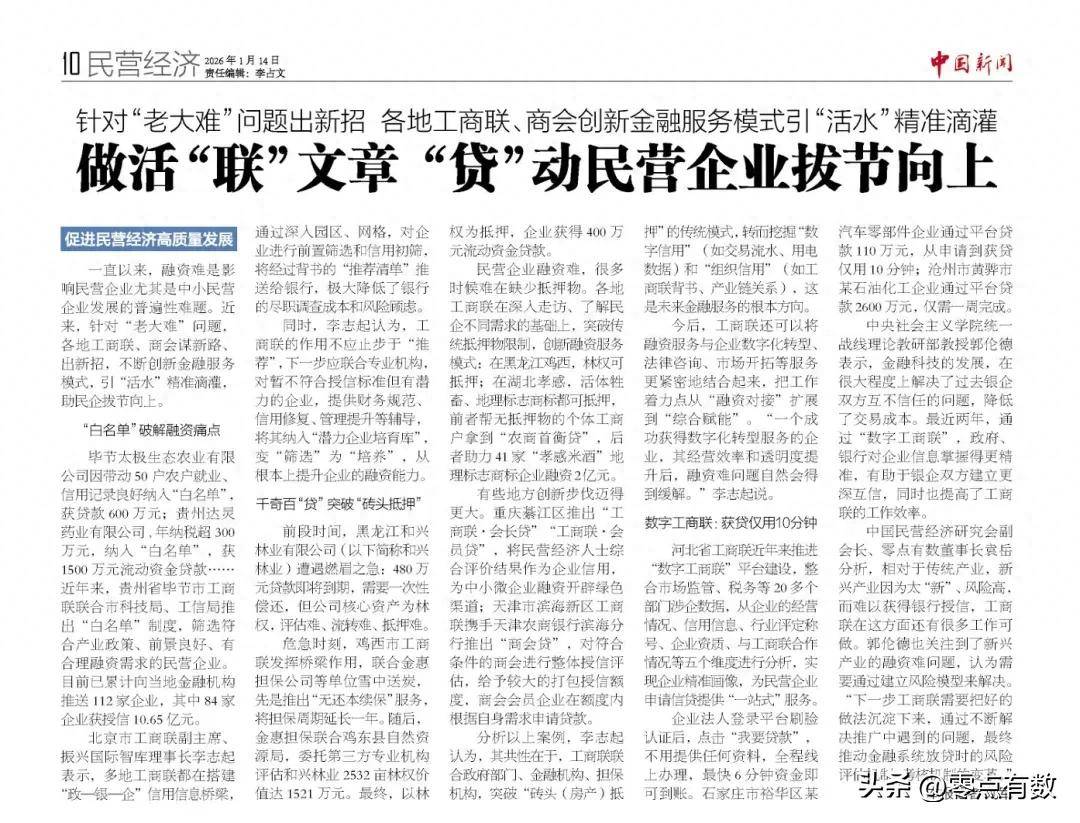
“联”合破局,民企融资迎来活水
Sou Hu Cai Jing· 2026-02-28 03:42
Core Viewpoint - The persistent issue of financing difficulties for private enterprises, especially small and medium-sized ones, is being addressed through innovative financial service models and collaboration among local business associations, government, and financial institutions [1][4]. Group 1: Financing Challenges and Solutions - Financing difficulties have long been a common challenge affecting the development of private enterprises, particularly small and medium-sized ones [4]. - Local business associations and chambers of commerce are exploring new paths and innovative financial service models to provide targeted support for private enterprises [4]. - The "white list" system in Bijie City, Guizhou Province, has successfully identified and supported 112 enterprises, resulting in a total credit of 1.065 billion yuan [4]. Group 2: Innovative Financial Models - Various regions are breaking traditional collateral requirements by allowing alternative forms of collateral, such as forest rights in Heilongjiang and live livestock in Hubei [5][6]. - The introduction of "business association loans" in Chongqing and "chamber of commerce loans" in Tianjin demonstrates a shift towards using comprehensive evaluations of private economic individuals as credit for financing [6]. Group 3: Digital Transformation and Financial Services - The integration of financing services with digital transformation, legal consulting, and market expansion is seen as a way to enhance overall enterprise capabilities [7]. - The "Digital Business Association" platform in Hebei Province allows for a streamlined loan application process, enabling quick access to funds for enterprises [7]. - Financial technology advancements are helping to build trust between banks and enterprises, reducing transaction costs and improving efficiency [7]. Group 4: Addressing Emerging Industry Financing - New industries face significant challenges in obtaining bank credit due to their novelty and associated risks, indicating a need for further efforts from business associations [8]. - Establishing risk models for new industries is suggested as a way to improve financing access and transform risk assessment mechanisms within the financial system [8].
国泰君安期货商品研究晨报-黑色系列-20260226
Guo Tai Jun An Qi Huo· 2026-02-26 02:24
1. Report's Industry Investment Ratings - Not provided in the given content 2. Core Views of the Report - The report provides daily research on the black series of commodities in the futures market, including iron ore, rebar, hot-rolled coil, ferrosilicon, silicomanganese, coke, coking coal, thermal coal, and logs, and gives corresponding trend judgments and investment suggestions [1][2] - The real estate policy is optimized and adjusted, which has an impact on the prices of related black series products. For example, the expectation of the real estate market warms up, which leads to the rebound of iron ore prices and the upward trend of log prices [2][4] - Macroeconomic factors and industry news have an impact on the market trends of commodities. For example, the temporary independent emission reduction notice during the two sessions affects the steel market, and the adjustment of coal production policies affects the coal market [5] 3. Summaries According to Relevant Catalogs Iron ore - **Price trend**: The price rebounds due to the warming expectation of the real estate market. The closing price of I2605 is 752.5 yuan/ton, up 12 yuan/ton or 1.62% [2][4] - **Fundamentals**: The prices of imported iron ore such as PB and Jinbuba have increased, while the price of super special iron ore has slightly decreased. The basis and spread have also changed to varying degrees [4] - **Industry news**: The real estate policy in Shanghai is optimized and adjusted, and some steel enterprises in North China receive temporary independent emission reduction notices during the two sessions [4][5] Rebar and hot-rolled coil - **Price trend**: Affected by macro - sentiment, the prices fluctuate repeatedly. The closing prices of RB2605 and HC2605 are 3,076 yuan/ton and 3,236 yuan/ton respectively, with increases of 1.72% and 1.19% [2][7] - **Fundamentals**: The trading volume and positions of the two have changed. The spot prices in different regions are relatively stable, and the basis and spread differences have also changed [7] - **Industry news**: The real estate policy in Shanghai is optimized and adjusted. The weekly data of steel production, inventory and apparent demand have changed, and the production and inventory of key steel enterprises have changed in January [8][9] Ferrosilicon and silicomanganese - **Price trend**: Affected by real estate sentiment, the sector fluctuates at a low level [2][11] - **Fundamentals**: The prices of futures and spot goods of ferrosilicon and silicomanganese have changed, and the basis, spread, and cross - variety spread have also changed [11] - **Industry news**: The prices of ferrosilicon and silicomanganese in different regions are reported, and the manganese ore price is firm [11][13] Coke and coking coal - **Price trend**: Both show wide - range fluctuations. The closing prices of JM2605 and J2605 are 1,126 yuan/ton and 1,674 yuan/ton respectively, with increases of 2.2% and 2.4% [2][14] - **Fundamentals**: The prices of futures and spot goods of coke and coking coal have changed, and the basis and spread differences have also changed [14] - **Industry news**: The CCI metallurgical coal index is reported, and the coking coal online auction situation is analyzed [14] Thermal coal - **Price trend**: The upstream quotation is firm, and the short - term coal price is strong. The price of Qinhuangdao Port's Shanxi - produced Q5500 is 732 yuan/ton, up 5 yuan/ton [19][20] - **Fundamentals**: The prices of coal in different producing areas, ports, and overseas have changed, and the long - term agreement price has also changed [20] - **Industry news**: The North Port market is stable and strong, the upstream quotation is high and firm, and the Indonesian coal production policy is adjusted [21] Logs - **Price trend**: Due to the warming expectation of the real estate market, the price fluctuates strongly. The closing prices of 2603, 2605, and 2607 contracts have increased to varying degrees [2][22] - **Fundamentals**: The trading volume, positions, and spreads of futures contracts and the prices of spot logs in different regions and varieties have changed [22] - **Industry news**: The real estate policy in Shanghai is optimized and adjusted, and the Trump administration plans to increase the temporary global tariff rate [24]
平潭发展股价涨5.98%,国泰基金旗下1只基金重仓,持有9800股浮盈赚取6468元
Xin Lang Ji Jin· 2026-02-26 01:45
Group 1 - Pingtan Development's stock price increased by 5.98% to 11.69 CNY per share, with a trading volume of 9.13 billion CNY and a turnover rate of 4.20%, resulting in a total market capitalization of 225.83 billion CNY [1] - The stock has risen for three consecutive days, with a cumulative increase of 5.45% during this period [1] - The company's main business segments include fiberboard sales (42.75%), commercial housing sales (36.79%), agricultural materials trade (13.81%), and other minor segments [1] Group 2 - Guotai Fund holds a significant position in Pingtan Development through its Guotai CSI 2000 ETF, which has 9,800 shares, accounting for 0.48% of the fund's net value, making it the second-largest holding [2] - The fund has generated a floating profit of approximately 6,468 CNY today and 5,586 CNY during the three-day increase [2] - The Guotai CSI 2000 ETF has a total scale of 31.29 million CNY and has achieved a year-to-date return of 12.33% [2]

平潭发展(000592.SZ):未有开展免税业务
Ge Long Hui· 2026-02-25 08:54
Core Viewpoint - Pingtan Development (000592.SZ) has clarified that it does not engage in duty-free business, focusing instead on forestry, timber product processing and sales, trade, and activities related to the development of the Pingtan Comprehensive Experimental Zone [1] Group 1 - The company primarily engages in afforestation and forest management [1] - The main business activities include processing and selling timber products [1] - The company is involved in trade activities related to its core business [1]
平潭发展(000592.SZ):公司未有开展免税业务
Ge Long Hui· 2026-02-25 08:54
Core Viewpoint - Pingtan Development (000592.SZ) has clarified that it does not engage in duty-free business, focusing instead on forestry, wood product processing and sales, trade, and activities related to the development of the Pingtan Comprehensive Experimental Zone [1] Group 1 - The company primarily engages in afforestation and forest management [1] - The company is involved in the processing and sales of wood products [1] - The company participates in trade activities [1] Group 2 - The company is associated with the development activities of the Pingtan Comprehensive Experimental Zone [1]
西北农林科技大学有个“杜仲军团”
Xin Lang Cai Jing· 2026-02-24 23:26
Core Insights - The article highlights the successful cultivation and commercialization of the Eucommia tree (杜仲) by Northwest A&F University, showcasing its potential as a sustainable resource for various industries [1][2]. Group 1: Cultivation and Economic Impact - In 2016, a company in Xinjiang began cultivating Eucommia trees on 200 acres of desert land, achieving an annual profit of over 3,000 yuan per acre [1]. - The cultivation area is set to expand by an additional 500 acres in the spring [1]. - The overall annual output value of the Eucommia industry in Lueyang County, Shaanxi Province, has exceeded 120 million yuan, making it the leading county for Eucommia cultivation in China [3]. Group 2: Research and Development - A team led by Zhang Kangjian at Northwest A&F University has been working since the 1980s to cultivate superior varieties of Eucommia, resulting in the first high-quality variety "Qinzhong No. 1" in 2003 [2]. - The team developed a new cultivation model that allows for a yield of 1.5 tons of dry leaves per acre, enhancing the resource's sustainability [2]. - Research has identified Eucommia leaves as a rich source of chlorogenic acid and flavonoids, while the bark is preferred for extracting Eucommia gum and specific glycosides [3]. Group 3: Industry Upgrades and Innovations - The extraction of Eucommia gum has been a bottleneck for industry upgrades, with new extraction technologies being developed to reduce energy consumption by 24% and solvent use by 60% [4][5]. - The development of a "rubber priority" extraction technology has achieved industrial-grade purity for Eucommia gum, positioning it as a potential substitute for natural rubber [5]. - The innovations have led to the creation of electromagnetic shielding materials from Eucommia gum, marking a significant advancement from theory to industry application [5].
高质量发展的生态底色更加鲜明
Jing Ji Ri Bao· 2026-02-24 22:08
Group 1: Green Transformation and Achievements - By 2025, China aims to complete land greening tasks covering 12.7 million hectares, including afforestation of 5.345 million hectares and restoration of 7.39 million hectares of degraded grasslands, with a current forest coverage rate of 25.09% and a forest stock volume of 20.988 billion cubic meters [2][3] - China has become the fastest-growing country in terms of greening, supported by planning, technology, engineering, and social participation, as highlighted by the National Forestry and Grassland Administration [2][3] - The ecological benefits are increasingly translating into economic and social benefits, with the forestry industry expected to generate nearly 11 trillion yuan in total output value by 2025, and direct employment for over 60 million people [3] Group 2: Clean Energy Development - By the end of 2025, the world's first commercial supercritical carbon dioxide power generation unit will be operational in Guizhou, achieving over 85% efficiency improvement compared to existing technologies [4] - China has established the world's largest clean power supply system, with renewable energy generation capacity exceeding 600 million kilowatts, accounting for over 60% of total power generation [4][5] - Energy investments are projected to exceed 3.5 trillion yuan in 2025, with a year-on-year growth of nearly 11%, driven by green transition investments and private sector participation [5] Group 3: Traditional Industry Transformation - The textile industry has made significant strides in green transformation, with companies like Shandong Jifa Group achieving waterless dyeing processes that reduce carbon emissions by approximately 50% [5] - Major energy-consuming industries, including construction materials and steel, have seen a notable decrease in energy consumption per unit of added value compared to 2024 [5][6] - The manufacturing sector is experiencing a surge in demand for energy-efficient and environmentally friendly equipment, driven by policy support and market needs [6] Group 4: Circular Economy and Resource Recovery - The circular economy is being promoted as a key strategy for reducing emissions, with projects like the electronic waste recycling facility in Guangdong processing approximately 39 tons of e-waste in 2025 [6] - The focus on transforming waste into valuable resources is a significant aspect of China's industrial system's shift towards sustainability [6]