江河战略

Search documents
中国—欧盟水政策对话机制第三次会议联合新闻稿
Shui Li Bu Wang Zhan· 2026-02-11 11:06
Core Viewpoint - The third meeting of the China-EU Water Policy Dialogue Mechanism emphasizes the urgent need for collaborative efforts to address global water challenges, highlighting the importance of water resource resilience and sustainable management strategies [1][3]. Group 1: Policy Measures and Strategies - The Chinese Ministry of Water Resources is committed to implementing a comprehensive water management strategy focused on water conservation, efficiency, and systemic governance, aligning with President Xi Jinping's directives [1][2]. - The EU's Water Resilience Strategy aims to restore and protect the water cycle, ensuring access to clean and affordable water while promoting a smart water economy [1][2]. Group 2: Technological Innovations - Both parties discussed the application of innovative digital tools to enhance water resilience, with China presenting its digital twin water management system for flood control and resource allocation [2]. - The EU introduced its digital action plan for the water sector, which includes the Copernicus Water Theme Center as a one-stop service for water data [2]. Group 3: Collaborative Efforts and Future Initiatives - The dialogue reaffirmed the shared responsibility of China and the EU to maintain a multilateral system and deepen cooperation in addressing global water challenges [3]. - Both sides are exploring joint activities at the upcoming 2026 UN Water Conference, focusing on water efficiency, digitalization, and sustainable development goals related to water [3]. Group 4: Historical Context and Development - China-EU water resource cooperation began in the early 21st century, with the establishment of the China-EU Water Resources Exchange Platform in 2012, further strengthened by a memorandum of understanding in 2017 [6]. - The EU Commission initiated a project in 2024 to support the activities of the China-EU Water Resources Exchange Platform, focusing on climate-adaptive basin management and water resilience [6].
“十四五”水利建设投资5.68万亿元
Zhong Guo Zheng Quan Bao· 2026-01-09 20:45
Group 1 - The core viewpoint of the articles highlights the significant progress in China's water conservancy infrastructure, with a total investment of 5.68 trillion yuan during the 14th Five-Year Plan period, and an expected investment of 1.28 trillion yuan by 2025, which will create 3.15 million jobs [1][2] - The construction of 181 major water conservancy projects has commenced, which is an increase of 65 projects compared to the previous five-year plan, with 94 projects completed and operational [1] - The national water network now covers 80.3% of the country's land area, providing essential water security for major strategic implementations and economic zones [1] Group 2 - By the end of 2025, the irrigated area of arable land is projected to reach 109 million acres, an increase of over 5.3 million acres from the end of the 13th Five-Year Plan, contributing to 80.76% of grain production [2] - The Ministry of Water Resources plans to focus on enhancing food security and agricultural water efficiency through the modernization of irrigation systems and the implementation of a comprehensive agricultural water-saving policy [2][3] - Major irrigation projects, such as the new large-scale irrigation areas in Guangdong and Jiangxi, are set to be developed, with a design irrigation area exceeding 6 million acres [3]
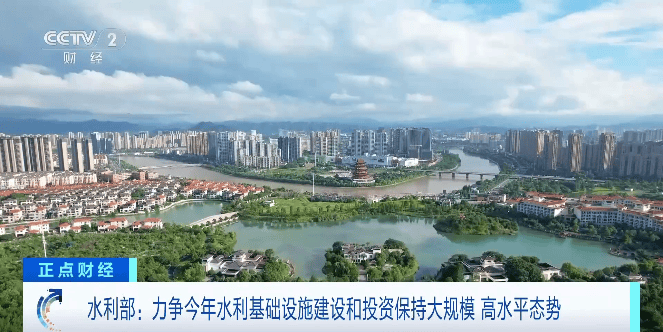
水利部:力争今年水利基础设施建设和投资保持大规模 高水平态势
Sou Hu Cai Jing· 2026-01-09 11:35
Core Viewpoint - The Ministry of Water Resources aims to maintain large-scale and high-level investment in water infrastructure construction as the starting year of the 14th Five-Year Plan approaches in 2026 [1][5]. Group 1: Investment and Infrastructure Development - The Ministry of Water Resources plans to implement the national "River Strategy" this year, focusing on both existing and new projects, as well as "hard investment" and "soft construction" to enhance the national water network [3]. - The goal is to ensure that water infrastructure construction and investment remain at a large scale and high level, promoting high-quality water development and ensuring water security in China [5]. Group 2: Modernization and Coverage Goals - During the 14th Five-Year Plan period, China will accelerate the construction of a modern water network that is comprehensive, safe, efficient, green, intelligent, and well-regulated [7]. - Key projects include the completion of the South-to-North Water Diversion Middle Line and the promotion of major inter-basin and inter-regional water diversion projects [7]. - The plan includes modernizing irrigation areas to add 40 million mu of irrigated farmland, increasing rural tap water coverage to 98%, and ensuring that large-scale water supply projects cover 78% of the rural population [7].

珠江水利委员会党组专题学习贯彻水利部流域管理机构座谈会精神
Shui Li Bu Wang Zhan· 2025-12-23 06:31
Core Viewpoint - The meeting emphasized the importance of implementing the national "river strategy" established by General Secretary Xi Jinping, focusing on unified governance and management of river basins to enhance river protection and management efforts [1][2] Group 1: Policy Implementation - The meeting highlighted the need to deeply learn and implement the spirit of the 20th Central Committee's Fourth Plenary Session, adhering to Xi Jinping's water management philosophy of prioritizing water conservation, spatial balance, systematic governance, and dual efforts [2] - It was stressed that the river management institutions should play a leading role in river governance, ensuring that the Ministry of Water Resources' directives regarding the "three rivers" are effectively integrated into the Pearl River's water management efforts [2] Group 2: Strategic Planning - The meeting called for a thorough political, strategic, and task-oriented alignment, focusing on clear objectives, logical planning, and effective implementation measures for the "14th Five-Year" water management work in the Pearl River basin [2] - There is an emphasis on the significance of scientifically formulating and continuously implementing five-year plans, promoting a unified approach across the commission to enhance the quality of development and ensure water security in the Pearl River [2]
长江水利委员会召开2025年第6次主任办公会议
Shui Li Bu Wang Zhan· 2025-12-16 12:31
Core Viewpoint - The meeting emphasizes the importance of implementing the guidelines from the Central Committee of the Communist Party of China and the State Council regarding comprehensive river protection and governance, aligning with Xi Jinping's water management philosophy and the national "river strategy" [1] Group 1 - The meeting is chaired by Liao Zhiwei, the Secretary of the Party Leadership Group and Director of the Yangtze River Water Resources Commission, focusing on the 2025 work plan [1] - The implementation of the guidelines is seen as a political requirement for enhancing water security and promoting the protection and governance of the Yangtze River Basin [1] - The meeting highlights the need to integrate water disaster management, water resource allocation, ecological protection, and environmental governance in the Yangtze River Basin [1]
松辽水利委员会召开2025年松辽流域水利规划计划工作座谈会
Shui Li Bu Wang Zhan· 2025-12-16 02:07
Core Viewpoint - The meeting organized by the Songliao Water Resources Committee focused on the planning and implementation of water resources strategies for the Songliao River Basin by 2025, emphasizing collaboration among various provinces and cities to enhance water management and infrastructure development [1][2]. Group 1: Meeting Overview - The Songliao Water Resources Committee held a meeting in Changchun to discuss the 2025 water resources planning for the Songliao River Basin, attended by representatives from five provinces and cities [1]. - The meeting included reports on the progress of water resources planning, project advancement, and investment execution from various regional water authorities [1]. Group 2: Strategic Emphasis - The meeting underscored the importance of adhering to Xi Jinping's thoughts on water management, focusing on water conservation, spatial balance, and systematic governance [2]. - It highlighted the need to align water resources work with national strategies for security and revitalization in Northeast China, promoting a unified approach to basin management [2]. Group 3: Key Initiatives - The meeting called for a comprehensive design for the "14th Five-Year Plan" to ensure long-term development and strategic security in the basin, including the preparation of major projects and plans [2]. - Emphasis was placed on accelerating the construction of significant water infrastructure projects and overcoming bureaucratic hurdles to facilitate project implementation [2]. - The need for integrated management of ecological protection, flood safety, and rational water resource use was discussed, aiming to enhance water security and environmental quality in the basin [2].
省委省政府与水利部在京举行工作会谈 李国英刘宁王凯出席
He Nan Ri Bao· 2025-12-12 10:54
Core Insights - The meeting between the provincial government of Henan and the Ministry of Water Resources emphasizes the importance of water management in supporting high-quality development in the region [1][2] Group 1: Government Initiatives - The Ministry of Water Resources will enhance support for Henan in major water projects, disaster prevention, resource conservation, and water rights trading reform [1] - Henan's government is committed to implementing the "1+2+4+N" target system to ensure economic stability and development while focusing on water safety and resource management [2] Group 2: Strategic Focus - The Ministry aims to align with President Xi Jinping's water management philosophy, which prioritizes water conservation, spatial balance, and systematic governance [1] - Henan's government plans to build a resilient modern water network and improve disaster prevention systems, while also enhancing ecological governance in the Yellow River floodplain [2]
2025长江文化南京论坛举行
Xin Hua Ri Bao· 2025-11-21 14:31
Group 1 - The forum emphasized the significance of the Yangtze River as a symbol of Chinese civilization and its role in shaping Jiangsu's geography, economy, and culture [1] - The forum aimed to deepen international cooperation among river basin countries, enhancing the protection and transmission of river culture while promoting green development [1][2] - The event highlighted the importance of high-quality development along the Yangtze River Economic Belt, aligning with the directives from the 20th Central Committee of the Communist Party of China [2] Group 2 - The forum featured discussions on the integration of historical culture preservation with urban green development and the revitalization of Yangtze culture [3] - Key initiatives announced included the "From Yangtze to Ocean" aquatic biological protection action plan and the launch of the "Eternal River - Yangtze Cultural Series" publishing project [3] - The forum attracted participation from various international organizations, think tanks, and government officials, indicating a collaborative approach to sustainable development [3]
抓铁有痕 踏石留印——“社会主义是干出来的”系列述评之三
Xin Hua She· 2025-10-20 02:57
Core Viewpoint - The article emphasizes the importance of the "Eight Regulations" implemented by the Chinese Communist Party, highlighting their role in promoting integrity and effective governance within the party and the country [2][4]. Summary by Sections Implementation of the Eight Regulations - The Eight Regulations, though concise, address significant issues such as corruption and waste, demonstrating a commitment to thorough governance [2]. - The approach involves tackling specific problems systematically, with a focus on various festivals and events to maintain discipline [2][3]. - The success of the Eight Regulations is seen as foundational for further regulations and party building efforts [2]. Leadership and Governance Philosophy - The article discusses the "nail-driving" spirit advocated by Xi Jinping, emphasizing the need for persistent and methodical efforts in governance [3]. - It highlights the importance of practical action over superficial efforts, advocating for a grounded and diligent approach to governance [4]. Regional Development Strategies - The article outlines the establishment of national strategies for regional development, including the "river strategy" and various economic zones, emphasizing systematic and coordinated efforts [6][7]. - It stresses the need for practical implementation of plans rather than mere rhetoric, with a focus on achieving tangible results [7]. Focus on Precision and Collaboration - The article underscores the importance of precision in reform efforts, targeting specific issues effectively, such as poverty alleviation and pollution control [8]. - It advocates for collaborative approaches in regional development, urging leaders to think beyond local interests for broader national goals [8]. Commitment to Continuous Improvement - The article concludes with a call for leaders to embody a spirit of responsibility and practical capability, ensuring that the decisions made by the central government are effectively executed [9].
绿水青山里的中国
Ren Min Ri Bao· 2025-08-14 22:10
Core Viewpoint - The article emphasizes the importance of water ecological environment protection in China, highlighting the government's commitment to improving water quality and promoting harmonious coexistence between humans and rivers [19]. Group 1: Government Initiatives - The Chinese government has prioritized water ecological environment protection as a key aspect of ecological civilization construction, addressing prominent water ecological issues as a priority for people's livelihoods [19]. - Major national strategies have been established, including the "Yangtze River Economic Belt Development" and "Yellow River Basin Ecological Protection and High-Quality Development" [19]. - Recent decisions, such as the April 2023 State Council meeting on beautiful river and lake protection and the June issuance of opinions on comprehensive river protection, aim to enhance water security and improve ecological conditions [19]. Group 2: Water Quality Improvement - The quality of water ecological environment in China has shown continuous improvement, with the proportion of national surface water quality monitoring points rated as good exceeding 90% for the first time [19]. - The article notes the transformation of local rivers from polluted to clear, contributing to a better living environment for citizens [19]. Group 3: Public Engagement - A public initiative called "I have a river in front of my house" has collected over 5,000 photographic submissions showcasing beautiful rivers and lakes, reflecting the positive impact of ecological improvements on community happiness and safety [20].