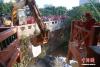
水陆两栖挖掘机

Search documents
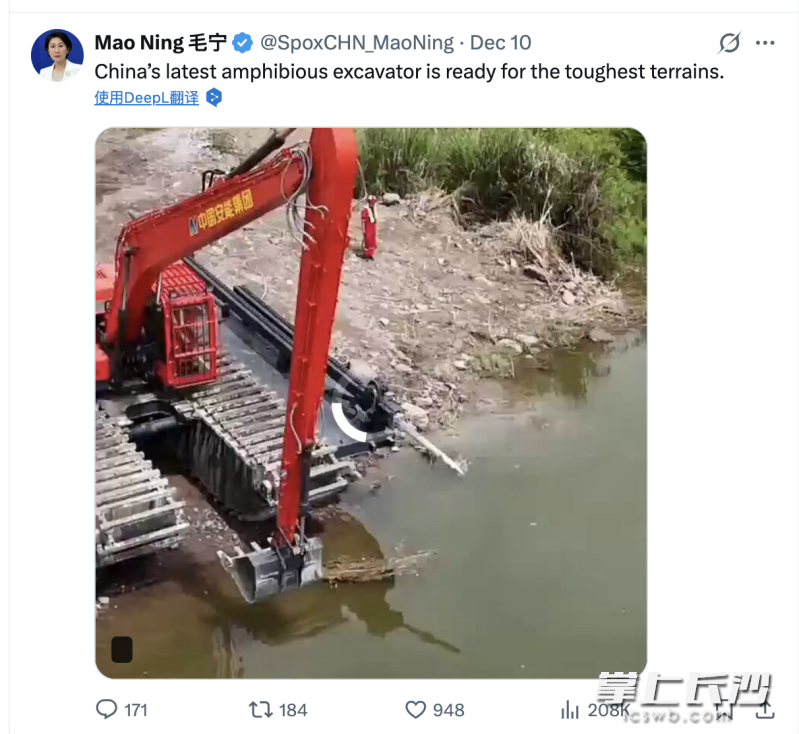
外交部发言人点赞的“救援利器”来自长沙
Chang Sha Wan Bao· 2025-12-12 12:39
Core Viewpoint - The Chinese amphibious excavator developed by Shanhe Intelligent is highlighted as a key rescue tool capable of operating in extreme terrains, receiving global attention through promotion by the Ministry of Foreign Affairs [1][3]. Group 1: Product Features - The amphibious excavator is designed for flood rescue and water engineering, combining the floating capabilities of a vessel with the operational strength of construction machinery [3]. - It has a buoyancy exceeding 60 tons and a navigation speed of up to 7 kilometers per hour, equipped with intelligent systems and remote control capabilities [3]. - The excavator features a telescopic floating box chassis for rapid transportation and can switch between various operational tools, allowing for multifunctional use [3]. Group 2: Operational Capabilities - The excavator is equipped with an anchor rod and propeller system, enabling autonomous navigation and fixed construction in deep water areas without relying on barges, enhancing its rescue capabilities in complex environments [5]. - It has been deployed in various real-world rescue operations, including emergency drills and actual disaster scenarios, demonstrating its effectiveness in flood and geological disaster response [5]. - The equipment has been reported on by major media outlets and is recognized as a critical tool for emergency rescue efforts in China [5]. Group 3: Future Developments - Shanhe Intelligent aims to continue advancing its technology to contribute to a stronger national emergency rescue system, emphasizing the importance of "Shanhe wisdom" and local capabilities [5].


看!应急救援的硬核力量
Guang Xi Ri Bao· 2025-10-14 01:40
Core Insights - The recent AI technology exhibition in Nanning showcased advanced emergency rescue products, highlighting the integration of AI in disaster response efforts [2][3] - The application of intelligent equipment during the recent flood rescue operations in Guangxi demonstrated a significant shift from manual to technology-driven emergency responses [4] - The collaboration between Guangxi and ASEAN countries aims to enhance regional disaster prevention and response capabilities through shared technology and resources [5][6] Group 1: Emergency Response Technology - The exhibition featured 18 AI systems and over 20 innovative applications, including a 119 emergency alert system that improves response speed by 20% [6] - The use of a fully automated sandbagging machine during drills can process 600 bags per hour, showcasing the efficiency of AI in emergency preparedness [3] - The integration of drones and robots in rescue operations has significantly reduced the time required to identify hazards from hours to minutes [3][6] Group 2: Regional Cooperation and Development - The 2025 China (Guangxi) - ASEAN Emergency Management Cooperation and Development Conference facilitated discussions on cross-border risk monitoring and AI disaster assessment [5] - A joint laboratory for fire product testing between China and ASEAN has been initiated to support mutual recognition of firefighting products [9] - The establishment of the Guangxi rescue team, which incorporates AI technology, aims to strengthen collaboration with ASEAN nations in emergency response [8][9] Group 3: International Collaboration - A recent multinational emergency rescue drill involved teams from 12 countries, emphasizing the importance of international cooperation in disaster response [7][8] - The drill adhered to international search and rescue guidelines, enhancing coordination and communication among participating nations [7] - The initiative to build a "firefighting AI cooperation hub" in Guangxi aims to foster sustainable international partnerships in disaster management [9]

救援利器集结 广西郁江南宁段工况稳定风险可控
Zhong Guo Xin Wen Wang· 2025-10-11 02:50
Core Viewpoint - The flood situation in Nanning, Guangxi is under control, with water levels in the Yujiang River gradually decreasing and the stability of the embankment being maintained [1][2]. Group 1: Emergency Response Measures - On October 9, over 1,500 personnel, 650 vehicles, and 2,000 tons of materials were mobilized for emergency response at the North University Bridge site, employing various strategies such as dynamic material transport and sandbag construction to address the flood threat [2]. - By 10 PM on October 9, the emergency team successfully blocked the seepage channel, significantly enhancing the overall stability of the embankment during the peak of the flood [2]. - Continuous monitoring of flow rates and surrounding hazards is being conducted as part of the ongoing emergency response efforts [2]. Group 2: Equipment and Technology Utilization - Advanced rescue equipment, including amphibious excavators and power ferry bridges, has been deployed to facilitate rescue operations and transport heavy equipment and materials via water routes [4][5]. - The use of amphibious excavators allows for excavation operations on water surfaces, aiding in clearing and creating access for rescue teams [4][7]. Group 3: Progress and Predictions - As of October 10, over 2,500 cubic meters of sand and gravel have been filled to reinforce the embankment, with core issues being largely resolved [6]. - The Nanning Hydrological Center predicts that the water level at the Yujiang Nanning Hydrological Station will drop to 74.9 meters by October 11 and further to the warning level of 73.0 meters by October 12 [6].