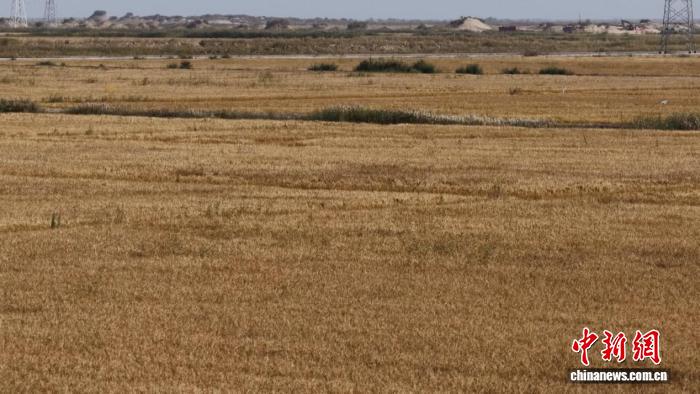
沙漠水稻

Search documents
视频丨技术改良盐碱地 新疆图木舒克沙漠水稻迎丰收
Yang Shi Xin Wen Ke Hu Duan· 2025-12-06 14:39
Core Viewpoint - The agricultural practices in Qianhai Town are successfully transforming saline-alkali land into productive rice fields through innovative irrigation and pest control methods, leading to a promising harvest of drought-resistant rice varieties by December 10. Group 1: Agricultural Practices - Qianhai Town's rice farmers are currently engaged in a busy harvest, with a single vehicle capable of processing approximately 200 acres per day, allowing for the completion of 4,000 acres in about 10 to 15 days [2] - The local agricultural team has implemented a "water-saving + alkali drainage" intermittent irrigation method, adjusting water levels according to the rice growth stages [4] - Techniques such as "water control and sun exposure" for pest management are being utilized to minimize chemical pesticide use, while local sunlight is leveraged to enhance pest control [5] Group 2: Soil Improvement Techniques - The agricultural team is focusing on improving desert soil by using local sunlight and water to eliminate pests without chemicals, which is a critical aspect of their strategy [5] - Methods such as local drainage of alkali and salt, along with straw return to the soil, are being employed to create a sustainable cycle of "using water to nourish rice, using rice to improve soil, and using soil to conserve water" [5] - The decomposition of straw after harvest significantly contributes to soil improvement by increasing organic matter [5]

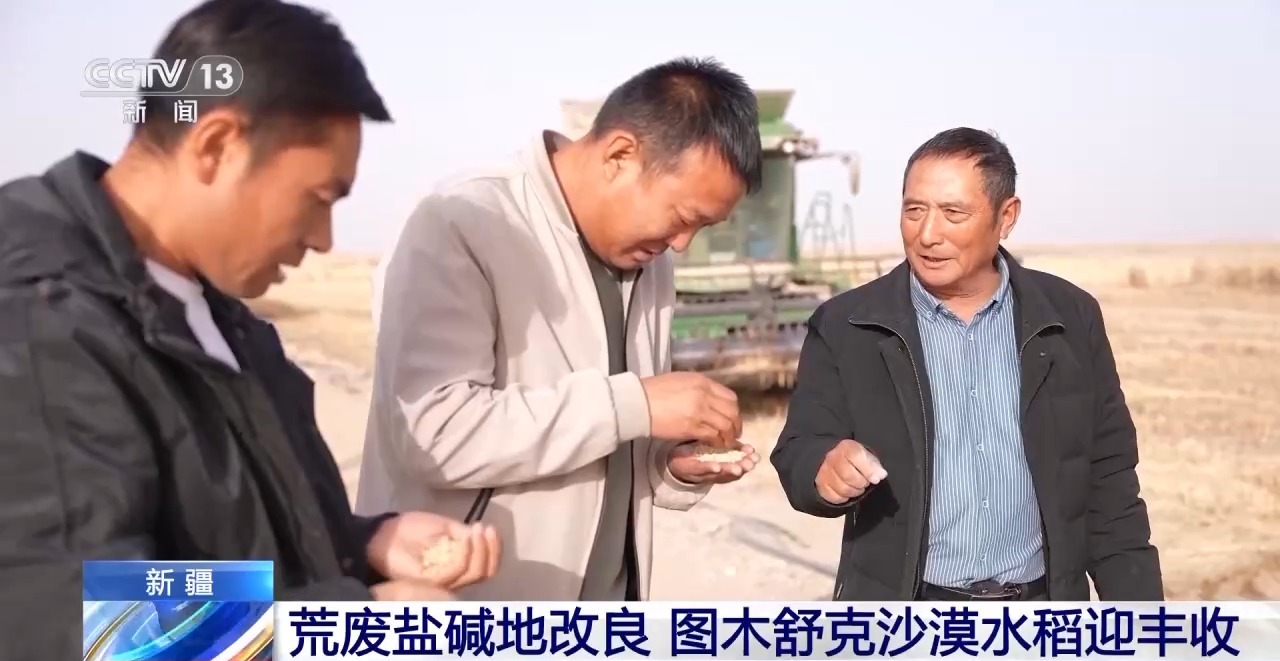
“量身定制”科学种田向沙漠要产量 “节水+排碱”助力荒废盐碱地喜迎丰收
Yang Shi Wang· 2025-12-06 13:44
Core Viewpoint - The agricultural transformation in Tumushuke City, Xinjiang, has led to a successful harvest of 4,000 acres of late-maturing desert rice, showcasing innovative farming techniques in challenging environments [1][3]. Group 1: Agricultural Practices - The rice is expected to be harvested by December 10, with the cultivation of drought-resistant and salt-tolerant rice varieties initiated since 2025 [3]. - The irrigation method employed is a "water-saving + salt drainage" intermittent irrigation system, allowing for flexible water management based on the rice growth stages [3]. - Local agricultural technicians utilize abundant sunlight for pest control through a "water control and sun drying" method, which reduces the need for chemical pesticides [6][8]. Group 2: Soil Improvement Techniques - Techniques such as local salt drainage and straw return are implemented to create a sustainable cycle of "using water to nourish rice, using rice to improve soil, and using soil to conserve water" [6]. - The process of washing away salt and alkalinity from the soil is crucial, with water needing to seep in locally to effectively remove salt [8]. - The decomposition of straw after harvesting significantly contributes to soil improvement by adding organic matter [8].
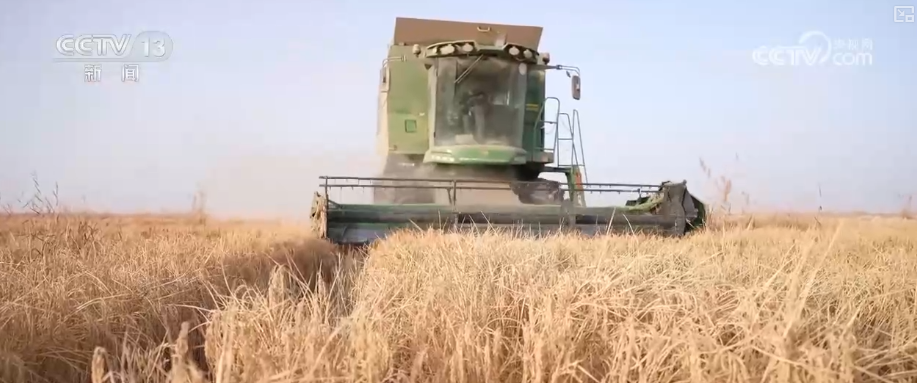
技术改良盐碱地 新疆图木舒克沙漠水稻迎丰收
Yang Shi Xin Wen Ke Hu Duan· 2025-12-06 12:36
Core Insights - The desert rice cultivation in Tumushuke City, Xinjiang, is experiencing a successful harvest, with 4,000 acres of late-maturing rice expected to be harvested by December 10 [1][3]. Group 1: Agricultural Practices - The local agricultural team has successfully transformed saline-alkali land by planting drought-resistant and salt-tolerant rice varieties, utilizing a "water-saving + alkali drainage" irrigation method [3]. - The irrigation strategy is flexible, adjusting water volume according to the different growth stages of the rice [3]. - To improve soil quality, techniques such as "water control and sun exposure" for pest control are employed, along with local practices like salt washing and straw returning to the soil [3]. Group 2: Pest Management - The pest management strategy avoids chemical pesticides, instead using water infiltration and sunlight to eliminate pests, which is a crucial aspect of the cultivation process [5]. - The approach also focuses on preventing soil salinization by ensuring water is absorbed locally to wash away salts [5]. Group 3: Soil Improvement - After harvesting, the decomposition of rice straw significantly contributes to soil improvement by adding organic matter [5].
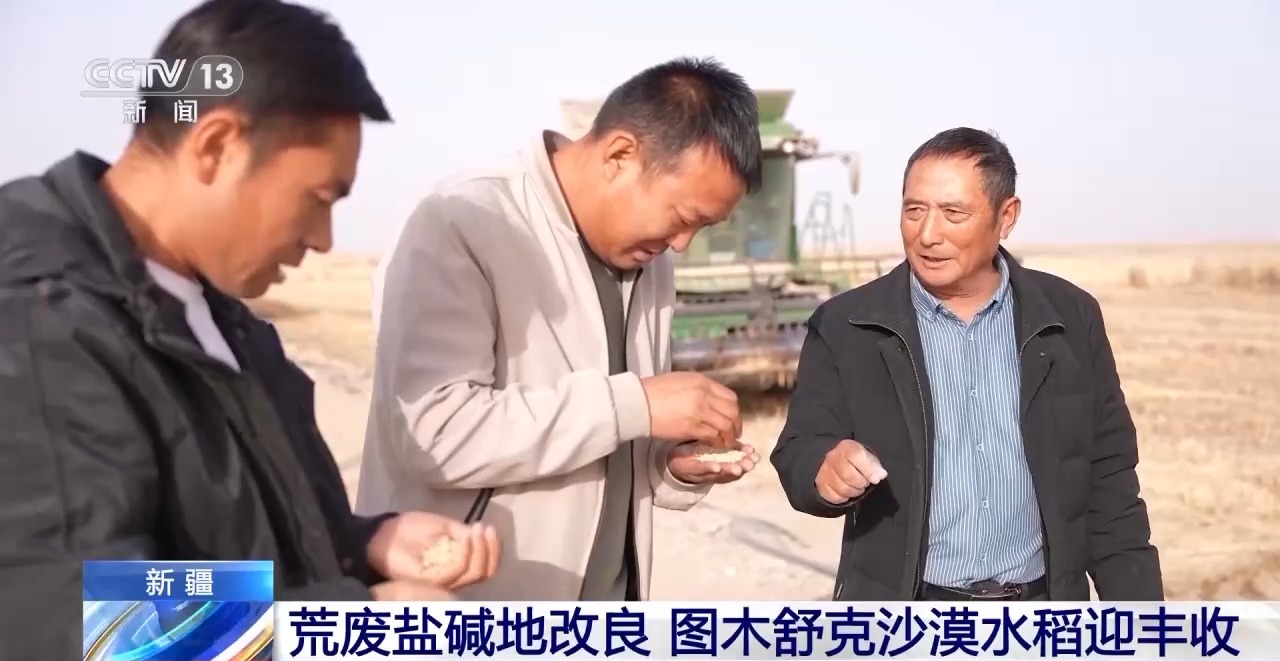
新疆阿拉尔市重盐碱地“沙漠水稻”首年平均亩产超600公斤
Zhong Guo Xin Wen Wang· 2025-10-16 10:42
Core Viewpoint - The successful cultivation of "desert rice" in Xinjiang's Aral City demonstrates the potential for high yields in saline-alkali land, with an average yield of 603.13 kg per mu in its first year, indicating a promising agricultural innovation for arid regions [1][5][7]. Group 1: Agricultural Innovation - The "desert rice" project covers over 40,000 mu, with 2,300 mu yielding an average of 603.13 kg per mu, showcasing the effectiveness of new rice varieties [1][3]. - The rice varieties used, New Jiang 9 and Taidao 8, are specifically bred for saline-alkali environments, highlighting advancements in agricultural biotechnology [3][5]. - The cultivation method includes dry direct seeding and a water-saving irrigation technique, which significantly reduces water costs while ensuring adequate moisture for the crops [3][5]. Group 2: Environmental Impact - The cultivation of rice in saline-alkali soil not only yields significant agricultural output but also contributes to ecological sustainability by promoting the leaching of salt, improving soil conditions for future crops like cotton and corn [5][7]. - The combination of salt-resistant varieties and efficient cultivation techniques provides a replicable model for agricultural practices in similar challenging environments [5][7]. Group 3: Future Prospects - The successful demonstration of salt-resistant rice varieties in Xinjiang serves as a model for potential large-scale production in southern Xinjiang and similar regions, paving the way for broader agricultural development [7].