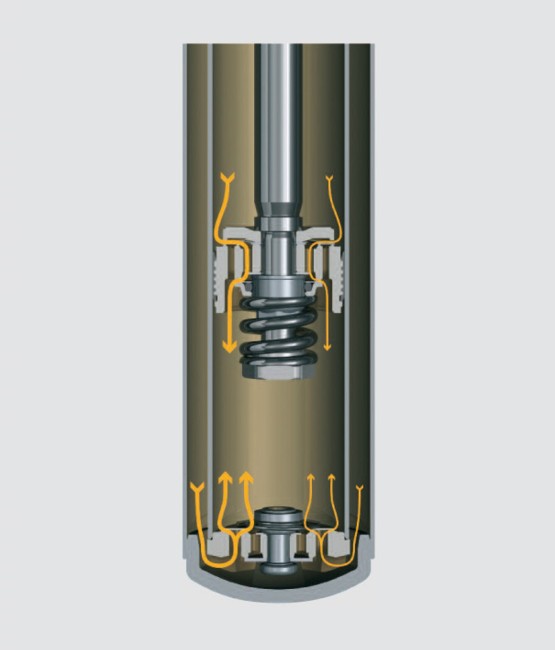
液压减振器

Search documents
磁流变悬架是什么?
Zhong Guo Zhi Liang Xin Wen Wang· 2025-10-16 08:10
Core Insights - The article discusses the importance of suspension systems in vehicles, focusing on their role in enhancing ride comfort and stability during driving. It highlights the evolution of suspension technologies, particularly the introduction of magnetorheological dampers as a significant advancement in this field [2][10]. Suspension Functions - The suspension system is crucial for vehicle stability, comfort, and handling. It typically consists of a combination of dampers and springs, with higher-end models utilizing variable damping and air suspension for improved performance [2][4]. Types of Dampers - The market primarily features passive hydraulic dampers and continuously variable damping dampers, which include electronic control for adjusting damping characteristics. These systems can enhance vehicle performance by adapting to driving conditions [4][10]. Magnetorheological Dampers - Magnetorheological dampers utilize a special fluid containing magnetic particles, allowing for rapid adjustments in damping force in response to an applied magnetic field. This technology enables a quick transition from liquid to a semi-solid state, providing superior damping capabilities [6][8][10]. Advantages of Magnetorheological Technology - Compared to traditional dampers, magnetorheological dampers offer faster response times (up to 1000 adjustments per second) and a broader range of damping force changes. This technology, although invented in the 1840s, gained commercial traction in the early 21st century, with companies like Delphi leading the development [10].