混合动力客车

Search documents
电动载人汽车出海月报|9月出口金额高位回落,南美等新兴市场增速领跑
Xin Lang Cai Jing· 2025-10-30 00:35
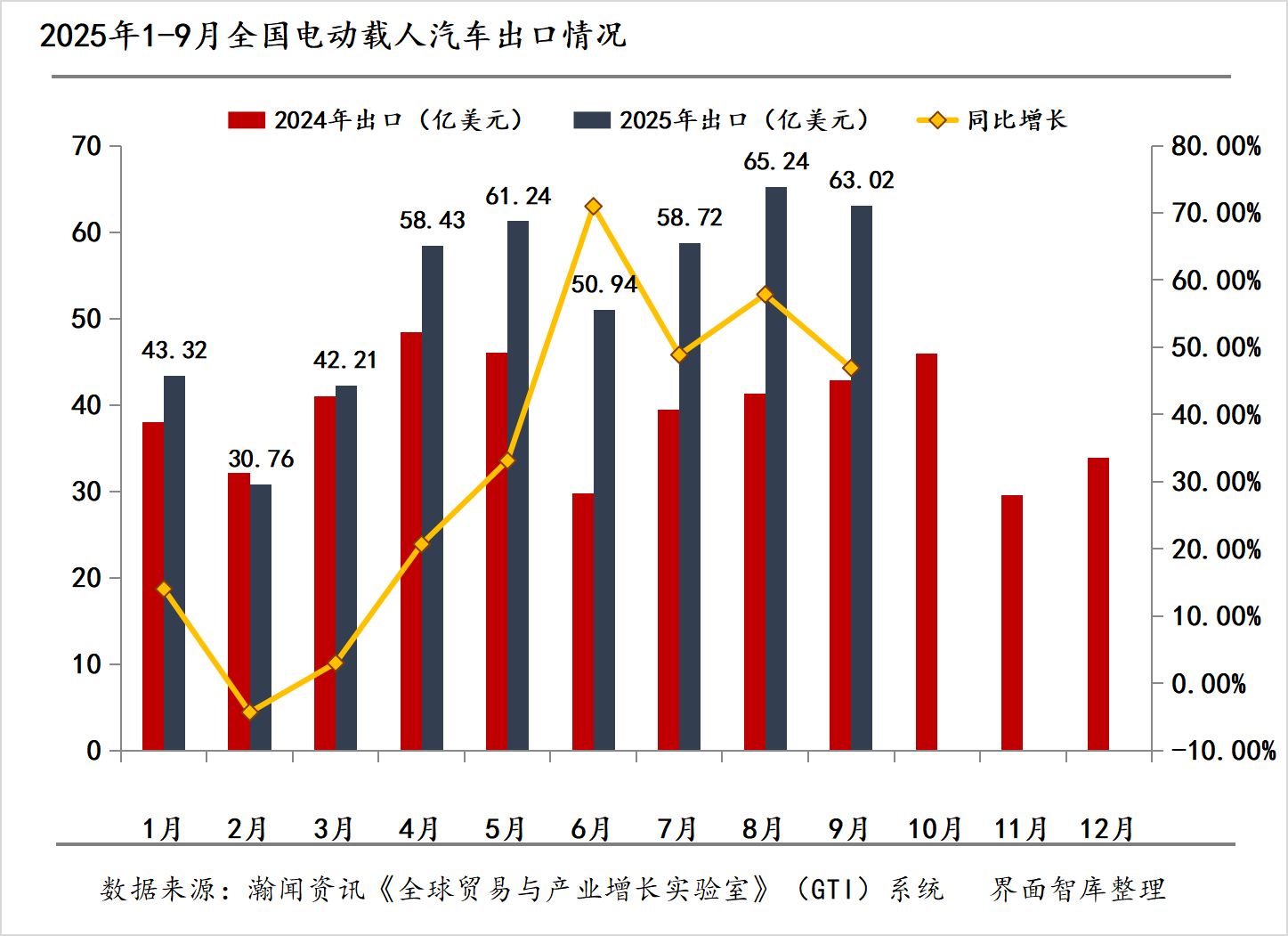
Core Insights - The article highlights the structural differentiation in China's electric passenger vehicle exports, with a significant increase in export value and volume in September 2025, indicating strong resilience in the global market despite a slight decline in import reliance [1][4]. Export Performance - In September 2025, China's electric passenger vehicle exports reached $6.302 billion, a year-on-year increase of 46.91%, with cumulative exports from January to September amounting to $47.388 billion, up 32.01% year-on-year [4][6]. - The total export volume for the first nine months was 2.6012 million units, reflecting a year-on-year growth of 55.15%, with the growth momentum continuing to strengthen [4][24]. Market Segmentation - The passenger car segment showed a significant "price for volume" strategy, with export volume reaching 343,900 units in September, a 69.40% increase year-on-year, while the average price decreased by 13.74% to $17,426.80 [2][6]. - In contrast, the bus segment experienced a "volume and price increase," with exports rising by 25.59% to 1,335 units, and the average price increased by 30.90% to $230,755.15 [8][24]. Regional Export Dynamics - Shanghai led the export with $10.247 billion, followed by Jiangsu at $6.046 billion, which saw a remarkable growth of 139.83%, and Anhui at $4.816 billion, with a growth of 255.96% [9][11]. - The top ten provinces accounted for 85.83% of the total electric passenger vehicle exports, indicating a solid dominance of leading regions [9]. Global Market Trends - The export destinations for China's electric passenger vehicles included Belgium ($5.037 billion, down 11.28%), the UK ($4.432 billion, up 32.70%), and the UAE ($2.955 billion, up 85.21%) [17]. - Emerging markets, particularly in South America and Africa, showed explosive growth, with South America experiencing a 242.34% increase in exports, highlighting the demand for electric vehicles in these regions [23][24]. Localization and Strategic Developments - The article notes the acceleration of localization strategies, with several companies establishing local production facilities in key markets, such as Geely's electric vehicle factory in Malaysia and BYD's plans for local production in Europe [24][25]. - Companies are adapting to regional trade policies, with some facing tariff increases while others are expanding their market presence through local partnerships and production [25][26].

电动载人汽车出海月报|7月出口量同比激增,出海迈入“生态输出”新阶段
Xin Lang Cai Jing· 2025-08-30 08:38
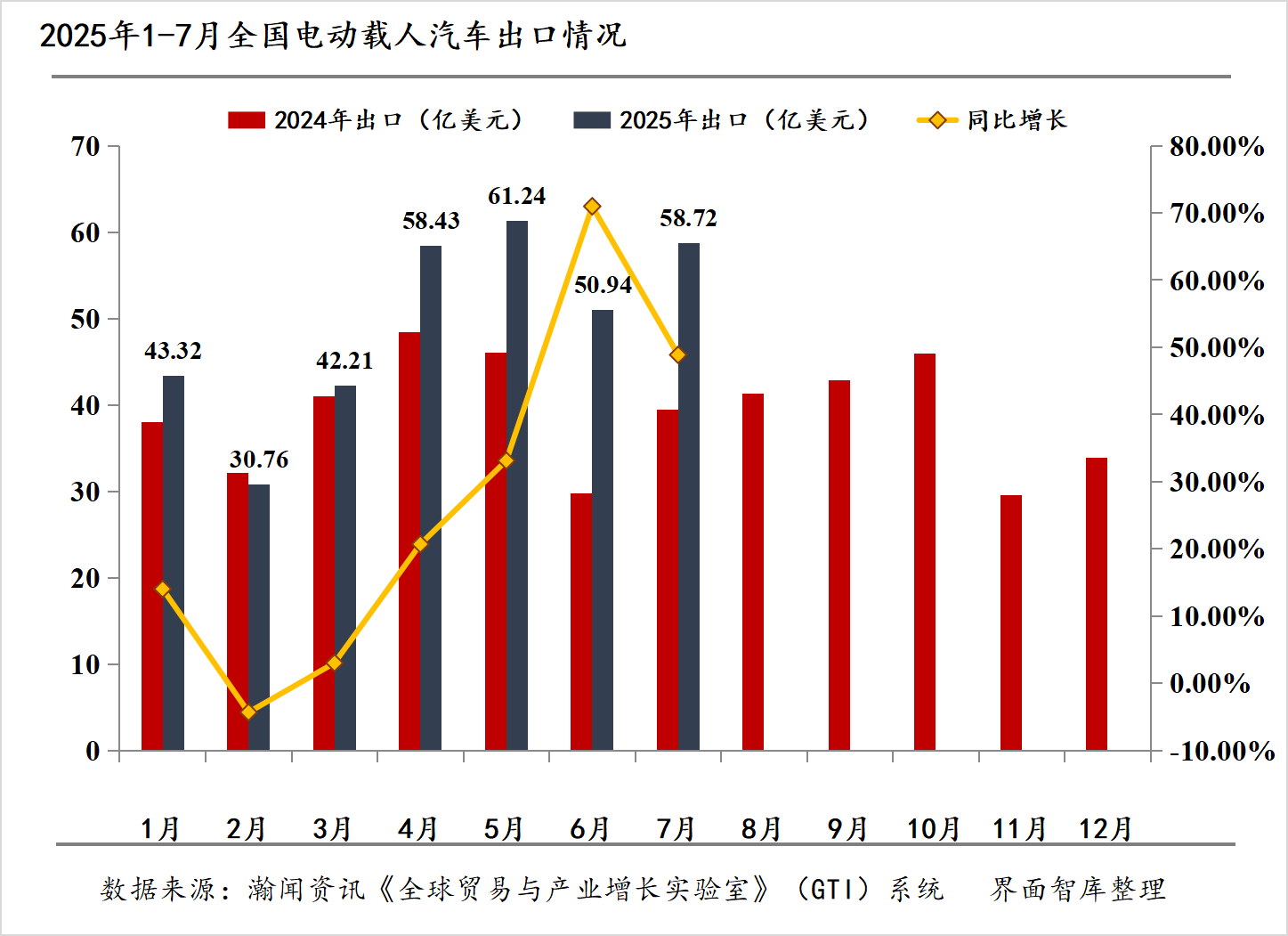
Core Insights - The article highlights the significant growth in China's electric passenger vehicle exports, with a notable increase in both export volume and value in July 2025, driven by advancements in battery technology and manufacturing processes [1][5][3] Export Performance - In the first seven months of 2025, China's total import and export value of electric passenger vehicles reached $36.583 billion, marking a 19% increase year-on-year [5] - Cumulative export value for the same period was $34.562 billion, reflecting a year-on-year growth of 25.79%, with export volume reaching 1.897 million units, up 48.58% [5] - July alone saw an export total of $5.872 billion, a 48.87% increase year-on-year and a 15.27% increase month-on-month, with a volume of 325,000 units, up 69.40% year-on-year [5][3] Price Trends - The average export price of electric passenger vehicles in July was $18,065.58, down 12.13% year-on-year, indicating a continuing downward trend in prices [5][7] - Specific price declines were noted in various vehicle types, with plug-in hybrid vehicles experiencing the largest drop [7] Market Segmentation - The passenger vehicle segment remains the core of electric vehicle exports, accounting for 99.58% of export volume and 95.52% of export value in July [7] - The bus segment showed a contrasting trend with a significant year-on-year increase in export volume (106.12%) but a month-on-month decline [9] Regional Export Dynamics - Shanghai regained its position as the top exporter of electric passenger vehicles, with a cumulative export value of $7.264 billion, despite a year-on-year decline [10][12] - Jiangsu and Shaanxi followed, with Jiangsu showing a remarkable year-on-year growth of 124.50% [10] Global Market Penetration - China's electric passenger vehicles are now exported to 166 countries and regions, with significant growth in emerging markets, particularly in Africa and South America [22][24] - The top export destinations included Belgium, the UK, and the UAE, with notable growth in exports to Argentina and Vietnam [17][19] Corporate Expansion - Chinese companies are actively expanding overseas, with BYD launching a passenger car factory in Brazil and Changan planning a factory in Europe [23][24] - The establishment of new logistics channels, such as the shipping route from Ningbo to Egypt, enhances export capabilities [23]