湘西腊肉

Search documents
(寻味中华|节令)除夕团年饭 湘西“过赶年”
Xin Lang Cai Jing· 2026-02-16 01:29
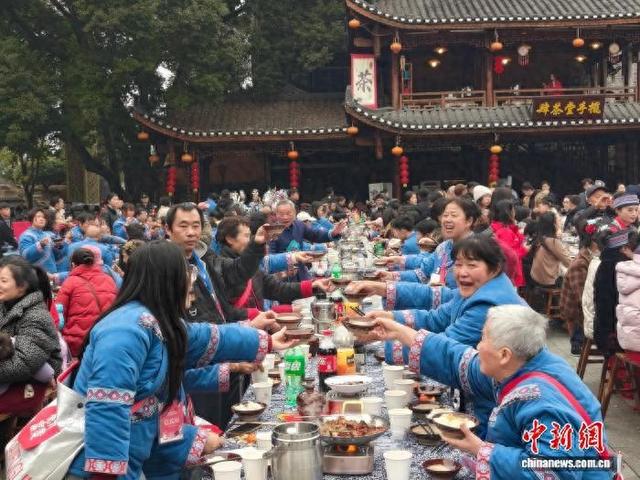
Core Viewpoint - The article highlights the unique cultural practice of "Guo Gan Nian" (过赶年) in the Tujia ethnic community of Hunan's Xiangxi region, where families celebrate the New Year with a grand feast known as the "Long Dragon Banquet" ahead of the traditional New Year’s Eve, emphasizing themes of reunion and cultural heritage [1][3][8]. Group 1: Cultural Significance - "Guo Gan Nian" is a tradition where families hold their reunion dinner a day or several days earlier than the New Year, symbolizing a connection to history and community [1][3]. - The origin of "Guo Gan Nian" dates back to the Ming Dynasty, where a farewell feast was held for warriors before they went to battle, marking the beginning of this custom [3][4]. Group 2: Culinary Aspects - The Long Dragon Banquet features a variety of local dishes, including Hunan cured pork, which is a highlight of the feast, showcasing the region's culinary heritage [6]. - Dishes such as "Jiang Guo" (浆果辣子) and "He Cai" (合菜) are essential components of the banquet, representing local flavors and the spirit of unity among guests [6][8]. Group 3: Community and Tourism - The Long Dragon Banquet has evolved into a significant cultural event that attracts tourists, serving as a platform for community bonding and cultural exchange [8]. - Local government and community initiatives have transformed the banquet into a key experience for visitors, showcasing Tujia culture through performances and traditional practices [8].

慢,是对传统最大的尊重
Ren Min Ri Bao· 2025-05-06 22:12
Core Insights - The article highlights the journey of Peng Nanke, who transitioned from various professions to become a guardian of traditional crafts, particularly focusing on the revival of intangible cultural heritage in rural China [1][2]. Group 1: Background and Personal Journey - Peng Nanke, at 49 years old, has had a diverse career, including roles as a teacher and photographer, before returning to his hometown to start a business centered around local delicacies [1]. - In 2022, he began documenting and reviving nearly lost traditional skills, motivated by a desire to preserve cultural heritage [1][2]. Group 2: Challenges and Achievements - Peng faced significant challenges in learning traditional crafts, such as making a raincoat, which required extensive research and hands-on practice [2]. - His efforts have led to the creation of over a hundred videos showcasing traditional crafts, with meticulous attention to detail in the filming process [4]. Group 3: Community Engagement and Impact - Peng initiated a "one village, one broadcaster" training program to empower local residents to document their crafts using smartphones [4]. - He established a workspace called "Nanke Courtyard," which serves as a hub for artisans to demonstrate their skills and develop cultural products [4].