
澳大利亚房地产

Search documents
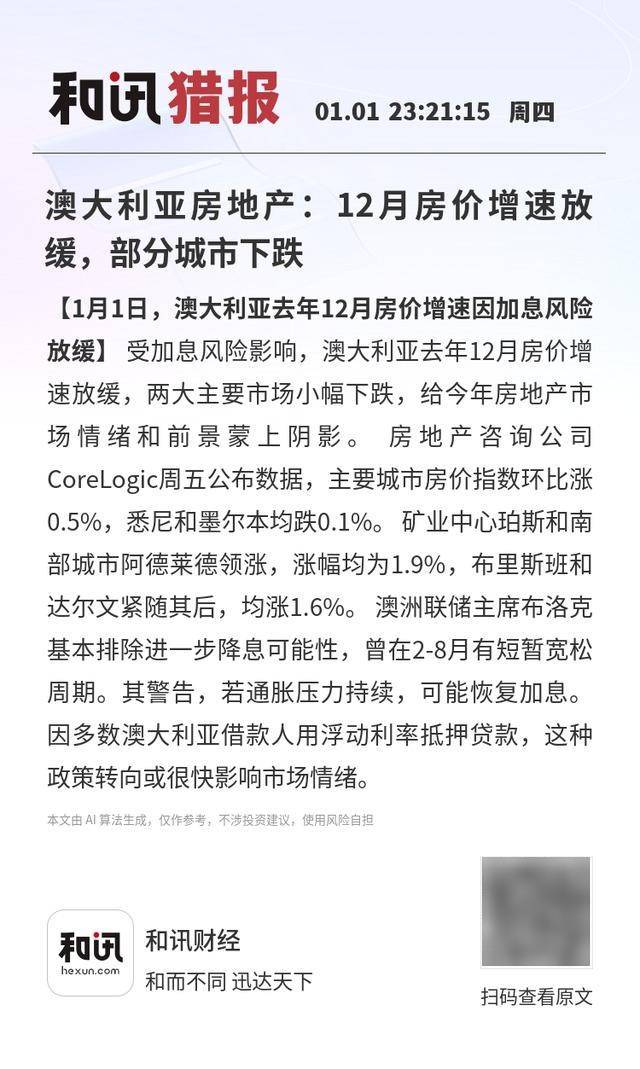
澳大利亚房地产:12月房价增速放缓,部分城市下跌
Sou Hu Cai Jing· 2026-01-02 00:21
Core Insights - The core viewpoint of the article highlights a slowdown in the growth rate of Australian housing prices in December due to interest rate hike risks, casting a shadow over the sentiment and outlook for the real estate market in 2023 [1] Group 1: Housing Market Performance - The CoreLogic data indicates that the major city housing price index increased by 0.5% month-on-month in December [1] - Sydney and Melbourne experienced a slight decline in housing prices, both down by 0.1% [1] - Perth and Adelaide led the gains with a rise of 1.9%, while Brisbane and Darwin followed closely with increases of 1.6% [1] Group 2: Monetary Policy Implications - The Reserve Bank of Australia (RBA) Chairman, Philip Lowe, has largely ruled out the possibility of further interest rate cuts, following a brief easing period from February to August [1] - Lowe warned that if inflationary pressures persist, the RBA may resume interest rate hikes, which could quickly impact market sentiment due to the prevalence of variable-rate mortgages among Australian borrowers [1]

你通往未来的指南:澳大利亚房地产市场
Knight Frank· 2025-09-16 02:38
Investment Rating - The report provides a positive outlook for the Australian real estate market, indicating a potential recovery and growth phase beginning in 2025 [19][92]. Core Insights - The Australian economy is expected to accelerate, with real disposable income projected to recover, leading to improved consumer confidence and spending [11][34]. - A shift in focus towards growth is anticipated, with expectations of interest rate cuts in the first half of 2025, which will support the recovery of the real estate market [36][45]. - Sydney is expected to lead the cyclical recovery, particularly in the industrial sector, as core assets are revalued and positioned for growth [19][92]. Economic Overview - The economy is projected to see an increase in real disposable income by 1.5% in 2025, following a decline of 2.8% in 2023, which will enhance consumer spending and support economic growth [34]. - Consumer confidence is on the rise, with indicators showing optimism returning to levels above 100 [29]. - The report highlights that the economic environment is becoming more favorable for real estate investments, with improved liquidity and sentiment in the market [85][89]. Capital Markets - The report indicates that the window for early-cycle acquisitions is now open, as the market begins to thaw, providing opportunities for investors to capitalize on undervalued assets [20][84]. - There is a notable divergence in performance across different sectors, with industrial assets showing resilience and expected rental growth despite increasing supply [21][93]. - The report emphasizes the importance of understanding the evolving neutral interest rate (R*) and its implications for long-term investment strategies [52][66]. Sector-Specific Insights - The industrial sector is expected to experience strong demand, driven by rising imports and a rebalancing of the market due to increased supply [44][93]. - Retail sales are projected to see a resurgence, with the strongest investor demand anticipated since 2015, as the sector benefits from improved consumer sentiment and reduced inventory levels [60][61]. - The office market is facing challenges, particularly in secondary locations, but prime assets in central business districts are expected to recover more quickly due to changing tenant demands [110][116]. ESG Considerations - The report notes that environmental, social, and governance (ESG) factors are increasingly influencing tenant demand, particularly in major cities like Adelaide [36].