激光焊接

Search documents
告别规模赛,全球锂电装备迎“新秩序”
高工锂电· 2025-12-10 11:02
Core Viewpoint - The ultimate goal of the new global lithium battery equipment order is to reshape industry value, with Chinese equipment companies aiming to become not only "order winners" but also "value leaders" in the global supply chain [1][21]. Group 1: Industry Trends - By 2025, the global lithium equipment industry is expected to experience a significant "order wave," with leading companies like Hai Moxing, Xian Dao Intelligent, Ying He Technology, and Li Yuan Heng signing and holding orders totaling over 30 billion yuan, marking a year-on-year increase of 70% to 80% [2]. - The current expansion cycle focuses on "high safety, high reliability, high performance, and high value," moving away from the previous emphasis on mere scale [3][7]. - The industry is transitioning from a phase of rapid scale competition to one centered on high-quality internal growth supported by global expansion [6]. Group 2: Equipment Demand and Value Creation - Customer demands for equipment have evolved from simply "being able to produce" to requiring "stable mass production, technological upgrades, and long-term service" [8]. - The shift in value perception means that customer trust now relies on quality and service over mere capacity guarantees, prompting companies to evolve from "equipment suppliers" to "lifecycle partners" [8][9]. - This expansion of value dimensions aligns with battery companies' demands for "high value" and distinguishes Chinese equipment firms from their overseas counterparts [9]. Group 3: Strategic Pathways for Leadership - Achieving a "leading position" in the new order requires a collaborative approach across technology, market, and globalization [12]. - Technological iteration is identified as the core variable and competitive advantage for equipment companies, with Hai Moxing adopting a dual-line R&D strategy to address challenges in solid-state battery production [13][14]. - The diversification of market dynamics provides essential support for Chinese equipment companies, allowing them to mitigate risks and expand their operational space [15]. Group 4: Globalization and Localization - The trend of "capacity going global" is a significant feature of the new order, necessitating enhanced globalization capabilities for Chinese companies [16]. - Chinese equipment firms should focus on "localization of organization, service, and innovation" to deeply integrate into the global industrial ecosystem [18]. - Hai Moxing's global strategy includes establishing 11 overseas subsidiaries and an innovation lab in Silicon Valley, emphasizing localized service and rapid response to customer needs [19][20]. Group 5: Value Restructuring Directions - The three main directions for value restructuring include transitioning from "equipment providers" to "standard co-creators," from "cost competition" to "technology premium," and from "individual efforts" to "ecosystem collaboration" [21][22][23]. - Hai Moxing collaborates with leading battery companies and research institutions to advance the standardization and industrial application of solid-state battery equipment [22]. - The focus on ecosystem collaboration aims to enhance the resilience and efficiency of the global supply chain, addressing common industry challenges [23].



“城市观察团”实地探寻创新策源力,武汉激光装备、无人机卖全球
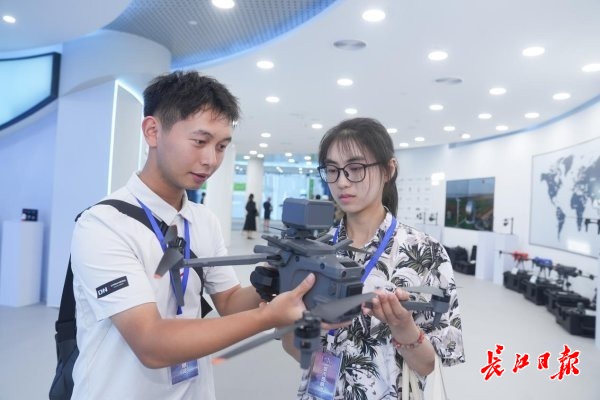
Chang Jiang Ri Bao· 2025-06-27 00:34
Core Insights - The event highlighted the advancements in laser technology and drone applications in Wuhan, showcasing the city's commitment to innovation and technology leadership [1][8]. Group 1: Laser Technology and Applications - Wuhan Huagong Technology Co., Ltd. has achieved over 70 "China First" milestones in the laser industry and has set the first international standard for the sector in China [5]. - The company has developed laser welding and cutting technologies that have surpassed foreign monopolies, reducing the welding time for electric vehicle bodies to just 43 seconds [3][5]. - The laser technology is applied across various industries, including digital electronics, semiconductors, and automotive manufacturing, demonstrating its broad relevance [3]. Group 2: Drone Technology and Low-altitude Economy - Puzhou Technology Co., Ltd. is leading the low-altitude economy in China, with a project that covers 518 square kilometers and plans for over 100,000 flights annually by 2025 [6][8]. - The company has integrated AI technology into its drone applications, providing services in smart city management, emergency response, and environmental protection [6]. - The establishment of a low-altitude shared drone platform marks a significant step in urban governance and positions Wuhan as a leader in the trillion-dollar low-altitude economy sector [8]. Group 3: Community Engagement and Perception - The "City Observation Group" comprised various stakeholders, including students and community workers, who expressed pride in Wuhan's technological advancements and entrepreneurial spirit [1][9]. - Participants noted the supportive environment for startups in Wuhan, highlighting government policies that foster innovation and technology development [9]. - The event served as a bridge for better understanding the local technological landscape and the importance of community involvement in supporting innovation [9].