火星轨道探测器MAVEN

Search documents
参考消息:NASA称与一火星轨道探测器失联
Xin Lang Cai Jing· 2025-12-20 11:52
Core Viewpoint - NASA has lost contact with the Mars orbiter MAVEN, which has been operational for nearly 10 years and has provided significant data on Mars' atmosphere [1] Group 1: Communication Issues - NASA has not received any routine data from MAVEN for approximately two weeks [1] - A NASA spokesperson indicated efforts are underway to re-establish communication with the orbiter [1] Group 2: MAVEN's Mission - MAVEN was launched at the end of 2013 and has been orbiting Mars for about a decade [1] - The orbiter has been crucial in providing important research data, particularly regarding the Martian atmosphere [1] Group 3: Technical Anomalies - Earlier this month, a brief tracking data indicated that MAVEN might be rotating in an unexpected manner [1]
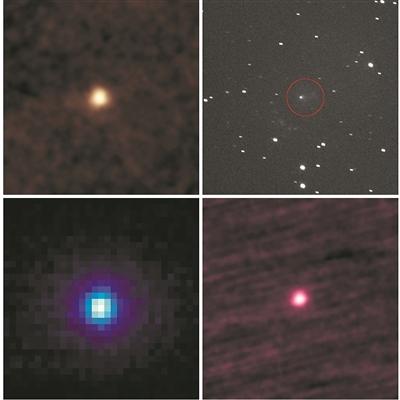
消除“外星母舰”疑云——NASA公布3I/ATLAS彗星最新图像
Ke Ji Ri Bao· 2025-11-24 01:40
Core Insights - The article discusses the recent observations of the interstellar comet 3I/ATLAS, which has sparked curiosity and speculation since its entry into the solar system this summer, traveling at a speed exceeding 240,000 kilometers per hour [2][3] Group 1: Observations and Findings - NASA has released images from multiple spacecraft, confirming that 3I/ATLAS is a typical comet driven by ordinary physical mechanisms, dismissing theories of it being an alien spacecraft [2] - The closest images were captured by the Mars Reconnaissance Orbiter (MRO), showing a blurry white ball composed of dust and ice, with the comet's activity increasing as it approaches the Sun [3] - Data from the James Webb Space Telescope and SPHEREx provided insights into the comet's composition, revealing a significant amount of carbon dioxide and water ice near its nucleus [3] Group 2: Anomalies and Characteristics - Observations indicated unusual phenomena, such as a rapid brightening of the comet as it neared the Sun and the detection of nickel vapor, which is atypical for low-temperature environments [4] - The comet's behavior was reconstructed in three-dimensional space using data from various spacecraft, enhancing the understanding of its characteristics [4] Group 3: Size and Origin - Despite accumulating observations, the exact size of 3I/ATLAS remains uncertain, estimated to be between several hundred meters to a few kilometers in diameter, with its shape obscured by dust [5] - The origin of 3I/ATLAS is challenging to determine, with possibilities suggesting it has been drifting in interstellar space for a long time or may originate from an older stellar system [5] - The comet is expected to come closest to Earth on December 19, at approximately 270 million kilometers away, before it begins to exit the solar system [5]