炉温预测模型

Search documents
无锡:AIoT智启新篇
Xin Hua Cai Jing· 2025-10-31 06:30
Core Insights - The World Internet of Things Expo in Wuxi has successfully evolved over 15 years, attracting over 2 million participants and facilitating more than 300 major industrial projects with a cooperation amount exceeding 150 billion yuan [1] - Wuxi is focusing on the integration of artificial intelligence and the Internet of Things (AIoT) to enhance its industrial capabilities and modernize urban development [1][3] Industry Development - Wuxi's IoT industry has developed a unique path characterized by demand-driven applications, technology-driven innovations, and ecosystem-driven industrial growth [2] - By the end of 2024, Wuxi's IoT cluster is expected to achieve over 250 billion yuan in revenue, with 60 national-level specialized "little giant" enterprises and 83 listed companies [2] Technological Integration - The IoT industry is transitioning into a new phase characterized by technological integration, data-driven approaches, and deeper applications, with AI playing a crucial role in this transformation [3] - Wuxi aims to create a smart industrial ecosystem where AI serves as the "brain" and IoT acts as the "body," facilitating a collaborative evolution [3] Focus on Smart Sensors - Smart sensors are identified as a key area in Wuxi's IoT strategy, serving as the foundation for both IoT and AI development [4] - Wuxi is enhancing sensor technology to provide high-quality training data for AI, focusing on areas such as MEMS manufacturing and multi-modal sensor technology [4][5] Innovation and R&D - Wuxi has established nearly 200 innovation platforms and centers to support the development of advanced sensing technologies and products [5] - The establishment of the Advanced Sensing R&D Center in 2022 aims to provide a public service platform for sensor design and production [5] Industrial Applications - The integration of AI and IoT is being applied in various sectors, including industrial manufacturing, where AI models optimize production processes [7][8] - Wuxi is focusing on energy sector innovations, developing AI models that integrate with market trading and virtual power plants [8] Urban and Social Applications - Wuxi is expanding the application of AIoT in urban governance and public services, enhancing city management through smart technologies [9] - The city is leveraging AI and IoT to address various urban challenges, including waste management and emergency response [9] Strategic Vision - Wuxi aims to build a world-class IoT advanced manufacturing cluster while contributing to national initiatives in manufacturing, networking, and digitalization [9]
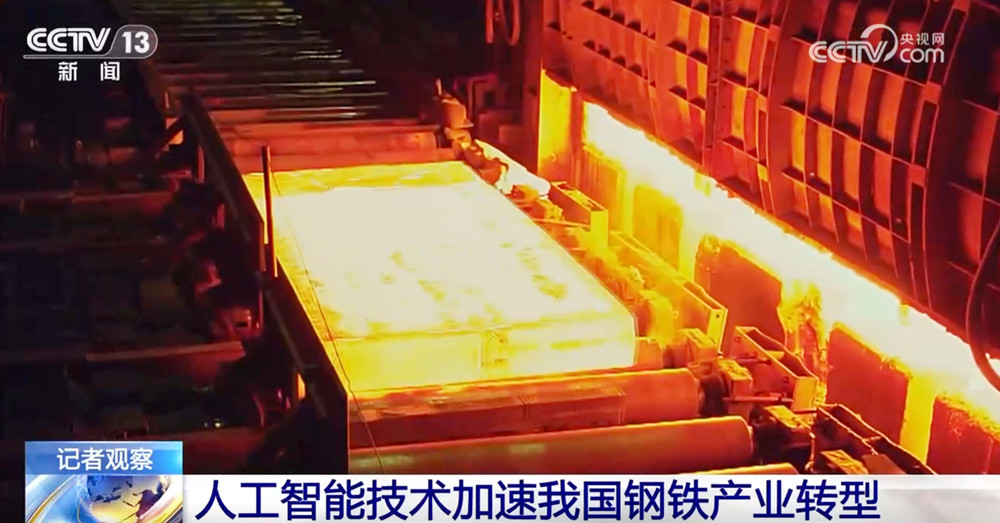
人工智能技术为转型按下“加速键” 钢铁产业正变得更“绿色”、更“聪明”
Yang Shi Wang· 2025-07-05 06:20
Group 1 - The steel industry in China is experiencing stable and positive performance supported by favorable policies, declining raw material prices, and increased exports [1] - From January to May 2025, key steel enterprises produced 355 million tons of crude steel, a year-on-year decrease of 0.1%, while pig iron production reached 314 million tons, up 0.3%, and steel products production was 352 million tons, an increase of 2.1% [1] - The net export of crude steel exceeded 50 million tons during the same period, an increase of 8.79 million tons compared to the previous year [1] Group 2 - The steel industry is becoming smarter and greener through the application of artificial intelligence (AI) technology [2] - At the world's first "lighthouse factory" in the special steel sector, AI visual inspection systems can identify surface cracks of 0.02 millimeters within 0.1 seconds [2] - The self-developed furnace temperature prediction model allows real-time monitoring of temperature, pressure, composition, and airflow, achieving transparency in the blast furnace process [4] Group 3 - There are currently six companies globally recognized as "lighthouse factories," with three of them being Chinese [6] - A major steel trading platform in Shanghai processes over 10 million transaction messages daily with an accuracy rate of over 95%, completing billions of intelligent transaction matches [6] - AI technology has reduced driver waiting time from 24 hours to 15 hours, resulting in a 12% decrease in waiting time and an 8% reduction in carbon emissions [6] Group 4 - Experts indicate that the steel industry's push for intelligent manufacturing is accelerating the synergy between energy efficiency optimization and green transformation [8] - A total of 29 steel companies have been recognized as national intelligent manufacturing demonstration factories, with 18 rated as excellent intelligent manufacturing factories [8]