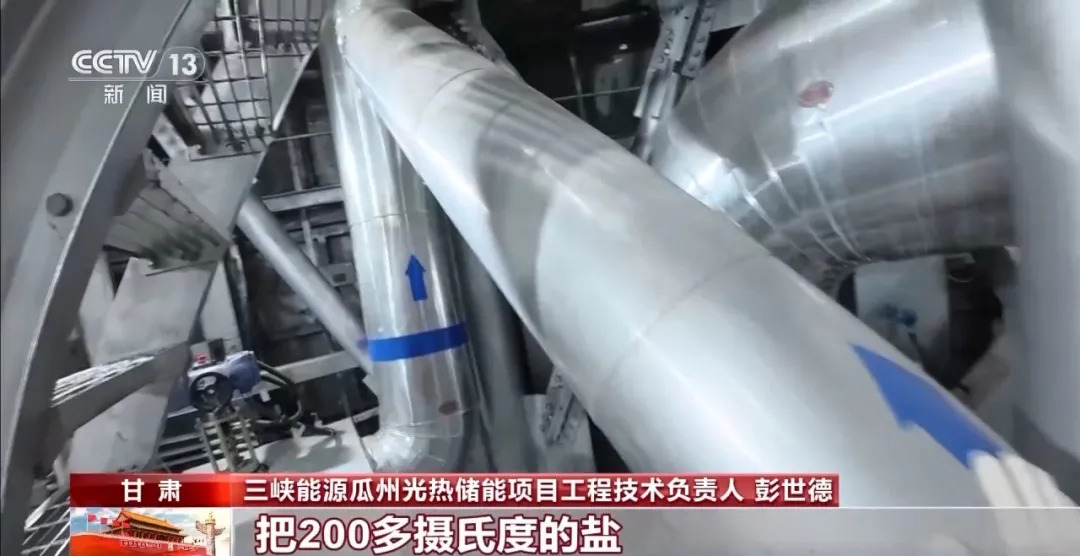
熔盐储热系统

Search documents
2026中部郑州太阳能利用大会及光热展览会助力“十五五”光热发电产业将迎10倍规模增长
Sou Hu Cai Jing· 2026-01-10 03:49
Core Insights - The solar thermal power industry is poised for unprecedented growth driven by the "dual carbon" goals and the accelerated construction of a new power system, with a target to increase installed capacity tenfold by 2030 compared to 2025 [1][4] Policy Support - The issuance of the "Opinions" provides systematic policy support for the industry, including improving electricity pricing mechanisms and encouraging participation in power market transactions [4] - The document emphasizes the need for technological innovation and domestic production of key equipment, aiming to enhance system efficiency to over 25% and reduce costs to below 15 yuan per watt [4] Technological Advantages - Solar thermal power combines generation and storage capabilities, offering long-duration energy storage and flexible peak-shaving abilities, which can achieve annual utilization hours exceeding 4000 hours with a 6-hour storage system [2] - The technology's ability to stabilize power supply makes it essential for large-scale wind and solar bases in regions like Qinghai and Gansu, where peak-shaving depth can reach 80% [2] Market Potential - By 2030, the cumulative installed capacity of solar thermal power in China is expected to exceed 60 GW, creating a trillion-yuan market scale across the upstream and downstream supply chains [4] - The upcoming 2026 China (Zhengzhou) International Solar Energy Utilization Conference will showcase core technologies and innovations in the solar thermal sector, attracting significant participation from industry stakeholders [6] Global Perspective - The International Energy Agency (IEA) projects a 156% increase in global solar thermal power capacity by 2025 compared to 2020, with China contributing over 40% [6] - Chinese companies are demonstrating their technological capabilities in international projects, positioning solar thermal power as a key element of China's green energy cooperation under the Belt and Road Initiative [6] Industry Growth Opportunities - The entire solar thermal power industry chain is experiencing explosive growth, with significant advancements in upstream and downstream capabilities, supported by financial institutions [7] - The integration of solar thermal power with hydrogen production is emerging as a new trend, enhancing overall system efficiency [7] Future Challenges - The solar thermal power industry must address three key challenges: establishing market mechanisms that reflect peak-shaving value, promoting collaborative innovation across the supply chain, and strengthening standardization in design and construction processes [8] - The upcoming Zhengzhou exhibition will serve as a critical platform for technology exchange and commercial collaboration, helping Chinese enterprises to capture a higher position in the global solar thermal technology landscape [8]


国家能源集团安徽公司宿州电厂:煤电机组装上超级“储热宝”
Ke Ji Ri Bao· 2025-11-25 00:35
Core Insights - The project at Suzhou Power Plant is China's largest "coal power + molten salt" energy storage project, which addresses the traditional coal power issue of "heat determining electricity" and provides a new model for flexible coal power generation [1][2]. Group 1: Project Overview - The molten salt energy storage project was completed and put into operation at the end of August, enabling coal power units to flexibly adjust their output, thus enhancing the overall efficiency of energy utilization [1][2]. - The project is part of the national initiative to transition to a low-carbon energy structure, addressing the increasing pressure on the power system for peak regulation as renewable energy sources grow [2]. Group 2: Technical Innovations - The molten salt storage technology allows excess heat from coal power units to be stored and used later for peak power generation, effectively decoupling heat supply from electricity generation [3][4]. - The project utilized a specific mixture of three types of nitrate salts, which operates efficiently within the temperature range of 190°C to 450°C, suitable for current heating unit operations [4]. Group 3: Performance and Benefits - The molten salt storage system significantly enhances the peak load and low load capabilities of the coal power unit, allowing for a minimum operational load reduction to 30% while maintaining continuous heating for up to 5 hours [7]. - The system is projected to improve renewable energy absorption by approximately 1.28 billion kilowatt-hours annually and reduce carbon emissions by about 85,000 tons, with an estimated annual revenue increase of 45 million yuan [7]. Group 4: Future Prospects - The technology developed for the Suzhou Power Plant is being promoted in other coal power plants, enhancing their responsiveness and flexibility, and contributing to the development of a new generation of coal power technologies [8].
2.7万块定日镜点亮东塔!全球首个“双塔一机”光热储能电站全系统成功试运行
Yang Shi Xin Wen· 2025-10-09 01:21
Core Insights - The world's first "dual-tower one machine" solar thermal energy storage power plant has successfully entered the final debugging phase, indicating that the entire system has successfully undergone trial operation [1] Group 1: Technology and Operation - The solar thermal power plant features two approximately 200-meter high heat-absorbing towers equipped with 27,000 heliostats that concentrate sunlight to generate stable clean energy [2] - The heat transfer system utilizes molten salt, which has a boiling point of 600°C, allowing it to store several times more heat than water [8] - The molten salt storage system can store a maximum heat equivalent to 600,000 kilowatt-hours, providing power for up to 6 hours [8] Group 2: Advantages and Future Prospects - The "dual-tower one machine" design overcomes the capacity limitations of traditional single-tower solar thermal power plants, enhancing power generation efficiency, total output, and energy storage capabilities [10] - This innovative approach paves the way for the large-scale development of solar thermal storage technology in China [10] Group 3: Broader Context - Various forms of solar thermal power plants, including tower, trough, linear Fresnel, and dish Stirling technologies, are contributing to China's energy system by providing stable power [11] - Solar thermal power plants are being established in regions like Gansu, Xinjiang, and Qinghai, acting as "artificial suns" that support China's transition to a clean and low-carbon energy system [11]